Complete guide: Education Systems
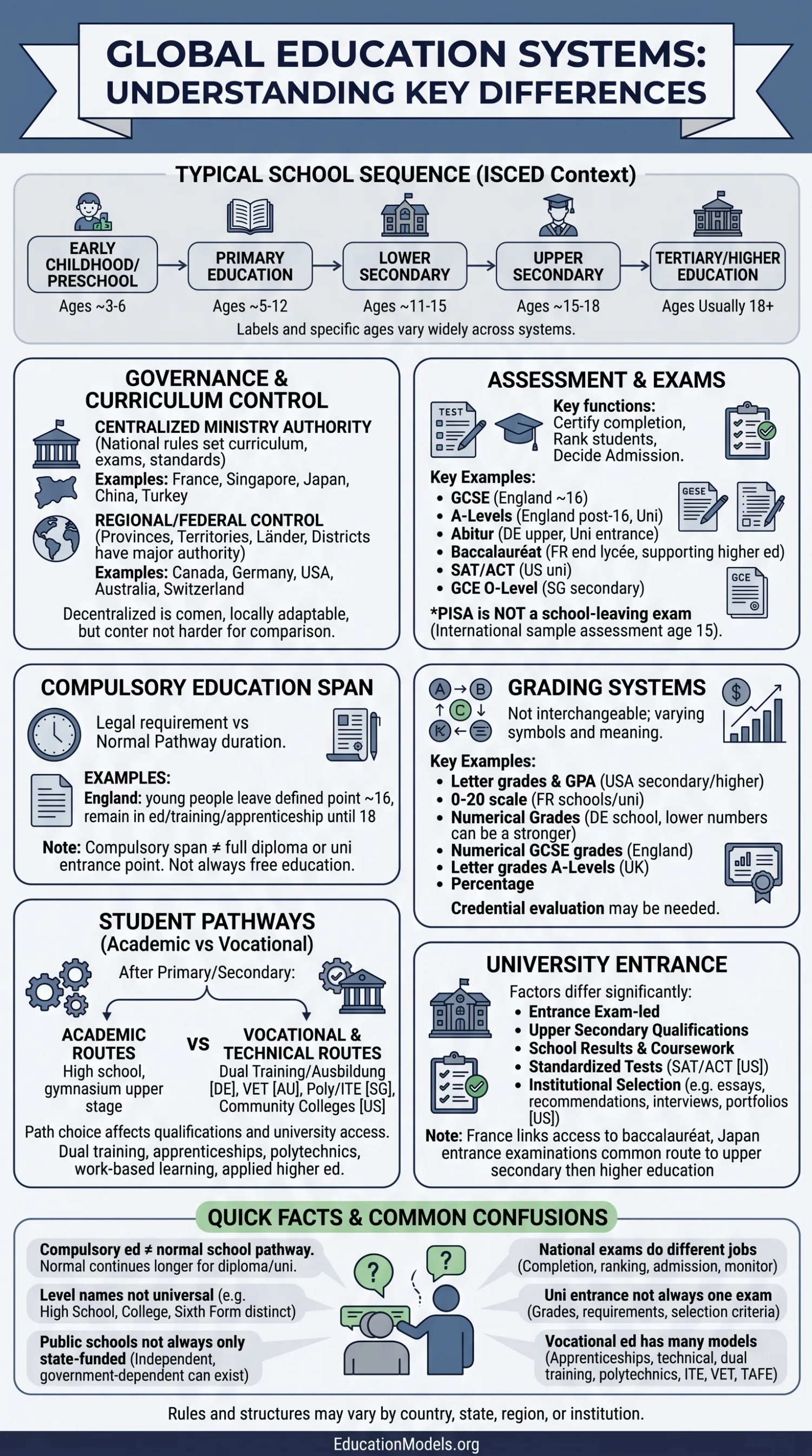
Education systems around the world differ in the way they divide school stages, assign authority, select students, award qualifications, and connect secondary education with university or work. A 15-year-old may still follow a common curriculum in Finland, prepare for GCSE subjects in England, enter a distinct secondary pathway in Germany or the Netherlands, or face a competitive upper-secondary transition in Japan. The labels primary school, secondary school, and college are therefore not reliable comparisons on their own. To understand how school systems differ by country, the useful questions are who controls the curriculum, when students begin to specialize, what examinations decide, and whether academic and vocational routes allow movement between them.
Why the Same Age Does Not Mean the Same School Stage
School terminology travels poorly across borders. In the United States, “middle school” commonly sits between elementary and high school. In France, collège is lower secondary education rather than a higher-education institution. In England, a college may provide education after age 16, while in Canada and the United States the word can also refer to postsecondary study. Germany’s Gymnasium is an academic secondary-school route, not a sports facility.
International comparisons often use the International Standard Classification of Education, known as ISCED, to place national programmes into comparable levels, as documented by the UNESCO Institute for Statistics. ISCED does not erase national differences. It gives researchers a common way to distinguish early childhood, primary, lower secondary, upper secondary, postsecondary non-tertiary, and tertiary education even when local names and grade ranges differ.
| Comparable Stage | Names Used in Different Systems | What Commonly Varies |
|---|---|---|
| Early childhood education | Preschool, nursery, kindergarten, école maternelle, early childhood education and care | Whether attendance is compulsory, the starting age, and whether the programme is part of the school system |
| Primary education | Primary school, elementary school, Grundschule, école élémentaire | Entry age, number of grades, class-teacher arrangements, and the point of transfer to secondary education |
| Lower secondary education | Middle school, junior high school, collège, lower secondary, Sekundarstufe I | Whether all students remain together or enter separate school types, courses, or ability levels |
| Upper secondary education | High school, senior high school, lycée, sixth form, gymnasiale Oberstufe | Academic and vocational routes, subject choice, final qualifications, and access to higher education |
| Postsecondary education below a bachelor’s degree | Community college, further education, MBO, ITE, technical college | Programme length, occupational focus, transfer rights, and the status of the qualification |
A Label Is Not a Level
Comparisons should match the educational purpose and qualification level of a programme, not rely on a translated school name. Two institutions called “college” may serve entirely different age groups and lead to different credentials.
Three Decisions Shape Most National Differences
Who Sets the Rules?
Some countries use a nationally directed model. A ministry or national agency defines much of the curriculum, sets common expectations, and may regulate examinations or approved qualifications. France, Japan, Singapore, and South Korea provide examples of strong national direction, though local authorities and schools still make operational decisions.
Other systems distribute authority across states, provinces, territories, Länder, municipalities, school boards, or districts. Education in the United States is primarily a state and local responsibility. Canada’s provinces and territories organize elementary, secondary, vocational, and postsecondary education. Germany’s Länder hold major education powers. These countries can have recognizable national patterns without one national curriculum or one set of graduation rules.
When Do Students Enter Different Routes?
A second difference is the timing of selection or tracking. Tracking means placing students into different school types, programmes, course levels, or qualification routes. Germany and the Netherlands make major pathway decisions relatively early. Finland keeps students in one basic-education structure for nine years before the general and vocational upper-secondary routes become distinct. The United States and Canada commonly retain a broad high-school structure while differentiating students through credits, course levels, electives, and local graduation requirements.
What Allows the Student to Move Forward?
In some systems, progression depends heavily on a named school-leaving qualification such as the baccalauréat, Abitur, A levels, Finnish matriculation examination, or South African National Senior Certificate. Elsewhere, a diploma is assembled through course credits and grades. University admission may then depend on a national examination, an institutional application, a rank derived from school results, or a combination of these measures.
| System Question | One Possible Model | Another Possible Model | Effect on Students |
|---|---|---|---|
| Who controls curriculum? | National ministry or curriculum agency | State, province, territory, or local authority | Students may encounter similar national content or marked regional variation |
| When are routes separated? | During lower secondary education | Near the end of common secondary education | Subject and school choices may become binding at different ages |
| How is completion certified? | External final qualification or examination | Credit-based diploma with school grades | The final years may focus on examination subjects or on completing required courses |
| How does university entry work? | National test or qualification threshold | Institution-led admission using several measures | Pressure may concentrate on one examination or be spread across several years |
School Entry and Compulsory Education Are Separate Questions
The age at which a child attends an early-years setting, begins formal primary education, and becomes legally subject to compulsory education may be different. A country can include preschool within compulsory education, provide a compulsory pre-primary year, or begin the legal duty when primary school starts. The end of compulsory schooling can also differ from the age at which most students finish upper secondary education.
France includes école maternelle within schooling from age three, as shown in the French school-system structure. Finland applies compulsory education from ages six to eighteen: it begins with pre-primary education, continues through nine years of basic education, and extends into upper-secondary study or another approved route described by the Finnish National Agency for Education. In the United Kingdom, education is devolved, so England, Scotland, Wales, and Northern Ireland do not share one complete set of rules. In the United States and Canada, legal ages can vary by state, province, or territory.
Legal Ages Can Change
Compulsory-schooling ages, admission cut-off dates, and participation duties are set by law and may change. Families making enrolment decisions should check the relevant ministry, state, province, territory, municipality, school board, or local education authority.
Curriculum Control Changes What Variation Looks Like
A national curriculum can specify subjects, learning goals, lesson allocations, assessment expectations, or approved content. It does not necessarily dictate every lesson. Japan’s national education overview describes centrally set courses of study, while schools and teachers organize classroom delivery. France uses national programmes across école, collège, and lycée. England’s national curriculum sets subjects and standards for many state-funded schools, but academies have more curricular freedom while still meeting legal and qualification requirements.
Finland’s education system combines a national core curriculum with local curricula prepared by education providers. That creates national direction without making every municipality or school identical. The United States has no single federal K–12 curriculum; states and communities develop curricula and set enrolment and graduation requirements. Canada follows a similar decentralised pattern through provincial and territorial ministries, although the details of governance differ by jurisdiction.
Curriculum flexibility and student choice are not the same. A teacher may have freedom over teaching methods while students follow many compulsory subjects. A tightly specified curriculum may still offer several upper-secondary electives or qualification routes.
The Timing of Pathway Choice Changes a Student’s Options
Countries differ sharply in the age at which academic and vocational directions become visible. The timing matters because a pathway can affect subject access, final qualifications, entry to higher education, apprenticeships, and later transfer opportunities.
Germany and the Netherlands: Earlier Differentiation
Germany’s structure varies by Land, but the transition after Grundschule can lead to school types or combined schools associated with different educational routes. Gymnasium leads toward the Abitur, while vocational education includes school-based programmes and the dual system, where learning is divided between a vocational school and a training employer. The system also provides routes for gaining further qualifications, so the first placement does not always determine a student’s final destination.
In the Netherlands, students move from primary school into VMBO, HAVO, or VWO. VMBO prepares mainly for secondary vocational education, known as MBO; HAVO leads mainly toward higher professional education, or HBO; and VWO prepares for university education. Bridge classes, mixed-level classes, and later transfers can soften the initial division, but the route choice still shapes the subjects, duration, and next qualification.
Finland: One Basic-Education Structure Before the Split
Finland places grades 1–9 within a single basic-education structure. After that stage, students may enter general upper secondary education or vocational education and training. General upper secondary study normally ends with the matriculation examination. A vocational upper-secondary qualification also gives general eligibility to apply for higher education, although institutions and programmes set their own admission processes.
Singapore: Subject Levels Rather Than Fixed Secondary Streams
Singapore has replaced the former Express, Normal (Academic), and Normal (Technical) secondary streams with Full Subject-Based Banding. Students can take subjects at different levels and later apply to postsecondary routes that include Junior Colleges, Millennia Institute, polytechnics, and the Institute of Technical Education. The change does not remove selection or qualification requirements, but it reduces the idea that one fixed stream must define every subject a student takes.
| Pathway Pattern | Country Examples | How Differentiation Appears | Main Point to Check |
|---|---|---|---|
| Earlier school-type or route selection | Germany, Netherlands | Students enter named secondary routes with different orientations and typical destinations | Whether transfer to another route is possible and which qualifications each route awards |
| Common schooling followed by upper-secondary choice | Finland and many Nordic systems | Students remain together longer before choosing general or vocational study | How admissions work for each upper-secondary option |
| Broad high school with internal differentiation | United States, much of Canada | Credits, course levels, electives, and local diploma rules shape individual programmes | State, provincial, district, board, and school requirements |
| Subject-level differentiation | Singapore | Students may study different subjects at different demand levels | How subject combinations connect to postsecondary admission |
Examinations Can Certify Learning, Select Students, or Do Both
The presence of national examinations does not by itself show how exam-focused a system is. The purpose of the examination matters. A test may certify completion, decide access to a school type, contribute to a final diploma, rank applicants for university, monitor school performance, or serve several of these purposes at once.
Qualifications at the End of Secondary Education
England uses subject qualifications such as GCSEs near the end of compulsory secondary schooling and A levels in many academic post-16 programmes. France’s upper-secondary routes lead to general, technological, or vocational forms of the baccalauréat. Germany’s Abitur is a higher-education entrance qualification reached through the gymnasiale Oberstufe and related routes. Finland’s general upper-secondary route ends with the matriculation examination, while vocational students complete occupational qualifications. South Africa combines school-based assessment and external Grade 12 examinations within the National Senior Certificate.
Entrance Examinations and Admission Systems
Japan requires students to complete nine years of compulsory elementary and lower-secondary education, and entry to upper secondary school commonly involves entrance examinations. Universities choose their admission methods, which can combine the national Common Test with institution-specific examinations and school records.
South Korea’s College Scholastic Ability Test, widely called Suneung, remains a central part of university admission, alongside school records and other admission routes. The country has announced a revised college entrance system for 2028, including changes to the CSAT subject structure and school-record grading. Students affected by the reform need the rules for their own examination year rather than a general description of the current test.
The United States uses institution-led admission. A high school diploma, transcript, course choices, GPA, essays, recommendations, activities, and sometimes SAT or ACT scores may be considered, but policies differ among institutions. This spreads selection across several records rather than placing every applicant into one national examination process.
Fewer National Tests Does Not Mean Less Assessment
Assessment may be concentrated in teacher grades, course credits, moderated school tasks, portfolios, local examinations, or institution-led admission. The decisive question is how much each result affects progression.
Vocational Education Can Be a Main Route Rather Than a Second Choice
The status and design of vocational education differ as much as school stages do. In Germany’s dual vocational model, an apprentice learns through an employer and attends Berufsschule. The qualification is tied closely to an occupation and labour-market standards. In the Netherlands, VMBO often leads to MBO, after which some learners continue to HBO. Finland’s vocational qualifications can lead to work or further study. Singapore’s ITE and polytechnics provide technical and applied routes with their own progression options.
In the United States, career and technical education may be offered inside high schools, technical centres, community colleges, or apprenticeship programmes. Because control is distributed, the quality, scale, employer involvement, and transfer value of a programme can vary. The term “vocational” therefore does not describe one global model. The useful comparison is whether training is school-based or work-based, whether it awards a recognized occupational qualification, and whether it leaves a route into higher education.
Public and Private Schools Are Defined Differently Across Countries
A private school is not always funded mainly through tuition. The Netherlands has a large publicly funded school sector that includes schools organized around religious, educational, or philosophical identities. England has local-authority-maintained schools as well as academies funded directly by government. The United States distinguishes traditional public schools, public charter schools, and private schools, but charter rules differ by state. France has private schools that operate under contracts with the state as well as fully independent institutions.
School ownership, public funding, admissions control, curriculum duties, inspection, and tuition should be examined separately. A school can be privately managed yet publicly financed, publicly funded yet selective under certain rules, or independent in governance while still teaching national qualifications.
Time in School Does Not Create a Simple Quality Ranking
OECD data for 2025 place average compulsory instruction time at about 804 hours per year in primary education and 922 hours in lower secondary education across participating countries and economies. National totals differ because school years, compulsory subjects, lesson lengths, and the duration of each stage differ.
More hours do not automatically produce stronger learning. Time can be used for core subjects, arts, physical education, languages, electives, tutoring, supervised study, or school activities. The effect also depends on teacher preparation, attendance, curriculum coherence, classroom conditions, student support, and what happens outside school. A country with a shorter statutory day may have more homework or private tutoring; another may include clubs, meals, and guided study within the school day.
Instruction-Time Data Needs Context
Statutory instruction hours describe scheduled compulsory teaching. They do not measure attendance, teaching quality, homework, tutoring, extracurricular learning, or the amount of time a student remains on the school site.
Twelve Systems Show the Main Patterns
| Country or Jurisdiction | Main Governance Pattern | Distinctive Secondary Structure | Typical Route Beyond School |
|---|---|---|---|
| United States | State and local control, with a limited federal role | K–12 schools use state, district, and school rules for credits, courses, testing, and graduation | Institution-led college admission, community college transfer, technical education, work, or apprenticeship |
| Canada | Provincial and territorial responsibility | Curriculum, assessment, diploma rules, language provision, and school-board structures vary by jurisdiction | College, university, technical education, apprenticeship, or direct employment |
| United Kingdom | Four devolved education systems | England, Scotland, Wales, and Northern Ireland use different curricula, qualifications, and assessment arrangements | Higher education, further education, apprenticeships, training, or employment through jurisdiction-specific qualifications |
| France | Strong national direction with regional académies | Collège is followed by general, technological, or vocational lycée routes | Baccalauréat routes connect to higher education; vocational qualifications also support employment and further study |
| Germany | Länder hold major authority | Several secondary school types and combined schools lead to academic or vocational qualifications | University, university of applied sciences, dual vocational training, school-based vocational study, or work |
| Netherlands | National rules with publicly funded school diversity | VMBO, HAVO, and VWO create distinct but connected routes | MBO, HBO, or university, with transfer options between parts of the system |
| Finland | National core curriculum with local implementation | Nine-year basic education is followed by general or vocational upper secondary education | University, university of applied sciences, vocational progression, or employment |
| Japan | National course-of-study system with local school administration | Nine years are compulsory; upper-secondary entry commonly involves examinations | University, junior college, professional training college, employment, or other postsecondary study |
| South Korea | Nationally directed curriculum and assessment policy | General, specialized, vocational, and other high-school options operate within an exam-aware system | University admission uses CSAT results, school records, and route-specific criteria; vocational and employment routes also exist |
| Singapore | Nationally coordinated system | Full Subject-Based Banding allows subject-level differentiation in secondary school | Junior College, Millennia Institute, polytechnic, ITE, arts institutions, or other routes |
| India | Union, state, territory, and board responsibilities overlap | CBSE, CISCE, state boards, and other recognized boards operate within a large and varied school sector | Higher education, technical and vocational study, competitive entrance routes, or employment; requirements depend on the programme and institution |
| South Africa | National curriculum policy with provincial administration | Grades R–12 follow the National Curriculum Statement and CAPS subject policies | National Senior Certificate results support entry to higher education, vocational study, training, or employment |
The table compares dominant structures, not every school. International schools, private institutions, special schools, alternative programmes, regional exceptions, and local admissions rules can sit beside the main national pattern. Federal and devolved systems require particular care because one country name may contain several legally distinct school systems.
Country Names Can Hide Major Internal Differences
The United Kingdom Is Not One School System
Education policy is devolved in the United Kingdom. England uses the national curriculum for many schools and qualifications that include GCSEs and A levels. Scotland uses its own curriculum and National Qualifications, including National 5, Higher, and Advanced Higher. Wales is introducing qualifications designed for the Curriculum for Wales. Northern Ireland has its own curriculum, school sectors, and qualification policies. A statement about “the UK school system” is accurate only when it describes a feature shared by all four jurisdictions.
The United States and Canada Require State or Provincial Detail
In the United States, school-entry cut-offs, course standards, diploma credits, assessment policies, charter-school law, and teacher licensing can differ by state. Districts and schools may add further rules. In Canada, each province and territory sets legislation, curricula, assessment, and graduation requirements. Quebec’s route through secondary school and CEGEP, for example, differs from the direct high-school-to-university pattern found in many other provinces.
Germany’s Länder Share Structures Without Being Identical
Germany has common qualification principles and cooperation through the Standing Conference of the Ministers of Education and Cultural Affairs, yet school names, transition rules, programme duration, and the organization of secondary education vary among the Länder. A national description can explain Gymnasium, Abitur, Ausbildung, and dual vocational training, but a family or student still needs the rules of the relevant Land.
Access to School and Learning in School Are Different Measures
Enrolment, attendance, completion, and learning outcomes measure different parts of an education system. The UNESCO 2026 Global Education Monitoring Report reported that primary and secondary enrolment reached about 1.4 billion students in 2024, while a related UNESCO estimate placed the number of children and young people out of school at 273 million. A system may expand access while still facing gaps by wealth, location, disability, language, or stage of education.
The World Bank and UNESCO Institute for Statistics use learning poverty to describe a child who cannot read and understand a simple age-appropriate text by age ten. The measure joins a schooling indicator with a learning indicator. It does not describe every subject or every age group, but it shows why enrolment alone cannot establish whether children are gaining foundational reading skills.
International Test Results Do Not Describe the Whole System
PISA, TIMSS, PIRLS, and national assessments can show how sampled students perform in selected domains under defined testing conditions. They do not directly measure every part of the curriculum, the quality of vocational routes, school climate, artistic learning, student health, special-education support, or the ease of moving between pathways.
A national average can also conceal regional and social differences. Scores may reflect school learning, family resources, private tutoring, language background, selection patterns, attendance, and who remains enrolled at the tested age. A ranking should therefore be read as one result from one assessment, not as a final judgment on a country’s schools.
Current Reforms Are Changing Several Familiar Models
School systems are not fixed. Singapore now uses Full Subject-Based Banding across secondary schools, with subject demand levels replacing the former stream labels. South Korea is preparing a revised college entrance system for 2028. India’s National Education Policy 2020 proposes a 5+3+3+4 curricular structure linked to developmental stages, but implementation depends on national, state, board, and school-level action. South Africa has made Grade R compulsory under recent legal changes while continuing work on implementation across the public system.
Reforms often take effect by cohort, grade, examination year, school type, or region. A description that was accurate for an older student may not apply to a younger sibling. Current official documents should be checked when the question concerns a live examination, admission cycle, curriculum change, or compulsory-schooling rule.
A Reliable Comparison Follows the Student’s Route
The clearest way to compare two countries is to follow a student from school entry to the next destination. Begin with the legal start of education, then identify the length of common schooling, the first consequential selection point, the upper-secondary options, the final qualifications, and the routes into university, technical study, apprenticeship, or work.
| Comparison Step | Question to Ask | Why It Matters |
|---|---|---|
| Entry | When do compulsory education and formal primary education begin? | Preschool participation and legal school entry may not start at the same age |
| Governance | Which level of government controls curriculum, funding, assessment, and graduation? | A national answer may be impossible in federal or devolved systems |
| Selection | When do students enter different schools, routes, subject levels, or programmes? | Earlier choices can shape later subject access and qualifications |
| Certification | Which diploma, examination, credit total, or qualification marks completion? | Completion and eligibility for the next stage are not always the same |
| Progression | Can vocational and academic learners move into higher education or transfer routes? | A system with several tracks may still allow movement between them |
| Outcomes | What do access, completion, learning, and equity indicators each show? | No single statistic describes the full student experience |
There is no neutral way to rank whole education systems with one measure. A system can offer broad access yet produce uneven learning. Another can post high test scores while placing heavy weight on private tutoring or high-stakes selection. A third can provide strong occupational routes but make later academic transfer difficult. The sound comparison identifies the outcome being examined and the trade-offs created by the system’s design.
This site is an independent informational resource and is not affiliated with any ministry of education, school authority, exam board, university, government agency, or official ranking organization. Education laws, qualifications, admissions rules, and reform timetables can change, so decisions should be checked with the responsible public authority, school, examination body, qualification agency, or institution.
Sources and Verification
- UNESCO Institute for Statistics — ISCED Mappings and Diagrams — Explains how national programmes and qualifications are mapped for cross-country comparison.
- OECD — How Much Time Do Students Spend in the Classroom? — Provides 2025 compulsory instruction-time averages and notes on curriculum allocation.
- UNESCO — 2026 Global Education Monitoring Report — Supports global enrolment, access, and equity context.
- UNESCO — More Children Out of School for the Seventh Year in a Row — Provides the 2026 estimate for children and young people outside education.
- World Bank — What Is Learning Poverty? — Defines the reading and schooling measure used in the article.
- U.S. Department of Education — Federal Role in Education — Verifies the primary state and local responsibility for education in the United States.
- Council of Ministers of Education, Canada — Education in Canada: An Overview — Describes provincial and territorial authority over Canadian education.
- UK Department for Education — Education Systems in the UK — Confirms devolved responsibility and differences among the four UK systems.
- GOV.UK — The National Curriculum — Describes subjects and standards used in England.
- GOV.UK — Types of School — Verifies the funding and governance distinction between maintained schools and academies in England.
- French Ministry of National Education — Table of School System Structure — Verifies French school stages, ages, and upper-secondary routes.
- French Ministry of National Education — General Principles — Verifies compulsory schooling principles and the status of private schools under state contract.
- Standing Conference of the Ministers of Education and Cultural Affairs — Educational Paths and Qualifications — Supports German pathway, qualification, and transfer descriptions.
- Standing Conference of the Ministers of Education and Cultural Affairs — Vocational Education — Verifies vocational routes and access to further qualifications in Germany.
- Finnish National Agency for Education — Finnish Education System — Verifies compulsory education, basic education, and upper-secondary routes.
- Japan Ministry of Education, Culture, Sports, Science and Technology — Education Overview — Supports the nine-year compulsory stage and upper-secondary entrance description.
- Republic of Korea Ministry of Education — 2028 College Entrance System Reform Initiative — Verifies planned changes to the CSAT and school-record grading.
- Singapore Ministry of Education — Secondary School Experience Under Full Subject-Based Banding — Explains subject-level study and progression from secondary school.
- Singapore Ministry of Education — Post-Secondary Education Institutions — Verifies Junior College, polytechnic, and ITE routes.
- Government of the Netherlands — Secondary Education — Verifies VMBO, HAVO, VWO, and their typical progression routes.
- Government of India Ministry of Education — National Education Policy — Supports the policy direction and the staged 5+3+3+4 school structure.
- South African Department of Basic Education — National Curriculum Statements Grades R–12 — Verifies the national curriculum and its relationship to learning, higher education, and work.
- South African Department of Basic Education — Practical Assessment Tasks — Confirms that National Senior Certificate assessment combines school-based work, practical or oral components where applicable, and external examinations.
- South African Department of Basic Education — Grade R as a Compulsory Grade — Supports the recent change to compulsory Grade R and its implementation context.
Related Topics
- → United States Education System: Grades, Schools, and College Pathways
- → United Kingdom Education System: GCSEs, A-Levels, and School Stages
- → Netherlands Education System: Schools, Tracks, and Learning Pathways
- → Japan Education System: Schools, Exams, and Student Life
- → South Korea Education System: Schools, Exams, and Academic Pressure
- → Canada Education System: Provinces, Schools, and Higher Education