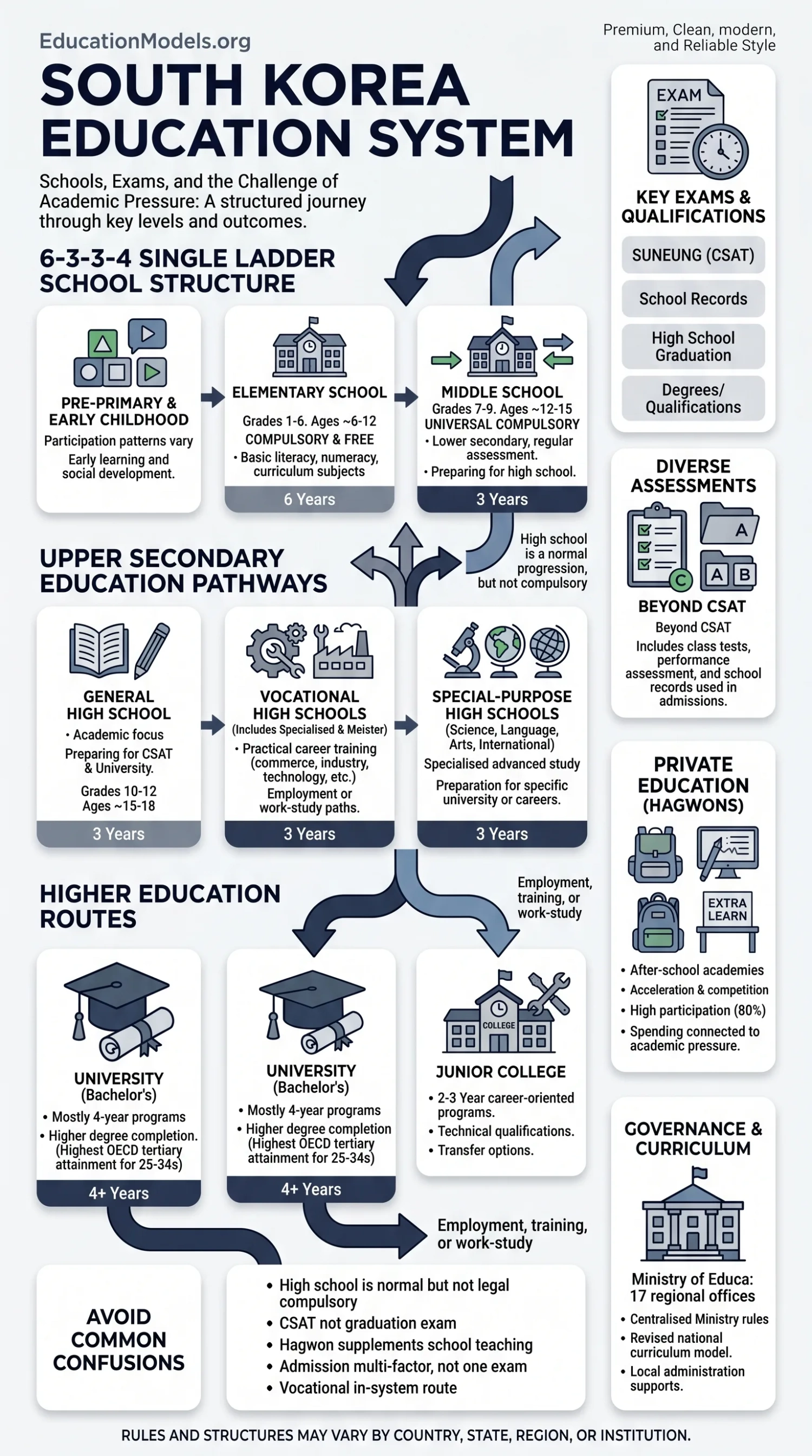
The South Korea education system follows a clear 6-3-3-4 structure: six years of elementary school, three years of middle school, three years of high school, and usually four years of university, with junior college routes also available. Elementary and middle school are compulsory, while high school is not legally compulsory but is a normal part of the student pathway for most learners. The system is known for strong national curriculum control, high participation in upper secondary and higher education, the College Scholastic Ability Test known as CSAT or Suneung, and a large private tutoring sector called hagwon. To understand Korean education, it is not enough to list school levels; the exam culture, school records, university entrance routes, vocational options, and pressure around academic achievement all matter.
How the South Korea Education System Works
South Korea uses a single ladder school structure. Students normally move from elementary school to middle school, then to high school, and then to higher education, employment, vocational training, or another post-secondary route. The Ministry of Education describes the Korean school system as a 6-3-3-4 structure, with six years in elementary school, three years in middle school, three years in high school, and four years in university or two to three years at junior college. It also states that the first semester begins in March and the second semester begins at the end of August, with elementary and middle schools forming compulsory education.[a]
This structure looks simple from the outside, but the lived experience of students depends on several layers: the national curriculum, local offices of education, school type, school records, private tutoring, and university admission rules. A student in a general high school preparing for Suneung may experience the system very differently from a student in a Meister high school preparing for skilled employment, even though both are within the same national education structure.
South Korea is more centralized than systems such as the United States or Canada, where states, provinces, local districts, or school boards often have wide curriculum authority. At the same time, Korean education is not run only from one office in Seoul. The national level sets broad rules and curriculum direction, while Metropolitan and Provincial Offices of Education and local education offices support implementation, school administration, and local education services.
A practical way to read the system: South Korea has a clear national school ladder, but student outcomes are shaped by exam preparation, school records, family decisions, private tutoring, high school type, and university admission strategy.
School Levels and Typical Ages
The main school sequence is elementary school, middle school, high school, and higher education. Elementary school starts at about age 6, followed by three years of middle school and three years of high school. The Ministry of Education’s primary education page states that elementary education consists of six years and that students begin at age 6.[b]
| School Level | Typical Age | Typical Grade or Year | What It Usually Covers |
|---|---|---|---|
| Kindergarten and Early Childhood Education | Before elementary school | Pre-primary | Early learning, social development, play-based activities, and preparation for formal schooling. Participation patterns can vary by family and institution. |
| Elementary School | About 6–12 | Grades 1–6 | Basic literacy, numeracy, Korean language, mathematics, social studies, science, arts, physical education, moral education, and school routines. |
| Middle School | About 12–15 | Grades 7–9 | Lower secondary education, broader subject teaching, regular school assessment, and preparation for high school pathways. |
| High School | About 15–18 | Grades 10–12 | Upper secondary education through general, vocational, special-purpose, autonomous, and gifted school routes. |
| Junior College | Usually after high school | Post-secondary | Two- or three-year programs with practical, technical, or career-oriented study. |
| University | Usually after high school | Undergraduate | Mostly four-year bachelor’s degree programs, with some fields requiring longer study. |
Age ranges should be read as typical rather than as a rule for every child. Month of birth, school entry timing, special education needs, transfer history, international school placement, and previous schooling abroad can all affect an individual student’s grade placement.
Compulsory Education
Compulsory education in South Korea covers elementary school and middle school. Elementary school is compulsory and free under the constitutional principle described by the Ministry of Education, and middle school compulsory education became universal for all three middle school grades in 2004. High school is not compulsory, but free high school education was expanded to all three high school grades in 2021, and high school enrollment is a normal expectation for most students.[c]
This distinction matters. When people say “almost everyone goes to high school in Korea,” they are usually describing the normal student pathway, not the legal definition of compulsory education. The legal core is elementary plus middle school. The practical pathway often continues through high school and then into university, junior college, employment, or vocational training.
Compulsory education should also not be confused with exam pressure. Pressure can begin before high school because later school placement, school records, and university goals influence family decisions from an early age. Even though the CSAT is taken near the end of high school, preparation culture can shape learning habits much earlier.
Academic Year and Grade Structure
The Korean academic year begins in March. The first semester runs from March into summer, and the second semester begins around late August. Summer vacation is typically in July and August, while winter vacation is usually between December and February. This schedule can surprise readers from countries where the school year begins in August, September, or January.
Grade naming can also cause confusion. International readers may describe South Korean middle school as Grades 7–9 and high school as Grades 10–12. In everyday Korean school context, people may refer to “first year of middle school,” “second year of middle school,” or “third year of high school,” rather than using the North American grade-number style.
Progression through school is usually linear. Students generally move forward by school year, and grade repetition is not a defining feature of the Korean school experience in the way it may be in some other countries. The more important pressure point is not usually repeating a grade; it is competition for high school type, school record strength, CSAT performance, and university admission outcomes.
Curriculum and School Governance
South Korea has a national curriculum model. The 2022 Revised National Curriculum was announced for primary, secondary, and special schools, with the Ministry of Education describing it as a revision intended to prepare students for future society and changing learning needs.[d]
The national curriculum does not mean every classroom is identical. Schools still make timetable decisions, teachers choose learning materials within rules, and local offices of education support schools. The Ministry of Education’s governance page describes a structure that includes the Ministry of Education at the central level, 17 Metropolitan and Provincial Offices of Education, 176 Local Offices of Education, and individual schools.[e]
Public schools form the main education route. Private schools also exist, especially at certain levels and in certain school categories. International schools and foreign schools operate for specific communities and may follow non-Korean curricula, but they should not be treated as the standard Korean school pathway. For most Korean students, the central path is the Korean national curriculum through elementary, middle, and high school.
Main Exams, Qualifications, and Assessments
The most widely known Korean exam is the College Scholastic Ability Test, called CSAT in English and Suneung in Korean. It is connected to university entrance, but it is not the only element used in all admissions decisions. School records, university-specific criteria, practical tests, interviews, essays, and program rules may also matter, depending on the institution and admission route.
The Ministry of Education reported that the Korea Institute for Curriculum and Evaluation, known as KICE, announces CSAT results and that report cards and certificates are posted through the CSAT website. The same announcement notes that standardized test scores and grade-level distributions by area or subject are released to help test takers make school-choice decisions.[f]
| Exam or Qualification | Typical Stage | Purpose | Notes |
|---|---|---|---|
| School-Based Assessments | Elementary, middle, and high school | Measure progress within school subjects. | Format and weight can vary by level, subject, and school policy. |
| School Records | Mostly important in high school | Document grades, course performance, activities, teacher comments, and other admission-relevant information. | University admission routes may use school records alongside CSAT or other criteria. |
| CSAT / Suneung | End of high school or after graduation | National university entrance examination used in many admission decisions. | Strongly associated with academic pressure because scores can affect university options. |
| High School Graduation | End of high school | Completion of upper secondary schooling. | High school completion is separate from CSAT performance. |
| Junior College Qualification | Post-secondary | Career-oriented study, often two or three years. | Can lead to employment or transfer opportunities. |
| Bachelor’s Degree | University | Four-year higher education route in many fields. | Some professional programs take longer. |
For international readers, one of the easiest mistakes is to treat CSAT as the Korean equivalent of every school exam. It is not. It is a national university entrance exam. Korean students also deal with school tests, performance assessment, semester grades, school records, and sometimes university-specific selection steps.
Grading System
South Korea does not have one simple grading format that explains every level and every institution. Elementary assessment, middle school assessment, high school records, CSAT score reporting, and university GPA can work differently. For readers comparing Korea with GPA-based countries, this is one of the most important points to understand.
At school level, assessment can include written tests, performance tasks, subject grades, teacher evaluation, and school records. At university level, many institutions use letter grades and grade-point averages, but scales may vary by university. In higher education admission, the Ministry of Education states that admission can be determined by multiple factors such as CSAT scores and school records.[g]
| Area | How It Is Commonly Used | Why It Matters |
|---|---|---|
| Class Tests | Used within school subjects to measure learning and contribute to records. | They affect student standing inside school, especially in upper secondary education. |
| Performance Assessment | May include projects, presentations, writing, practical work, or participation depending on subject and school. | It means school evaluation is not only one final written exam. |
| School Records | Used in some university admission routes as part of the student’s profile. | They can make everyday high school performance feel admission-relevant. |
| CSAT Scores and Grade Bands | Used for national university entrance comparison and admission decisions. | They create a shared national reference point across schools. |
| University GPA | Used after entry to higher education. | It should not be confused with high school CSAT scoring or school records. |
Because grading and admission rules can change, readers should avoid using old conversion tables as final proof. A Korean high school record is not the same thing as a U.S. GPA transcript, and a CSAT grade band is not the same thing as a classroom grade. When decisions depend on grades, the official school, university, or admission office should be checked.
Public, Private, and International Schools
Public schools are the normal route for most students in South Korea. They follow the national curriculum and are administered within the national and local education system. Private schools also operate within the Korean system, and some have their own traditions, admissions features, or school culture while still being part of the broader regulated education environment.
International schools and foreign schools are different. They may use foreign curricula, teach mainly in English or another language, and serve families with international mobility needs. They are not the main model for Korean students preparing for CSAT, though some Korean families may consider them for global university pathways.
For parents comparing school types, the main questions are not only “public or private?” but also: Which curriculum is used? Which language is used? Does the school prepare students for the Korean university entrance route, international university admissions, or both? What qualifications does the student receive? How does the school record transfer across countries?
Vocational and Technical Education
Vocational education is an important part of the Korean system, even though many international summaries focus mostly on CSAT and university entrance. The Ministry of Education states that vocational education in Korea begins in high school and is mainly offered through vocational high schools. It describes vocational high schools as including specialized high schools and Meister high schools, with Meister high schools designed to meet industrial sector needs.[h]
Specialized high schools often focus on practical fields such as commerce, industry, agriculture, fisheries, information technology, design, or service-related areas, depending on the school. Meister high schools are more tightly connected to industrial demand and skilled employment. These schools can provide a route into work, further training, junior college, or later higher education.
The vocational route is not simply a lower-status version of academic high school. It is a different pathway. In practice, social expectations around university can still affect how families view vocational education, but the system has built routes that connect school, employment, and later study.
| Pathway | Typical Route | Common Outcome |
|---|---|---|
| General High School | Middle school to general high school, then CSAT and university admission preparation. | University, junior college, or other post-secondary study. |
| Special-Purpose High School | High school focused on areas such as science, foreign language, arts, physical education, international studies, or gifted education. | Advanced academic preparation, specialized study, or university entrance. |
| Vocational High School | High school with practical and career-oriented training. | Employment, junior college, university, or work-study progression. |
| Meister High School | Industry-linked high school route focused on skilled technical fields. | Employment in technical sectors, later study, or career advancement. |
| Junior College | Post-secondary two- or three-year institution. | Technical qualification, employment, or transfer to a four-year university. |
| University | Four-year bachelor’s route in many fields. | Degree completion, graduate study, professional preparation, or employment. |
Higher Education and University Entrance
Higher education in South Korea includes four-year universities, universities of education, open and cyber universities, industrial colleges, junior colleges, company-linked institutions, and polytechnic colleges. The Ministry of Education explains that higher education is available to high school graduates or those with equivalent approved credentials, while admission is determined by several factors, including CSAT scores and school records.
This creates two layers of competition. First, students want access to higher education. Second, many students and families focus on which institution and which field of study the student can enter. Admission to selective universities can create pressure throughout high school because CSAT performance, school records, and admission strategy are linked to future options.
Korean higher education also has strong participation. OECD’s Education at a Glance 2025 country note reports that Korea has the highest rate of tertiary attainment among young adults across OECD countries, with 71% of 25–34-year-olds having completed tertiary education, compared with an OECD average of 48%. The same note says Korean students have less classroom time than OECD averages at primary and lower secondary levels but spend more time studying outside school, reflecting strong academic pressure beyond formal schooling.[i]
CSAT, Suneung, and Exam Culture
CSAT, or Suneung, is often treated as the symbol of the South Korean education system. It is a national exam, but its social meaning goes beyond the test paper. Students, parents, schools, hagwons, and universities all respond to the role it plays in selection.
For many students, Suneung preparation shapes the final years of high school. Students may also retake the exam after graduation if they want a better result for university admission. This retaker culture is one reason CSAT is not only a Grade 12 event. It is part of a wider education pathway in which timing, repetition, and admission strategy can extend beyond the official end of high school.
It is also wrong to say that CSAT alone explains Korean education. School records, early admission routes, university-specific requirements, vocational choices, and non-CSAT pathways all exist. Yet CSAT remains a central shared reference point, and because it is national, visible, and admission-linked, it carries emotional weight.
Hagwons and Private Education
A hagwon is a private education academy. Hagwons may teach English, mathematics, science, Korean language, essay writing, arts, coding, music, test preparation, or other subjects. Some are remedial, but many are used for acceleration and competition. For international readers, hagwons are sometimes translated as “cram schools,” but that phrase can be too narrow because many hagwons operate as regular after-school learning businesses.
Private education is one of the clearest signs of academic pressure in South Korea. Statistics Korea reported that total private education expenditures for elementary, middle, and high school students reached 29.2 trillion won in 2024, up 7.7% from 2023, while the private education participation rate stood at 80.0%. The average monthly private education expenditure per student was 474 thousand won, and the weekly participation time was 7.6 hours per student.[j]
These numbers do not mean every student has the same experience. Participation and spending vary by household income, region, grade level, subject, family goals, and student needs. Still, the data show that private education is not a side issue. It is deeply connected to how families experience schooling, exams, and competition.
Where pressure often comes from: The strongest pressure is not only the school day. It often comes from the link between school records, Suneung, university reputation, family expectations, peer comparison, and private education.
Academic Pressure and Student Life
Academic pressure in South Korea is real, but it should be explained carefully. It does not mean every student is unhappy, every school is the same, or every family follows the same path. It means the education system sits inside a society where university admission, credentials, and school reputation can feel closely connected to future opportunity.
Pressure can appear in several forms:
- long school days followed by hagwon or self-study;
- competition for strong school records;
- CSAT preparation and retake decisions;
- comparison between students, schools, and neighborhoods;
- family spending on private education;
- anxiety around university name, major, and career prospects;
- early preparation before high school.
At the same time, international data gives a more balanced picture than simple stereotypes. OECD’s PISA 2022 country note reports strong academic performance indicators for Korea, including high shares of students reaching baseline and top performance levels in mathematics, reading, and science. It also reports that 79% of Korean students felt they belong at school, while 22% reported low life satisfaction on the PISA scale.[k]
This mixed picture matters. South Korea combines high academic performance, high education participation, strong family investment, and visible stress around exams. Any honest explanation should hold these points together rather than reduce the system to either “excellent” or “too pressured.”
How This System Compares Internationally
Compared with many Western systems, South Korea is more nationally structured, more exam-focused, and more connected to private tutoring. Compared with some decentralized systems, the Korean national curriculum creates a more consistent school ladder across the country. Compared with systems where vocational education has equal social status with university routes, Korea still has strong cultural demand for university pathways, though vocational and Meister routes provide alternatives.
South Korea is often grouped with other high-performing East Asian education systems such as Japan, Singapore, China, and Taiwan in international discussion. That comparison can be useful, but it can also hide local differences. South Korea’s hagwon sector, CSAT culture, school record system, and high tertiary attainment pattern give it a distinct education profile.
Education by Country’s South Korea profile also describes the system as a 6-3-3-4 ladder, with compulsory schooling covering primary and middle school, and notes the role of private tutoring and university entrance pressure in the broader Korean education model.
What Readers Often Confuse
Compulsory Education and Normal Attendance Are Not the Same
Elementary and middle school are compulsory. High school is not compulsory in the same legal sense, but most students continue to high school. This is why short explanations can sound contradictory: legally, compulsory education ends after middle school; practically, high school is a normal part of the pathway.
CSAT Is Not a High School Graduation Exam
CSAT is tied to university entrance, not basic high school completion. A student’s high school graduation and a student’s CSAT result are different things. This is one reason some graduates retake Suneung after finishing high school.
Hagwon Does Not Mean the Public School System Has No Teaching
Hagwons are private learning institutions. Their popularity does not mean schools do not teach the curriculum. It means many families seek extra practice, acceleration, test preparation, or competitive support beyond school.
University Entrance Is Not One Single Route
CSAT is central, but universities may use several admission factors. School records, interviews, practical tests, essays, subject requirements, or program-specific criteria can also matter. The balance can change by year and institution.
Vocational High Schools Are Not Outside the System
Vocational high schools, specialized high schools, and Meister high schools are part of the Korean secondary education landscape. They connect to employment and further study routes, even if public attention often focuses on general high schools and university entrance.
High Performance Does Not Remove Pressure
South Korea can show strong international performance while still facing pressure around exams, private education, and university competition. These facts can exist at the same time.
Common Terms Readers Should Know
| Term | Meaning | Why It Matters |
|---|---|---|
| 6-3-3-4 System | Six years elementary, three years middle, three years high school, and usually four years university. | It is the basic structure of the Korean education ladder. |
| Elementary School | The first compulsory school level, normally six years. | It begins formal education and core subject learning. |
| Middle School | Three-year lower secondary stage. | It completes compulsory schooling and prepares students for high school pathways. |
| High School | Three-year upper secondary stage. | It is closely linked to university preparation, vocational education, and later pathways. |
| CSAT | College Scholastic Ability Test. | It is the main national university entrance exam. |
| Suneung | Korean name commonly used for CSAT. | It carries strong social meaning because of its role in university entrance. |
| KICE | Korea Institute for Curriculum and Evaluation. | It is connected to national assessment and CSAT administration. |
| Hagwon | Private after-school education academy. | It is central to private education spending and academic pressure. |
| Meister High School | Industry-linked vocational high school route. | It supports skilled employment and technical education. |
| Metropolitan and Provincial Offices of Education | Regional education authorities. | They help administer education locally within the national system. |
| School Records | Student records used in school progression and some admissions decisions. | They make everyday high school performance important beyond final exams. |
What Can Change Over Time
Several parts of the Korean education system can change: curriculum details, CSAT subject rules, university admission ratios, school record use, high school credit requirements, private education policy, vocational education programs, and local school administration. Even when the 6-3-3-4 school ladder stays stable, the rules students actually face can shift.
Families and students should verify official information before making decisions about school entry, university applications, CSAT registration, international transfer, vocational programs, or school documents. A university admission rule for one year may not apply in the same way later. A private school or international school may also have its own admission rules, language policies, and credential requirements.
This site is an independent informational guide and is not affiliated with any ministry of education, school authority, exam board, university, government agency, or official ranking organization. It can help readers understand the structure, terms, and context, but final decisions should be checked with the relevant official institution.
Sources and Verification
- [a] Ministry of Education > Education System > Overview — Used for the 6-3-3-4 structure, semester timing, vacation timing, and compulsory elementary and middle school statement. (Reliable because it is an official Ministry of Education source.)
- [b] Ministry of Education > Education System > Primary Education — Used for elementary school duration and starting age information. (Reliable because it is an official Ministry of Education source.)
- [c] Ministry of Education > Education System > Secondary Education — Used for middle school compulsory education, high school types, high school enrollment, and free high school education context. (Reliable because it is an official Ministry of Education source.)
- [d] 2022 Revised National Curriculum for primary, secondary and special schools announced — Used for the national curriculum revision and curriculum governance context. (Reliable because it is an official Ministry of Education announcement.)
- [e] Ministry of Education > Education System > Education Administration System — Used for central, metropolitan, provincial, local, and school-level education administration structure. (Reliable because it is an official Ministry of Education source.)
- [f] Results of 2024 CSAT Announced — Used for KICE, CSAT result reporting, CSAT report cards, and standardized score distribution context. (Reliable because it is an official Ministry of Education press release.)
- [g] Ministry of Education > Education System > Higher Education — Used for higher education institution types and the role of CSAT scores and school records in admission. (Reliable because it is an official Ministry of Education source.)
- [h] Ministry of Education > Education System > Vocational Education — Used for vocational high schools, specialized high schools, Meister high schools, and vocational education policy context. (Reliable because it is an official Ministry of Education source.)
- [i] Education at a Glance 2025: Korea — Used for tertiary attainment, OECD comparison, classroom time, and study-time context. (Reliable because OECD is an established international education data organization.)
- [j] Private Education Expenditures Survey of Elementary, Middle and High School Students in 2024 — Used for private education spending, participation rate, average monthly spending, and weekly participation hours. (Reliable because it is an official national statistics source.)
- [k] PISA 2022 Results (Volume I and II) – Country Notes: Korea — Used for PISA performance, student belonging, and life satisfaction context. (Reliable because OECD runs the PISA assessment and publishes country notes.)