Complete guide: Education Models
The IB education model is an international school model built around inquiry, subject depth, student reflection, and external assessment at the upper-secondary level. It is best known for the IB Diploma Programme, but the International Baccalaureate also offers the Primary Years Programme, Middle Years Programme, and Career-related Programme. Together, these programmes serve students aged 3 to 19 in IB World Schools across many national school systems. The IB reports that its four programmes are offered to more than 1.95 million students, with over 8,900 programmes across more than 6,200 schools in over 160 countries as of May 2026.[a]
How the IB Education Model Works
The International Baccalaureate is not a national school system. It does not replace the legal education rules of a country, state, province, or ministry. Instead, it provides a set of internationally used school programmes that authorized schools can teach alongside, or within, local education requirements.
A school may offer one IB programme or several. Some schools offer only the Diploma Programme for the final two years of secondary education. Others build a longer IB pathway through the PYP, MYP, and then the DP or CP. This is why two IB schools can feel quite different in daily classroom life. The shared IB model gives them common programme expectations, but the school calendar, language policy, local graduation rules, national exams, and university preparation can still vary.
The IB model is often described through several recurring ideas: inquiry, conceptual understanding, international-mindedness, student reflection, and assessment against stated learning aims. In practical terms, this means students are usually expected to ask questions, connect learning across subjects, write and present often, work on research tasks, and explain how they know what they claim to know.
A Practical Way to Understand the System
Think of the IB as a programme model used inside schools, not as a single country’s education system. The IB sets programme expectations, assessment rules, and authorization requirements, while each school still operates within its own national or regional education setting.
IB Programmes and Typical Ages
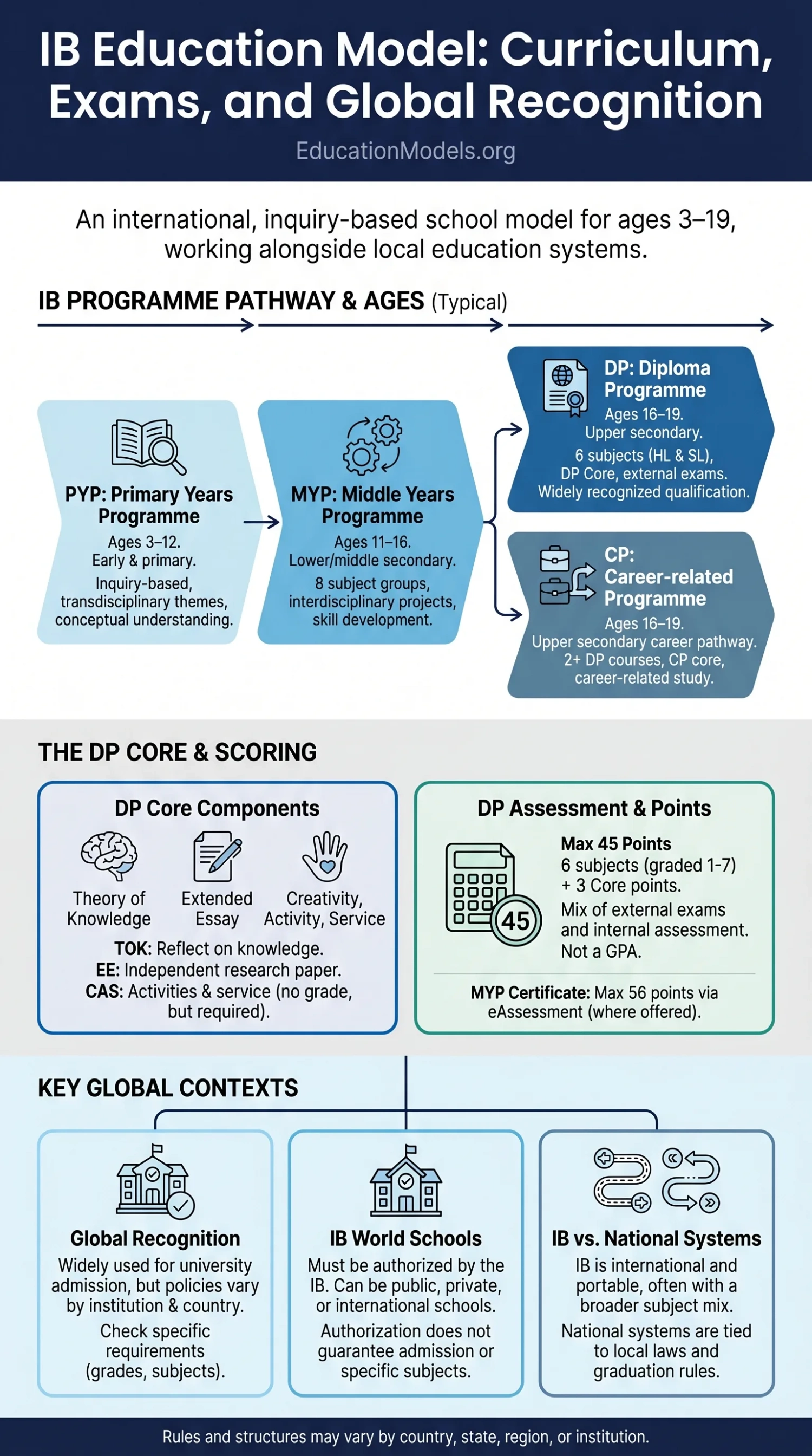
The IB offers four programmes for different stages of schooling. The age ranges are broad because countries organize school years differently, and some schools fit IB programmes around local grade structures. The official IB programme page lists the PYP for ages 3–12, the MYP for ages 11–16, and both the DP and CP for ages 16–19.[b]
| IB Programme | Typical Age Range | Typical School Stage | What It Usually Covers |
|---|---|---|---|
| Primary Years Programme (PYP) | 3–12 | Early years and primary education | Inquiry-based learning, transdisciplinary themes, early conceptual understanding, student agency, and classroom community. |
| Middle Years Programme (MYP) | 11–16 | Lower to middle secondary education | Eight subject groups, interdisciplinary learning, projects, skill development, and preparation for later secondary study. |
| Diploma Programme (DP) | 16–19 | Upper secondary education | Six subject groups, Standard Level and Higher Level courses, Theory of Knowledge, Extended Essay, CAS, and external assessment. |
| Career-related Programme (CP) | 16–19 | Upper secondary career-oriented pathway | At least two DP courses, CP core components, and a career-related study chosen by the school. |
The age overlap between PYP and MYP, and between DP and CP, can confuse readers. The overlap does not mean a student takes all programmes at the same time. It reflects how different school systems place students into grades, years, or levels. A school may use the MYP through Grade 10 or Year 11 in one country, while another school may adapt the timing to match national rules.
Curriculum: What Students Study in IB Schools
The IB curriculum is not a single textbook list. It is a structured learning model that schools use to design lessons, units, projects, assessments, and subject pathways. At younger ages, the model is more inquiry-based and transdisciplinary. In the final school years, the model becomes more subject-based, especially in the Diploma Programme.
Primary Years Programme
The PYP is designed for younger learners and places inquiry at the centre of classroom learning. The IB describes the PYP as transdisciplinary, inquiry-based, and student-centered, with the learner, learning and teaching, and the learning community shaping the curriculum model.[c] In practice, PYP classrooms often organize learning around broad themes rather than isolated subject lessons only.
This does not mean children avoid core skills. Reading, writing, mathematics, science, social learning, arts, and physical education can still be present. The difference is that schools try to connect those areas through questions, units of inquiry, projects, and reflection. A unit might ask students to study how communities use natural resources, then connect language, data, geography, and personal responsibility.
Middle Years Programme
The MYP is built for early adolescents. The official MYP curriculum includes eight subject groups: language acquisition, language and literature, individuals and societies, sciences, mathematics, arts, physical and health education, and design. The IB also states that MYP schools provide at least 50 hours of teaching time for each subject group in each programme year, with flexibility in years 4 and 5 under certain limits.[d]
The MYP is not simply “pre-IB Diploma.” It has its own learning design. Students work across subjects, complete long-term projects, and learn through concepts and contexts. For many families, the MYP is where the IB’s emphasis on research, reflection, and independent learning becomes more visible.
Diploma Programme
The DP is the best-known IB programme because it leads to a widely recognized upper-secondary qualification. The DP curriculum is made up of the DP core and six subject groups. The core includes Theory of Knowledge, the Extended Essay, and Creativity, Activity, Service.[e]
Most full Diploma Programme students take six subjects. Some are taken at Higher Level, usually with more teaching time and greater depth, while others are taken at Standard Level. The exact subjects available depend on the school. A school may offer several sciences and languages, or a narrower selection if staffing and timetable limits require it.
Career-related Programme
The CP is also for ages 16–19, but it has a different purpose from the full DP. The official CP curriculum consists of courses from the IB Diploma Programme, the CP core, and career-related studies. Students complete at least two DP courses, and the school chooses a career-related study that suits local conditions and student needs.[f]
This makes the CP more pathway-oriented. It can suit students who want an academically respected upper-secondary route while also connecting school learning with a professional field, applied study, internship preparation, apprenticeship preparation, or a local career programme.
IB Exams, Assessment, and Qualifications
Assessment is one of the biggest differences between IB programmes. Younger IB students are usually assessed mainly through school-based work, teacher feedback, projects, and reporting against learning aims. At the DP level, assessment becomes more formal, with external examinations and externally marked or moderated work.
For the Diploma Programme, the IB says it assesses student work as direct evidence of achievement against the stated goals of DP courses. DP assessment looks for advanced academic skills such as analyzing and presenting information, evaluating arguments, and solving problems creatively.[g]
| Assessment or Qualification | Typical Stage | Purpose | Notes |
|---|---|---|---|
| PYP school-based assessment | Primary years | Tracks learning, reflection, skills, and conceptual understanding. | Usually handled by the school through ongoing classroom assessment and reporting. |
| MYP projects | Middle years | Develops independent planning, inquiry, and presentation of learning. | Often includes a personal or community-oriented project, depending on the programme year. |
| MYP eAssessment | Final MYP years, where offered | Provides IB-validated assessment in selected subject and project areas. | Not every MYP school uses all optional assessment routes. |
| IB MYP Certificate | End of MYP | Recognizes achievement across required eAssessment components. | Uses a 1–7 grade scale for components and a total score model where applicable. |
| DP internal assessment | Diploma Programme | Assesses coursework, investigations, oral work, projects, or subject tasks. | Often marked by teachers first and moderated or checked under IB rules. |
| DP external assessment | Diploma Programme | Assesses course learning through externally marked examinations or tasks. | Used heavily in final DP results. |
| IB Diploma | End of DP | Serves as an internationally used upper-secondary qualification. | Maximum score is 45 points, with conditions for the award of the diploma. |
| IB Career-related Programme Certificate | End of CP | Recognizes completion of DP courses, CP core, and career-related study. | Recognition can vary by university, country, and programme of study. |
DP Scoring: How IB Diploma Points Work
The full IB Diploma is scored out of 45 points. The IB explains that the maximum comes from six subjects graded up to 7 points each, plus up to 3 extra points from the combination of Theory of Knowledge and the Extended Essay. CAS does not receive a grade, but participation must be completed under school and IB requirements.[h]
This scoring system is one reason universities often ask for an overall point score as well as subject-specific grades. A student applying for engineering, for example, may need a strong overall score and a required grade in Higher Level Mathematics or Physics, depending on the university and country.
A Useful Way to Read the Data
An IB Diploma score is not the same as a GPA. The DP uses subject grades, core points, and award conditions. Universities may convert IB results into local admission terms, but those conversions are set by each institution or national admission body.
MYP scoring works differently. Where students pursue the IB MYP certificate through eAssessment, the official grading and awards page states that the maximum total score is 56, with grades from 1 to 7 assigned to required eAssessment components. It also states that students must achieve at least 28 points, with a grade of 3 or higher in each eAssessment component, to be eligible for the MYP certificate.[i]
The DP Core: TOK, Extended Essay, and CAS
The DP core is one of the most recognizable parts of the IB model. It is designed to make the Diploma Programme more than a collection of separate subject exams. The official DP core page describes three parts: Theory of Knowledge, in which students reflect on knowledge and how we know; the Extended Essay, an independent research paper of up to 4,000 words; and Creativity, Activity, Service, in which students take part in activities connected to the three CAS strands.[n]
TOK often surprises students because it is not a traditional subject. It asks students to think about evidence, interpretation, perspective, and claims across areas of knowledge. The Extended Essay asks for longer research planning and academic writing than many students have done before. CAS is different again: it is not a points-bearing academic subject, but it matters because full DP students must meet CAS expectations to receive the diploma.
Teaching Style and Student Role
IB classrooms are often associated with discussion, inquiry, projects, and written reflection. This can be true, but the model should not be reduced to “student-led learning” alone. A strong IB classroom still needs clear teaching, subject knowledge, feedback, planning, and assessment. The difference is that students are usually expected to take a more active role in explaining their thinking and connecting ideas.
The IB learner profile gives schools a shared language for student development. The IB lists learner profile attributes such as inquirers, knowledgeable, thinkers, communicators, principled, open-minded, caring, risk-takers, balanced, and reflective.[m] Schools may use these words in classroom displays, reports, assemblies, unit planning, and student reflection tasks.
For students, this means success is not only about memorizing material. They may need to ask better questions, write with evidence, plan long tasks, manage time, collaborate, present ideas, and reflect on feedback. For teachers, it means designing lessons that meet subject goals while also building research, communication, thinking, social, and self-management skills.
IB World Schools and School Authorization
A school cannot simply call itself an IB World School because it likes the IB approach. The official authorization process states that a school must be authorized by the IB to offer one or more IB programmes.[l] This matters because IB authorization connects the school to programme standards, teacher preparation, evaluation, and official assessment procedures.
Authorization does not make all IB schools identical. A public school, private school, bilingual school, boarding school, or international school may all offer IB programmes, depending on local rules and authorization. One IB school may teach mostly in English; another may teach in another language or offer bilingual pathways. One school may offer many DP Higher Level subjects; another may offer fewer options.
The IB label tells readers that a school is authorized for a programme. It does not, by itself, tell them the school’s tuition cost, selectivity, boarding status, national graduation route, university counselling quality, or subject range.
Public, Private, and International IB Schools
IB programmes are often associated with international schools, but they are not limited to them. In many countries, public schools also offer IB programmes. Private schools may use the IB as their main curriculum, as an upper-secondary option, or as part of a bilingual or international pathway.
The practical differences for families usually come from the school, not from the IB name alone. The main areas to compare are language of instruction, school fees, local diploma requirements, university counselling, subject availability, class size, and whether students can combine IB study with national qualifications.
- Public IB schools may follow local rules on admission, residency, national curriculum, and graduation.
- Private IB schools may have their own admissions process, tuition model, language policy, and subject timetable.
- International IB schools often serve mobile families, expatriate communities, or students seeking internationally portable qualifications.
- Bilingual IB schools may combine national language requirements with IB teaching and assessment expectations.
Global Recognition and University Admission
The IB Diploma is widely used in university admission, but recognition is not automatic in the same way everywhere. The IB Recognition Statements Database contains recognition statements for countries, territories, U.S. states, Canadian provinces, and universities around the world. The IB states that the country and territory function includes more than 140 countries, while the university function includes more than 2,000 universities and institutions of higher education.[j]
This is where careful reading matters. One university may accept the full IB Diploma for general admission but require particular Higher Level subjects for medicine, engineering, law, architecture, or economics. Another institution may award credit, advanced standing, or placement for certain IB subject grades. A third may accept IB results but still require a national entrance exam, language test, portfolio, interview, or local application process.
| Recognition Area | What It May Mean | What Students Should Check |
|---|---|---|
| General admission | The university accepts the IB Diploma as a valid upper-secondary qualification. | Minimum total points, required subject grades, language requirements, and application route. |
| Course-specific entry | A degree programme may require certain HL or SL subjects. | Required mathematics course, science subjects, language level, portfolio, interview, or aptitude test. |
| Credit or advanced standing | Some universities may grant credit for high IB subject scores. | Which subjects count, whether SL is accepted, and whether credit reduces time or only changes placement. |
| National systems | Some countries translate IB results into local admission rules. | National equivalency rules, recognition statements, deadlines, and document submission process. |
| Career-related Programme | CP recognition can depend more heavily on the institution and programme. | Whether the university recognizes CP, DP courses within CP, and the chosen career-related study. |
Where Official Details May Vary
University recognition can change by country, institution, degree programme, year of entry, and subject combination. Students should always check the university’s own admission page and the relevant national admission body before choosing IB subjects or applying.
IB Compared With Traditional National Curricula
The IB is often compared with national school systems such as A-Levels, AP, local high school diplomas, national baccalaureates, or state curricula. The comparison depends on the country, but several broad differences are common.
National curricula are usually tied to one country’s education law, assessment system, and university admission route. The IB is more portable across borders, especially at DP level, but students still need to meet local rules. A student moving from one country to another may find the IB useful because the programme language and assessment model are known to many international schools and universities. A student staying in one country may still benefit from the IB, but local recognition rules matter more.
| Area | IB Model | Many National Models |
|---|---|---|
| Curriculum identity | International programme model used by authorized schools. | Usually set by a ministry, state, province, exam board, or national authority. |
| Student pathway | Can support international mobility and university applications in several countries. | Often designed mainly for local graduation and local higher education entry. |
| Assessment | DP uses a mix of external assessment, internal assessment, subject grades, and core requirements. | May rely on national exams, school grades, coursework, local credits, or a mix of these. |
| Subject choice | DP students usually balance six subject areas and the core. | Some systems allow early specialization; others require a broader set of subjects. |
| Recognition | Recognition is broad but must be checked by country, university, and programme. | Recognition is usually clearest inside the country that owns the qualification. |
Who the IB Model May Suit
The IB can suit students who are comfortable with reading, writing, research, discussion, and longer assignments. It may also suit families who expect international mobility or who want a qualification known by many universities outside a single national system.
The full Diploma Programme can be demanding because students usually balance six subjects, internal assessments, external exams, TOK, the Extended Essay, and CAS. A student who wants to specialize very early in only three subjects may prefer a different upper-secondary route in some countries. A student who wants a more applied upper-secondary route may find the Career-related Programme more suitable, if the school offers it and if universities of interest recognize it for the intended course.
- It may suit internationally mobile students who need a recognizable school pathway across borders.
- It may suit academically broad students who do not want to narrow their subjects too early.
- It may suit reflective learners who can manage research, writing, feedback, and independent planning.
- It may be harder for students who prefer short tasks only, avoid writing, or need a lighter assessment load.
What Readers Often Confuse
Several misunderstandings appear often when people compare IB schools and qualifications. These points matter because they affect school choice, subject planning, and university applications.
IB School vs International School
An IB school is not always an international school. Some IB World Schools are public local schools. Some international schools do not offer IB programmes at all. The two labels can overlap, but they are not the same.
IB Diploma vs IB Courses
A student may take the full IB Diploma or individual DP courses, depending on the school and local rules. Universities can treat these differently. Full diploma recognition does not always mean that individual IB courses carry the same admission value.
Higher Level vs Better Level
Higher Level does not mean “better” in a general sense. It means the subject is studied in greater depth and often matters for university courses that require advanced preparation. A student’s best subject plan depends on the intended degree, strengths, timetable, and admission rules.
IB Recognition vs Guaranteed Admission
Recognition means an institution or country has a policy for considering IB results. It does not guarantee admission. Competitive programmes may require high scores, specific subjects, language proof, interviews, portfolios, or local entrance steps.
IB Curriculum vs School Quality
The IB curriculum model can be strong, but school quality also depends on leadership, teachers, subject choice, support systems, counselling, timetable design, and student wellbeing. The IB name alone should not replace careful school research.
Common IB Terms Readers Should Know
| Term | Meaning | Why It Matters |
|---|---|---|
| IB World School | A school authorized to offer one or more IB programmes. | Authorization tells families which IB programme the school may officially teach. |
| PYP | Primary Years Programme for younger learners. | It shapes early learning through inquiry and transdisciplinary units. |
| MYP | Middle Years Programme for ages around 11–16. | It bridges primary learning and later upper-secondary pathways. |
| DP | Diploma Programme for ages around 16–19. | It is the IB route most often used for university admission. |
| CP | Career-related Programme for ages around 16–19. | It combines DP courses with career-related study and a CP core. |
| HL | Higher Level subject. | Universities may require HL subjects for selective or subject-specific degrees. |
| SL | Standard Level subject. | SL subjects help students keep a balanced subject profile. |
| TOK | Theory of Knowledge. | It asks students to reflect on knowledge, evidence, and claims. |
| EE | Extended Essay. | It develops independent academic research and long-form writing. |
| CAS | Creativity, Activity, Service. | It is required for the full diploma but does not add points to the total score. |
| MYP eAssessment | IB-validated assessment route for the MYP where offered. | It can lead to recognized MYP results or the MYP certificate under IB rules. |
| Recognition statement | A university, country, state, or province policy explaining how IB results are considered. | It helps students check admission, credit, and advanced standing rules. |
What Can Change Over Time
IB programme details can change through curriculum review, subject updates, assessment adjustments, and recognition policy changes. The IB’s curriculum update page explains that DP and CP subject and core updates are shared in line with recent and upcoming curriculum update cycles.[k]
For families and students, the most change-sensitive areas are subject availability, exam rules, grade requirements, university recognition, national equivalency rules, language requirements, and application deadlines. A school may also change which DP subjects it offers from one year to another because of staffing, student demand, or timetable design.
This site is an independent informational guide and is not affiliated with any ministry of education, school authority, exam board, university, government agency, or official ranking organization. For decisions about school enrollment, subject selection, diploma equivalency, immigration-linked study rules, or university admission, readers should verify details with the relevant IB World School, university, national admission body, or official education authority.
Sources and Verification
- [a] Facts and figures – International Baccalaureate® — Used for the number of IB students, programmes, schools, and countries as of May 2026. (Reliable because it is the official International Baccalaureate facts and figures page.)
- [b] Education programmes – International Baccalaureate® — Used for official IB programme age ranges and first-offered programme context. (Reliable because it is the official IB programme overview page.)
- [c] PYP curriculum framework – International Baccalaureate® — Used for the PYP’s inquiry-based, transdisciplinary curriculum structure and its main organizing elements. (Reliable because it is the official IB PYP curriculum page.)
- [d] MYP curriculum – International Baccalaureate® — Used for the MYP subject groups, teaching time expectation, and interdisciplinary learning context. (Reliable because it is the official IB MYP curriculum page.)
- [e] DP curriculum – International Baccalaureate® — Used for the DP core and six subject groups. (Reliable because it is the official IB DP curriculum page.)
- [f] CP curriculum – International Baccalaureate® — Used for the CP structure, including DP courses, CP core, and career-related studies. (Reliable because it is the official IB CP curriculum page.)
- [g] Assessment & exams – International Baccalaureate® — Used for DP assessment aims and the types of academic skills measured. (Reliable because it is the official IB Diploma Programme assessment page.)
- [h] DP passing criteria – International Baccalaureate® — Used for the maximum DP score of 45 points, the role of TOK and the Extended Essay, and the CAS completion note. (Reliable because it is the official IB page explaining DP passing criteria.)
- [i] Grading and awards – International Baccalaureate® — Used for MYP certificate scoring, grade scale, and award conditions. (Reliable because it is the official IB MYP grading and awards page.)
- [j] Find countries and universities that admit IB students – International Baccalaureate® — Used for IB recognition statement database information and university recognition context. (Reliable because it is the official IB university admission and recognition page.)
- [k] Read curriculum updates – International Baccalaureate® — Used for the note that DP and CP curriculum and core details can be updated through curriculum review cycles. (Reliable because it is an official IB curriculum update page.)
- [l] The authorization process – International Baccalaureate® — Used for the explanation that schools must be authorized to become IB World Schools. (Reliable because it is the official IB authorization process page.)
- [m] Learner profile for IB students – International Baccalaureate® — Used for the IB learner profile attributes. (Reliable because it is the official IB learner profile page.)
- [n] DP core – International Baccalaureate® — Used for the definitions of Theory of Knowledge, the Extended Essay, and Creativity, Activity, Service. (Reliable because it is the official IB DP core page.)