Complete guide: Education Systems
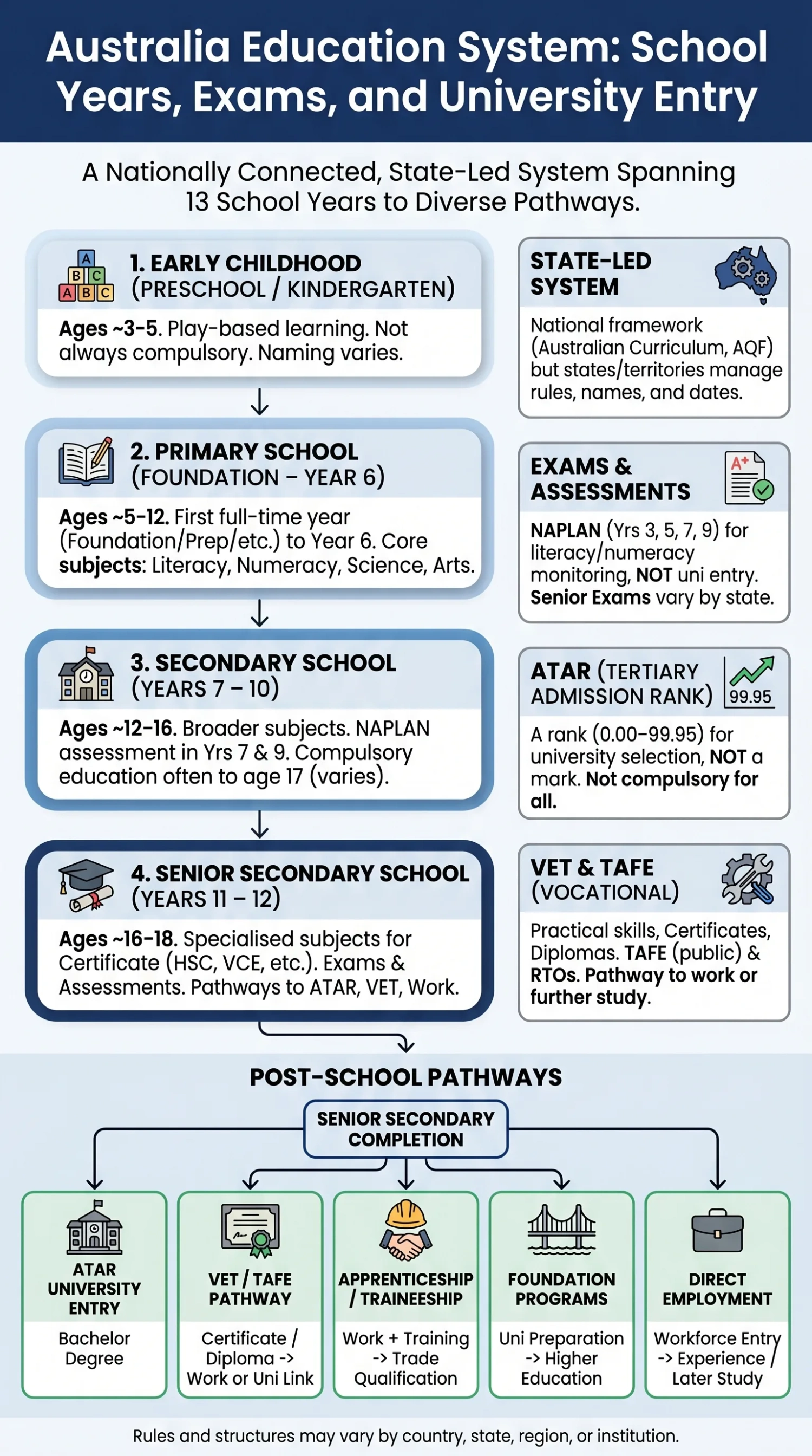
Australia provides 13 years of formal schooling, beginning with a Foundation year and continuing through Year 12. Primary school normally covers Foundation to Year 6, secondary school begins in Year 7, and Years 11 and 12 form the senior secondary stage. The broad sequence is national, but the details are not controlled by one school authority. States and territories set enrolment rules, administer schools, issue different Year 12 certificates and manage their own senior assessment arrangements. University entry commonly uses the Australian Tertiary Admission Rank, or ATAR, yet an ATAR is a rank rather than a final-exam percentage, and it is not the only route into higher education.
This combination of national and state-based arrangements explains why two students in different parts of Australia may follow similar year levels and curriculum expectations but encounter different certificate names, subject rules, assessment patterns and tertiary application systems.
One National Curriculum, Eight School Jurisdictions
School education is mainly the responsibility of Australia’s six states and two territories. State and territory governments own and manage government schools and register non-government schools, while the Australian Government contributes funding and participates in national policy. This division of responsibility affects school-entry cut-offs, attendance laws, curriculum implementation, assessment and senior certification.[a]
Schools are commonly grouped into government and non-government sectors. The non-government sector includes Catholic schools and independent schools. These labels describe governance rather than a single teaching style. Independent schools may be secular or faith-based, academically selective or non-selective, and may use different educational approaches while still meeting registration and curriculum requirements in their jurisdiction.
Why National Answers Need a State Check
A statement may be accurate for the national school sequence but incomplete for enrolment, attendance, Year 12 subjects or university admission. The relevant state or territory authority remains the final source for a student’s local rules.
The School Journey From Foundation to Year 12
All states and territories provide 13 years of formal schooling. A Foundation year comes before Year 1, primary education continues to Year 6, and secondary education runs from Year 7 to Year 12. The age ranges below are typical rather than enrolment guarantees because birthdays, local cut-off dates, delayed entry and grade repetition can change a student’s position.[b]
| Stage | Common Year Levels | Typical Ages | Main Educational Focus |
|---|---|---|---|
| Preschool year | Year before full-time school | About 4–5 | Early learning, communication, play, social development and preparation for school |
| First full-time school year | Foundation under the national terminology | About 5–6 | Early literacy, numeracy, routines, communication and learning through guided activity |
| Primary school | Years 1–6 | About 6–12 | English, mathematics, science, humanities, health, arts, technologies and languages |
| Junior secondary school | Years 7–10 | About 12–16 | Subject-based teaching, broader assessment and growing choice of electives |
| Senior secondary school | Years 11–12 | About 16–18 | Senior certificate, tertiary preparation, VET, apprenticeships or employment pathways |
The First School Year Has Different Names
The national curriculum uses Foundation for the year before Year 1. Families rarely see that word used in exactly the same way everywhere. The local names below refer to the first formal year of full-time schooling, not automatically to preschool. This distinction matters because words such as Kindergarten and Prep may also be used for an earlier childhood program in another jurisdiction.[c]
| State or Territory | Local Name for Foundation |
|---|---|
| Australian Capital Territory | Kindergarten |
| New South Wales | Kindergarten |
| Northern Territory | Transition |
| Queensland | Preparatory or Prep |
| South Australia | Reception |
| Tasmania | Preparatory or Prep |
| Victoria | Preparatory or Prep |
| Western Australia | Pre-primary |
School Entry and Attendance Rules Are Local
The formal year structure is now consistent across Australia, but the legal age for starting school and the conditions for remaining in education or approved training are set by state and territory legislation. A child’s correct entry year therefore depends on the jurisdiction’s birth-date cut-off and enrolment policy. Moving interstate can also place the same-aged child under a different entry rule. The Australian Bureau of Statistics describes Foundation to Year 6 as primary schooling and Years 7–12 as secondary schooling, while confirming that compulsory attendance ages are governed locally.[d]
Age Tables Are Planning Tools, Not Enrolment Decisions
A typical age cannot replace a state education department’s cut-off rule. Families enrolling a child should check the official rule for the child’s date of birth, the intended school year and the state or territory where the school is located.
What Students Learn Before Senior Secondary School
The Australian Curriculum sets learning expectations from Foundation to Year 10. Version 9.0 was released in 2022 for implementation by jurisdictions from 2023. State, territory and non-government education authorities decide the timing, classroom practices and supporting resources used to deliver it. The result is a common national reference point without identical day-to-day teaching in every school.[e]
The curriculum contains eight learning areas: English, Mathematics, Science, Humanities and Social Sciences, Health and Physical Education, Languages, Technologies and The Arts. It also identifies general capabilities such as literacy, numeracy, digital literacy, critical and creative thinking, personal and social capability, intercultural understanding and ethical understanding.
Foundation to Year 6
Early primary years place strong attention on reading, writing, oral language and number sense. Students gradually move from highly guided work to longer texts, investigations, projects and independent problem-solving. A primary class may spend much of the week with one generalist teacher, although specialist teachers often lead areas such as languages, music, physical education or technologies.
By Years 5 and 6, students are usually expected to manage more complex written tasks, apply mathematics in unfamiliar situations, use evidence in science and humanities, and prepare for the organisational demands of secondary school.
Years 7 to 10
Secondary students normally move between subject teachers and classrooms. English, mathematics, science and humanities remain central, while elective choice often expands in technologies, arts, languages, commerce, agriculture, media or other locally offered subjects. Course availability depends on the school’s staffing, facilities and timetable.
Year 10 carries extra weight because students begin planning their senior program. Choices made at this point can affect eligibility for advanced mathematics, sciences, languages and other Year 11–12 subjects. They can also affect university prerequisites later. A student who is considering engineering, for example, may need a mathematics sequence that cannot be entered easily after choosing a lower-level course.
Assessment Before Year 11
Most assessment before senior secondary school is created and marked by teachers. Evidence may come from written assignments, tests, experiments, performances, presentations, portfolios, practical work and classroom participation. Reports commonly describe achievement against curriculum expectations and may also comment on effort, engagement or learning habits. The exact grading language differs between systems and schools.
NAPLAN Measures Literacy and Numeracy at Four Points
NAPLAN, the National Assessment Program—Literacy and Numeracy, is an annual assessment for students in Years 3, 5, 7 and 9. It covers reading, writing, language conventions and numeracy. Its purpose is to provide a nationwide measure of whether students are developing core literacy and numeracy skills.[f]
NAPLAN is not a school-leaving examination, an ATAR calculation or a university entrance test. A result can help identify areas where a student may need extension or support, but it should be read with classroom work and teacher judgment rather than treated as a complete account of the student’s learning.
Results are reported through four proficiency levels: Exceeding, Strong, Developing and Needs additional support. These levels have been used under the current reporting approach since 2023, replacing the older numerical-band and national-minimum-standard reporting model.[g]
NAPLAN and University Entry Are Separate
NAPLAN occurs years before tertiary applications and does not produce an ATAR. University selection is based on senior secondary results, admission ranks and any course-specific criteria.
Years 11 and 12: Certificates, Subjects and Pathway Choices
Senior secondary education covers Years 11 and 12. Students build a program from subjects and recognised learning options allowed by their state or territory certificate. One student may choose a set of scored academic subjects designed to produce an ATAR. Another may combine school subjects with Vocational Education and Training, or VET. A third may complete Year 12 without seeking an ATAR and move into employment, an apprenticeship, TAFE or a later university-entry pathway.
The certificate and the ATAR serve different purposes. A senior secondary certificate records completion and achievement under the jurisdiction’s rules. An ATAR is a separate tertiary admission rank calculated only for students who satisfy the relevant eligibility conditions.
Senior Secondary Certificates by Jurisdiction
Each state and territory develops and administers its own senior secondary certificate within Australia’s national qualifications system. Certificate authorities also decide how school subjects, external assessment and recognised VET learning contribute to completion.[h]
| Jurisdiction | Main Senior Secondary Certificate | Certificate Authority |
|---|---|---|
| Australian Capital Territory | ACT Senior Secondary Certificate | ACT Board of Senior Secondary Studies |
| New South Wales | Higher School Certificate (HSC) | NSW Education Standards Authority |
| Northern Territory | Northern Territory Certificate of Education and Training (NTCET) | Northern Territory Board of Studies, using SACE arrangements |
| Queensland | Queensland Certificate of Education (QCE) | Queensland Curriculum and Assessment Authority |
| South Australia | South Australian Certificate of Education (SACE) | SACE Board of South Australia |
| Tasmania | Tasmanian Certificate of Education (TCE) | Office of Tasmanian Assessment, Standards and Certification |
| Victoria | Victorian Certificate of Education (VCE) | Victorian Curriculum and Assessment Authority |
| Western Australia | Western Australian Certificate of Education (WACE) | School Curriculum and Standards Authority |
Certificate Completion Does Not Automatically Mean ATAR Eligibility
A student can satisfy a Year 12 certificate through an approved program that does not contain the subject pattern needed for an ATAR. Certificate planning and tertiary-rank planning should be checked as two related but separate tasks.
A Current Queensland Requirement
For students graduating from Year 12 in Queensland from 2026, completion of an academic integrity course forms part of QCE eligibility. Queensland students must also meet the certificate’s learning, standard, pattern, literacy and numeracy requirements. This is a certificate rule, not a national condition applied to every Australian Year 12 student.[i]
Victoria’s VCE Vocational Major
Victoria introduced the VCE Vocational Major and the Victorian Pathways Certificate in 2023. The VCE Vocational Major replaced the former Victorian Certificate of Applied Learning as the vocational and applied learning option within the VCE. It is designed around applied study, workplace-related learning and routes into apprenticeships, traineeships, further education or employment.[j]
How Year 12 Assessment Works
Australia does not use one national Year 12 examination taken under identical rules. Each jurisdiction controls the assessment and reporting that contribute to its senior secondary certificate. Depending on the subject and jurisdiction, final results may combine school-based assignments, practical work, investigations, oral tasks, performances and examinations with externally set or externally marked components.[k]
Moderation is used in various forms to make school-based results more comparable. Scaling is a separate statistical process used in tertiary-ranking calculations to compare results from different subject groups. Neither process means that a teacher’s raw mark simply becomes the ATAR.
The balance between internal and external assessment is not uniform. A subject may rely heavily on externally assessed examinations in one jurisdiction while a similar subject elsewhere uses a different mix. Students should read the syllabus and assessment information issued for their own certificate rather than apply rules from another state.
ATAR Explained as a Rank
The Australian Tertiary Admission Rank indicates a student’s position relative to the relevant Year 12 age cohort. It is a percentile rank, not the percentage of questions answered correctly and not the student’s Year 12 certificate score. An ATAR of 85.00 broadly places the student ahead of about 85 per cent of the age cohort used for the ranking.
ATARs are reported from 99.95 downward in increments of 0.05. The issuing admissions centre may group very low ranks rather than publish an exact number. State calculations differ because the eligible subjects, result combinations and local senior assessment systems differ. Queensland, for example, calculates ATARs through QTAC from eligible scaled senior results and uses the rank only to support tertiary selection.[l]
The General Route From Subject Results to ATAR
- The student completes an ATAR-eligible senior subject program under the local rules.
- School-based and external assessment results are finalised by the relevant authority.
- Eligible subject results are moderated or scaled where the jurisdiction’s process requires it.
- A prescribed combination of results is used to create an aggregate.
- The aggregate is converted into a rank against the relevant age cohort.
This sequence explains the idea, not a national calculation formula. The number of contributing subjects, English requirements, treatment of VET and other eligibility conditions must be checked with the student’s certificate authority and tertiary admissions centre.
Reading an ATAR Correctly
85.00 ATAR does not mean an 85 per cent examination mark. It expresses relative position. Two students may reach a similar ATAR through different subject combinations after the relevant scaling and aggregation process.
ATAR, Selection Rank and Course Requirements
Universities do not always compare applicants using the unadjusted ATAR alone. For a particular course preference, an institution may create a selection rank by adding adjustment factors for eligible circumstances or achievements. Adjustments may relate to performance in relevant Year 12 subjects, location, educational disadvantage or another approved scheme. They do not alter the ATAR itself, and the same applicant can have different selection ranks for different courses.[m]
| Term | What It Represents | How It Is Used |
|---|---|---|
| Year 12 subject result | Achievement in a particular senior subject | Certificate completion, subject reporting and possible ATAR calculation |
| ATAR | Relative academic rank against the relevant age cohort | A common starting point for tertiary selection |
| Adjustment factor | Course-specific consideration awarded under an institution’s rules | Added to the ATAR-based rank, not to the ATAR |
| Selection rank | ATAR or equivalent admission rank after applicable adjustments | Used to compare applicants for a particular course |
| Lowest selection rank | The lowest rank that received an offer in a stated intake or offer round | Historical admission information, not a guaranteed future threshold |
Prerequisites Can Matter More Than a Higher Rank
A course may require a particular subject, result or level of English. Mathematics, chemistry and physics prerequisites are common examples in courses that rely on prior technical study. Meeting the published selection rank does not override a mandatory prerequisite.
Assumed knowledge is different. It indicates that the university expects students to arrive with certain knowledge but may not use that subject as an absolute admission barrier. Students admitted without it may need bridging study. Other programs can use portfolios, auditions, interviews, aptitude tests, work experience, health checks or other course-specific criteria alongside academic results.
Why a Published Cut-Off Can Move
The rank needed for an offer can change with applicant demand, available places, the strength of the applicant pool, preference patterns and the offer round. A previous intake’s lowest selection rank describes what occurred in that round. It does not promise entry at the same number in a later year.
University Applications and Offer Rounds
Many domestic school-leaver applications pass through a regional tertiary admissions centre. Applicants create an account, list course preferences, supply required information and receive offers through scheduled rounds. Some institutions or applicant categories use direct applications instead. The Australian Government’s StudyAssist service identifies the main application routes and also confirms that early offers, prior learning and work history may provide alternatives to an ATAR-only decision.[n]
| Region | Main Admissions Route | Common Abbreviation |
|---|---|---|
| New South Wales and Australian Capital Territory | Universities Admissions Centre | UAC |
| Victoria | Victorian Tertiary Admissions Centre | VTAC |
| Queensland | Queensland Tertiary Admissions Centre | QTAC |
| South Australia and Northern Territory | South Australian Tertiary Admissions Centre | SATAC |
| Western Australia | Tertiary Institutions Service Centre | TISC |
| Tasmania | University of Tasmania application process | UTAS |
A Typical School-Leaver Application Sequence
- Research courses, prerequisites, assumed knowledge and any additional selection criteria.
- Apply through the relevant admissions centre or directly to the provider.
- Place courses in genuine preference order and meet document deadlines.
- Receive final Year 12 results and an ATAR or another recognised admission rank.
- Allow institutions to assess each preference using the applicable selection rank and requirements.
- Receive an offer in one of the scheduled rounds and complete enrolment with the provider.
An offer for a lower preference does not always end consideration for a higher preference in later rounds, but rules and advice differ by admissions centre. Applicants should follow the instructions attached to the offer rather than assume that accepting or declining will have the same effect in every system.
Routes Into Higher Education Without a Direct ATAR Offer
An ATAR is a common school-leaver route, not a universal entry requirement. Providers may consider a senior secondary certificate, VET qualification, prior tertiary study, work history, preparation course, portfolio or other evidence. The available route depends on the course and institution.
VET, TAFE and School-Based Training
Students can include recognised VET study in a senior secondary program. This can provide credit toward both a senior certificate and a vocational qualification. Delivery may occur through a school, TAFE institute or another Registered Training Organisation. School-based apprenticeships and traineeships can combine paid work with recognised training.[o]
After school, a Certificate, Diploma or Advanced Diploma may lead directly to employment or support a later university application. Some diploma-to-degree arrangements grant credit, reducing the amount of repeated study. Credit is never automatic across all providers; the receiving institution decides what it will recognise.
Preparation and Enabling Programs
Universities and pathway colleges may offer enabling, foundation or tertiary preparation programs for applicants who lack the required rank or academic background. Successful completion can create a new admission basis. These programs vary in length, fees, subject content and progression guarantees, so the conditions should be read carefully.
Early Offers and School Recommendations
Some providers make offers before the main Year 12 offer rounds. They may consider Year 11 results, school recommendations, a portfolio, community participation or other published criteria. An early offer can still require the student to complete Year 12, pass a prerequisite or meet a minimum result. The written conditions of the offer determine whether it is conditional or unconditional.
Prior Study, Work History and Internal Transfer
Applicants who are no longer assessed as current school leavers may be considered through previous secondary results, VET study, university study, employment experience or another institution-approved measure. A student may also begin in a related course and apply to transfer after establishing a tertiary academic record. Transfer places can be competitive and are not guaranteed.
Three Routes From Year 10 to Further Study
Direct ATAR Route
The student chooses prerequisite senior subjects in Year 10, completes an ATAR-eligible Year 11–12 program, receives an ATAR, applies through the relevant admissions system and competes for an offer using a course-specific selection rank.
VET or Diploma Route
The student combines senior schooling with VET or enters a TAFE qualification after school. The qualification can lead to employment, a later university application or a credit-bearing pathway into a degree where an agreement exists.
Preparation or Transfer Route
The student completes Year 12 without the required rank, enters an enabling, foundation or related tertiary course, builds a new academic record and applies for progression or transfer under the provider’s rules.
These routes can overlap. A student may have an ATAR and still choose TAFE, use VET as part of an ATAR-eligible program, accept an early offer, or later transfer between providers. The Australian system does not treat one Year 12 decision as the only possible entry point for all future study.
What Must Be Checked for an Individual Student
A reliable plan connects four separate sets of rules: the state’s school-entry and attendance law, the senior certificate requirements, the local ATAR eligibility rules and the chosen university course’s admission criteria. Confusing one with another creates avoidable problems. Completing Year 12 does not guarantee an ATAR, receiving an ATAR does not satisfy every prerequisite, and meeting a previous selection rank does not guarantee a future offer.
- For school entry, verify the child’s date of birth against the state or territory cut-off.
- For Years 11 and 12, check certificate completion and ATAR eligibility separately.
- For a university course, confirm prerequisites, adjustment rules, additional criteria and the correct application route.
- For VET or diploma pathways, confirm the qualification provider, recognition status and any written credit agreement.
- For an offer, read the conditions and enrolment deadline issued by the university or admissions centre.
This site is an independent informational guide and is not affiliated with any ministry of education, school authority, exam board, university, government agency or official ranking organization. Education and admission rules can change, so decisions should be checked with the responsible state authority, certificate body, admissions centre, school or university.
Sources and Verification
- [a] How schools are funded — Confirms the division of school responsibility between the Australian Government and state and territory governments. (Australian Government Department of Education.)
- [b] National Report on Schooling in Australia 2024 — Confirms the 13-year formal school sequence and the national primary and secondary structure. (Australian Curriculum, Assessment and Reporting Authority.)
- [c] Student Background data collection for independent schools — Lists the jurisdiction-specific names used for the national Foundation year. (Australian Curriculum, Assessment and Reporting Authority.)
- [d] Schools methodology, 2025 — Defines the formal school stages and confirms that compulsory attendance ages are set in state and territory legislation. (Australian Bureau of Statistics.)
- [e] Australian Curriculum — Verifies Version 9.0, the Foundation–Year 10 scope, learning areas and jurisdictional implementation. (Australian Government Department of Education.)
- [f] NAPLAN — Confirms the tested year levels and the national literacy and numeracy purpose. (National Assessment Program.)
- [g] NAPLAN proficiency level descriptions — Defines the four current NAPLAN proficiency levels. (National Assessment Program.)
- [h] Senior Secondary Certificates — Verifies that states and territories administer separate senior certificates and recognise VET within them. (Australasian Curriculum, Assessment and Certification Authorities.)
- [i] Senior secondary information for parents and families — Confirms QCE requirements, Queensland ATAR eligibility and the academic integrity requirement applying from 2026. (Queensland Curriculum and Assessment Authority.)
- [j] Victorian Senior Secondary Certificate Reform — Verifies the introduction and purpose of the VCE Vocational Major and Victorian Pathways Certificate. (Victorian Curriculum and Assessment Authority.)
- [k] Assessment and reporting — Supports the state- and territory-based administration of senior secondary assessment and reporting. (Australasian Curriculum, Assessment and Certification Authorities.)
- [l] ATAR — Explains the ATAR as a percentile rank, its reporting scale and Queensland calculation arrangements. (Queensland Tertiary Admissions Centre.)
- [m] University selection rank adjustments — Explains how adjustments affect a course-specific selection rank without changing the ATAR. (Universities Admissions Centre.)
- [n] Getting into higher education — Lists regional application services and outlines offer rounds, early offers and non-ATAR admission evidence. (Australian Government StudyAssist.)
- [o] Vocational Education and Training — Confirms how recognised VET can contribute to both a vocational qualification and a senior secondary certificate. (Australasian Curriculum, Assessment and Certification Authorities.)
Related Topics
- → United Kingdom Education System: GCSEs, A-Levels, and School Stages
- → Canada Education System: Provinces, Schools, and Higher Education
- → Education Systems Around the World: How School Systems Differ by Country
- → School Starting Age by Country: A Global Guide
- → Compulsory Education Age by Country: How Long Students Must Attend School