Complete guide: Education Systems
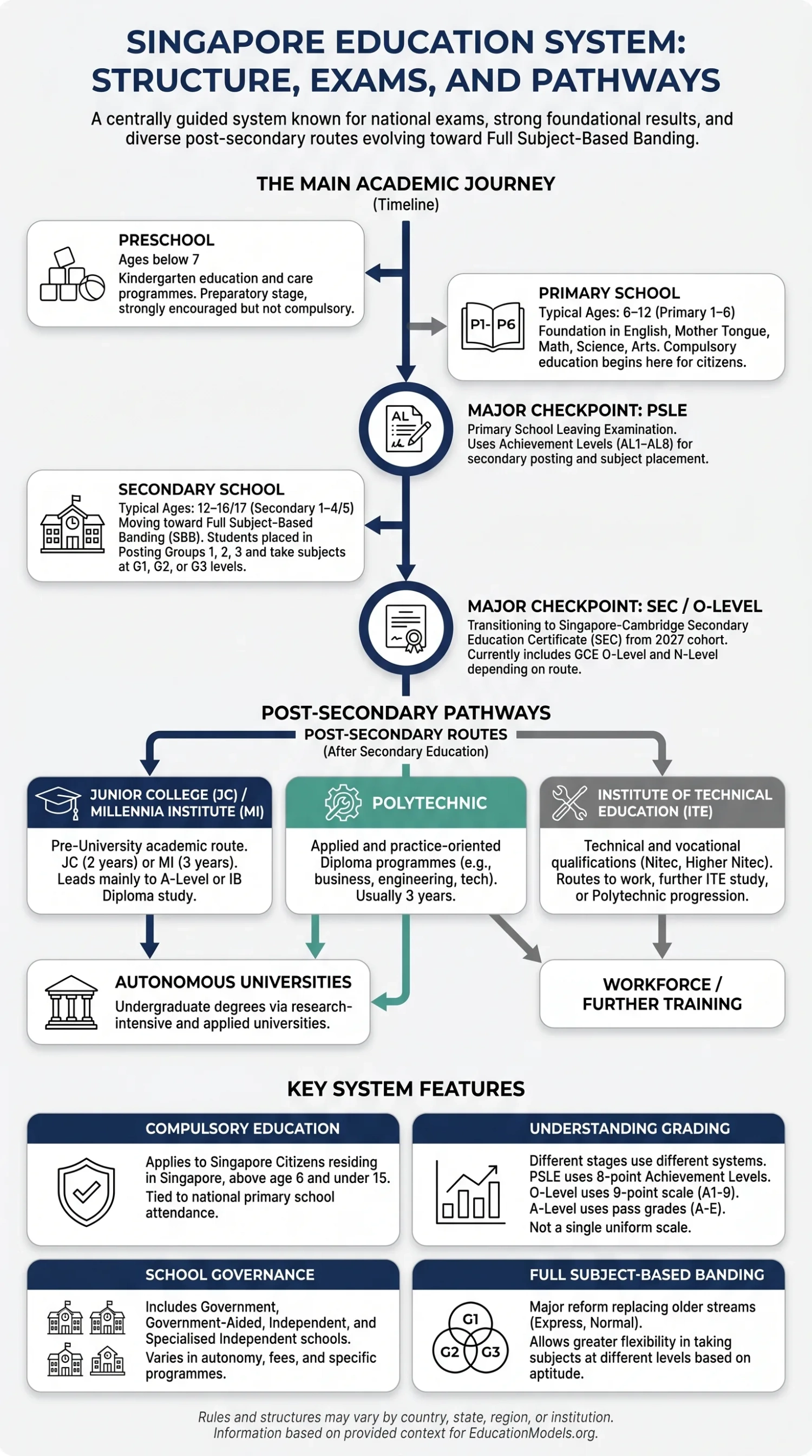
Singapore’s education system follows a nationally coordinated route from six years of primary school to secondary education and then to junior college, Millennia Institute, a polytechnic or the Institute of Technical Education. Its best-known examination is the Primary School Leaving Examination (PSLE), but the system is changing most visibly at secondary level. Students entering Secondary 1 from 2024 are no longer placed into Express, Normal (Academic) or Normal (Technical) streams. They enter through Posting Groups and take individual subjects at G1, G2 or G3 under Full Subject-Based Banding. From 2027, the separate N- and O-Level certificates will give way to the Singapore-Cambridge Secondary Education Certificate (SEC).
This makes Singapore both examination-led and pathway-based. National assessments still shape progression, yet one student may take different subjects at different demand levels and later choose an academic, applied or technical route. International studies show very high average achievement, while also revealing differences by socioeconomic background and between test performance and students’ interest in learning.
The Route from Primary 1 to Post-Secondary Education
Most students enter Primary 1 in the calendar year associated with age six to seven, complete Primary 6 around age twelve, and begin Secondary 1 around age thirteen. The table uses typical progression ages rather than fixed age guarantees. Admission age can differ for international students, returning students, deferred entry and other individual circumstances.[a]
| Stage | Typical Age | Usual Length | Main Exit Point or Qualification | Common Next Routes |
|---|---|---|---|---|
| Preschool | Before 7 | Varies | No national school-leaving examination | Primary 1 |
| Primary School | About 7–12 | 6 years | PSLE at Primary 6 | Secondary school |
| Secondary School | About 13–16 or 17 | Usually 4 years; a fifth year remains available for eligible students | SEC from the 2027 graduating cohort, or an alternative qualification in selected programmes | JC, MI, polytechnic or ITE |
| Junior College | Usually from 17 | 2 years | GCE A-Level or, in selected institutions, IB Diploma | University or other tertiary study |
| Millennia Institute | Usually from 17 | 3 years | GCE A-Level | University or other tertiary study |
| Polytechnic | Usually from 17 | Commonly 3 years for diploma study | Diploma | Employment, university or further professional study |
| Institute of Technical Education | Usually from 17 | Programme-dependent | Nitec or Higher Nitec pathway | Employment, related polytechnic study or further training |
Compulsory Schooling Has a Defined Legal Scope
Singapore’s compulsory education rule applies to Singapore Citizens who meet the statutory conditions and requires attendance at a national primary school unless an exemption is granted. MOE defines compulsory school age as above six and under fifteen. This rule should not be presented as an identical attendance requirement for every non-citizen or every type of school.[b]
Primary School Builds Toward the PSLE
Primary education lasts six years. English is the main language of instruction in the national system, while students also study a Mother Tongue Language. The curriculum includes English, Mother Tongue, mathematics, science, art, music, social studies and other learning areas. The purpose is broader than preparing four papers for the PSLE, though those four examined subjects become central to Secondary 1 placement.[c]
Standard and Foundation Subjects in Primary 5 and 6
Subject-Based Banding already operates before secondary school. In Primary 5 and Primary 6, a student may take a combination of Standard and Foundation subjects according to learning needs and strengths. Mother Tongue also has a Higher option for eligible students. A Foundation subject is a different curricular demand level; it does not label the child’s entire programme or permanently fix the later secondary route.
How the PSLE Achievement Level Score Works
The PSLE assesses English Language, Mother Tongue Language, Mathematics and Science. Each Standard subject receives an Achievement Level from AL1 to AL8. The four AL values are added, so a lower total indicates stronger examination performance. Four AL1 results produce a total of 4, while four AL8 results produce 32. Foundation results use letter grades that are mapped for Secondary 1 posting. The scoring design creates 29 possible total scores and groups similar performance into wider bands rather than ranking every mark difference as a separate outcome.[d]
| Achievement Level | Raw Mark Range for a Standard Subject |
|---|---|
| AL1 | 90 and above |
| AL2 | 85–89 |
| AL3 | 80–84 |
| AL4 | 75–79 |
| AL5 | 65–74 |
| AL6 | 45–64 |
| AL7 | 20–44 |
| AL8 | Below 20 |
A PSLE Total Is Not a School Guarantee
The total helps determine eligibility and posting, but admission to a particular secondary school also depends on the schools selected, available places and tie-break rules. A previous intake’s score range can help explain past demand; it cannot guarantee the next posting result.
Secondary Education Now Uses Full Subject-Based Banding
The 2023 Secondary 1 cohort was the last cohort placed into the older Express, Normal (Academic) and Normal (Technical) courses. From the 2024 Secondary 1 cohort, schools that previously used academic streams moved to Full Subject-Based Banding (Full SBB). Students can take different subjects at different levels and may change levels as their readiness develops. English, Mother Tongue, mathematics, science and humanities are among the subjects offered at G1, G2 and G3. Mixed form classes also bring together students taking different subject combinations.[e]
Posting Groups and Subject Levels Answer Different Questions
Posting Groups 1, 2 and 3 are used for entry to secondary school and to guide the initial level of most subjects. G1, G2 and G3 describe the demand level of an individual subject. A student posted through Group 2 may begin with most subjects at G2 while taking mathematics or science at G3 after meeting the relevant subject criteria. The Posting Group is therefore not a replacement name for a fixed stream.[f]
| Term | What It Does | What It Does Not Mean |
|---|---|---|
| Posting Group | Supports initial Secondary 1 placement and indicates the starting level for most subjects. | It does not require every subject to remain at one level throughout secondary school. |
| G1, G2 or G3 | Shows the curricular and assessment level for a particular subject. | It is not a label for the student’s overall ability or school identity. |
| Mixed Form Class | Places students with different subject combinations in the same form class for common learning and school life. | It does not mean every student attends the same level class for every examinable subject. |
What a Mixed Subject Profile Can Look Like
A student might take English and Mother Tongue at G2, mathematics and science at G3, and humanities at G2. Another student may take most subjects at G1 while studying one language or mathematics at G2. Schools consider subject performance, learning pace and readiness when advising movement between levels. The aim is to fit the demand of each subject more closely to the student rather than forcing one level across the entire timetable.
Older Stream Labels Still Appear in Transitional Information
O-Level, N(A)-Level and N(T)-Level rules remain relevant to cohorts completing the earlier system. They should not be applied automatically to students who entered Secondary 1 from 2024. Cohort year matters when reading examination, grading and admissions information.
The SEC Becomes the Main Secondary Exit Certificate in 2027
The Singapore-Cambridge Secondary Education Certificate begins with the 2027 graduating cohort. It combines and renames the separate Singapore-Cambridge GCE N(T)-Level, N(A)-Level and O-Level certificates. Students still sit papers at the subject level they studied—G1, G2 or G3—and the certificate records both the subject and its level. SEAB states that the examination standards remain aligned with the earlier level-specific examinations; a common certificate does not mean a single common paper for all candidates.[g]
SEC Grading Retains Three Level-Specific Scales
| SEC Subject Level | Grade Scale | Relationship to the Earlier Examination Level |
|---|---|---|
| G1 | A, B, C, D, E | Uses the grading structure associated with N(T)-Level subjects. |
| G2 | 1, 2, 3, 4, 5, 6 | Uses the grading structure associated with N(A)-Level subjects. |
| G3 | A1, A2, B3, B4, C5, C6, D7, E8, 9 | Uses the grading structure associated with O-Level subjects. |
Grade mapping is used only where an admissions aggregate needs subjects taken at a more demanding level to be expressed on another level’s scale. It does not erase the original subject level shown on the certificate. Written English and Mother Tongue examinations are scheduled in September, most other written papers run from October to November, and practical, oral and listening components take place earlier. Results are released together in January of the following year.
| Secondary Exit Feature | Earlier Cohorts | From the 2027 Graduating Cohort |
|---|---|---|
| Certificate | Separate N(T)-Level, N(A)-Level and O-Level certificates | One SEC showing subjects and their G1, G2 or G3 levels |
| Written Examination Period | Different calendars for N- and O-Level papers | English and Mother Tongue in September; most other written papers from October to November |
| Results Release | N-Level results in December and O-Level results in January | One January release |
| Post-Secondary Application Timing | Several admissions exercises linked to different qualifications | Main routes can be considered together through the 2028 PSE |
The Integrated Programme Follows a Different Examination Sequence
Not every secondary student follows the standard SEC route. The Integrated Programme (IP) is a six-year course leading to the GCE A-Level, International Baccalaureate Diploma or NUS High School Diploma, depending on the school. IP students do not take the SEC in Secondary 4. Their Years 1–4 connect directly to Years 5–6 or the institution’s equivalent pre-university stage.[h]
This distinction matters when comparing student pathways. Full SBB changes subject levels within mainstream secondary education. The Integrated Programme is a separate six-year route with a different exit qualification. Specialised independent schools and practice-oriented schools may also use curricula or qualifications shaped around their particular educational purpose.
JC, MI, Polytechnics and ITE Lead to Different Forms of Study
After secondary school, the main publicly recognised routes are Junior College (JC), Millennia Institute (MI), the polytechnics and the Institute of Technical Education (ITE). JC and MI are pre-university routes. Polytechnics award diplomas through applied, course-specific study. ITE offers technical and career-oriented education through Nitec and Higher Nitec routes. These are connected pathways rather than a simple ranking from highest to lowest.[i]
| Route | Learning Pattern | Main Award | Typical Progression |
|---|---|---|---|
| Junior College | Broad academic study over two years, with subjects commonly taken at H1, H2 or H3 level | GCE A-Level or IB Diploma in selected JCs | University and other tertiary routes |
| Millennia Institute | Three-year pre-university study with a more extended pace | GCE A-Level | University and other tertiary routes |
| Polytechnic | Applied diploma study using lectures, laboratories, projects, industry-linked work and assessment across the course | Diploma | Employment or university, subject to programme and admission requirements |
| ITE | Technical, practical and industry-oriented learning | Nitec or Higher Nitec | Employment, further ITE study or related polytechnic routes |
A polytechnic diploma can lead to university, and an ITE qualification can lead to a related polytechnic course. Progression depends on the qualification, course match, grades, available places and the receiving institution’s rules.
The 2028 PSE Brings the Main Post-Secondary Choices Together
Students receiving the first SEC results in January 2028 will use the new Post-Secondary Admissions Exercise (PSE) for the main admission routes to JC, MI, polytechnic diploma programmes, the Polytechnic Foundation Programme and ITE Higher Nitec programmes. The PSE replaces several separate result-based exercises, allowing eligible applicants to consider these routes in one application period. Direct School Admission to JC, Polytechnic Early Admissions Exercise and ITE Early Admissions Exercise continue as separate aptitude- or interest-based channels. Choice order becomes a tie-breaker when applicants have the same net aggregate score.[j]
JC and MI Eligibility Changes with the First SEC Admissions Cycle
For the 2028 admissions cycle, JC eligibility moves from the older L1R5 calculation to L1R4. The gross aggregate ceiling is 16 for JC and 20 for MI, with subject-grade requirements also applying. All subjects used in the L1R4 calculation must be taken at G3. Eligibility allows an application; it does not promise admission to a chosen institution, because posting also depends on course choices, vacancies and competition among eligible applicants.[k]
Admissions Rules Are Cohort-Specific
Students using O-Level results before the PSE transition remain subject to the rules for their own admissions exercise. SEC grade mapping, L1R4 criteria and PSE choice-order rules should be checked against the candidate’s examination year and intended intake.
A-Level Assessment Now Uses a 70-Point University Admission Score
The GCE A-Level route commonly includes content subjects at H1 and H2, with H3 available for deeper study in selected areas. General Paper is part of the pre-university curriculum, and Project Work develops research, collaboration and communication through a different assessment format from written subject papers.
The revised University Admission Score applied to the 2025 A-Level cohort whose results were released in 2026. Project Work is now Pass/Fail and is excluded from the point calculation, though a pass remains required. The maximum score is 70 rather than 90. A fourth content-based subject is counted only when it improves the candidate’s score. University admission is still programme- and institution-dependent; the headline score is not the only condition for every course.[l]
| Admission-Score Element | Earlier Calculation | Revised Calculation |
|---|---|---|
| Maximum University Admission Score | 90 points | 70 points |
| Project Work | Graded and included in the score | Pass/Fail and excluded from the score; a pass is required |
| Fourth Content-Based Subject | Part of the standard calculation | Included only when it improves the score |
National Examinations Are Major Checkpoints, Not the Entire Assessment System
The main national checkpoints are PSLE at the end of primary school, SEC or an alternative qualification at the end of secondary education, and A-Level or another pre-university award for students on that route. Between these points, schools use classroom tasks, projects, practical work, oral assessment, tests and teacher feedback. Polytechnic and ITE programmes also depend heavily on course-based assessment rather than one national leaving examination.
The system therefore cannot be described accurately as a sequence of three tests alone. Examinations control some high-stakes transitions, but subject-level placement, school-based evidence, course requirements and student choice also shape the path.
PISA 2022 Shows High Achievement and a Wide Socioeconomic Gap
PISA tests how well 15-year-olds can use knowledge and skills in mathematics, reading and science, rather than checking mastery of one national syllabus. In PISA 2022, Singapore recorded mean scores of 575 in mathematics, 543 in reading and 561 in science, compared with OECD averages of 472, 476 and 485. Singapore had the highest mean score among participating systems in all three domains. Forty-one percent of students reached Level 5 or 6 in mathematics, compared with an OECD average of 9 percent. The difference between Singapore’s most socioeconomically advantaged quarter and its least advantaged quarter was 112 mathematics points, against an OECD average difference of 93 points.[m]
| PISA 2022 Domain | Singapore Mean Score | OECD Average |
|---|---|---|
| Mathematics | 575 | 472 |
| Reading | 543 | 476 |
| Science | 561 | 485 |
High national means and unequal outcomes can exist at the same time, so a ranking does not describe every student’s access, support or daily school experience.
TIMSS 2023 Confirms Strong Curriculum-Based Mathematics and Science Results
TIMSS is closer to school mathematics and science curricula than PISA and assesses students at two grade levels. In TIMSS 2023, Singapore’s Primary 4 students recorded mean scores of 615 in mathematics and 607 in science. Secondary 2 students recorded 605 in mathematics and 606 in science. Singapore placed first in the reported comparisons for all four grade-and-subject combinations. The share of Primary 4 students saying they enjoyed learning mathematics a lot fell from 48 percent in 2019 to 42 percent in 2023; the Secondary 2 share moved from 37 percent to 35 percent.[n]
| TIMSS 2023 Group | Mathematics | Science |
|---|---|---|
| Primary 4 | 615 | 607 |
| Secondary 2 | 605 | 606 |
Achievement and enjoyment do not move in lockstep. Test scores, confidence, interest, belonging and wellbeing measure different parts of education.
PISA and TIMSS Should Not Be Combined into One Score
PISA assesses 15-year-olds’ use of knowledge in unfamiliar and real-life problem settings. TIMSS assesses mathematics and science at Primary 4 and Secondary 2 with closer links to taught curricula. Their scales, populations and purposes differ, so the point values are not directly interchangeable.
How Singapore Produces Strong Academic Results
No single policy explains Singapore’s results. The national curriculum sets a clear sequence of expected learning. Primary school gives sustained attention to language, mathematics and science foundations. Teacher preparation, common syllabuses, national assessment and targeted learning support keep instruction tied to shared expectations. Bilingual education combines English-medium schooling with Mother Tongue study, while applied and technical routes connect school qualifications with further study and employment.
Full SBB modifies an older part of that model. Earlier secondary streams grouped most subjects under one course label. The newer design retains differentiated subject demand but moves the differentiation to each subject. SEC then records that mixed profile on one certificate. The change aims to widen movement without removing academic standards or the qualification requirements used by post-secondary institutions.
Strong averages should still be read with limits. International assessments do not measure every curriculum area, student relationship, creative activity, mental-health experience or long-term career outcome. They show what sampled students could do under defined test conditions. They do not establish that every school, pathway or learner experiences the system in the same way.
The System Is Moving from Whole-Student Labels to Mixed Subject Profiles
Three linked changes define the current direction of Singapore secondary education. Full SBB replaces fixed academic streams for newer cohorts. The SEC replaces separate N- and O-Level certificates from 2027. The PSE brings the main result-based post-secondary applications together from 2028. The continuing role of G1, G2 and G3 shows that differentiated study remains; the difference is that a student’s subjects can form a mixed profile rather than following one stream label.
For families and students, the examination year now matters as much as the examination name. A learner finishing under O- or N-Level rules may face a different timetable and admissions process from a learner receiving an SEC one year later. Official MOE, SEAB, school and institution pages should be checked before decisions involving subject selection, eligibility or applications.
This site is an independent informational guide and is not affiliated with any ministry of education, school authority, exam board, university, government agency or official ranking organization.
Sources and Verification
- [a] Studying in Singapore — Provides MOE’s age-to-level reference for admission into mainstream schools. (Official Ministry of Education source.)
- [b] Overview of compulsory education — Defines the legal scope and age conditions for compulsory primary education. (Official Ministry of Education source.)
- [c] Curriculum and subjects — Describes primary curriculum areas, Mother Tongue study and subject-based learning. (Official Ministry of Education source.)
- [d] PSLE Scoring System — Explains Achievement Levels, raw-mark bands and the calculation of the PSLE total. (Official Ministry of Education source.)
- [e] Curriculum for secondary schools — Confirms the removal of Express and Normal streams for the 2024 Secondary 1 cohort and explains G1–G3 subject study. (Official Ministry of Education source.)
- [f] What are posting groups — Distinguishes Secondary 1 Posting Groups from individual subject levels. (Official Ministry of Education source.)
- [g] Secondary Education Certificate (SEC) — Sets out the 2027 introduction, grading scales, examination periods and certificate rules. (Official Singapore Examinations and Assessment Board source.)
- [h] Integrated Programme — Explains the six-year route and its A-Level, IB Diploma or NUS High School Diploma outcomes. (Official Ministry of Education source.)
- [i] Overview of Post-Secondary Education Institutions — Describes JC, MI, polytechnic and ITE pathways and programme lengths. (Official Ministry of Education source.)
- [j] Post-Secondary Admissions Exercise (PSE) — Explains the joined admissions process beginning with the 2028 intake. (Official Ministry of Education source.)
- [k] Changes to JC and MI admission criteria from 2028 JAE — Provides the L1R4 ceilings and G3 subject conditions for JC and MI eligibility. (Official Ministry of Education source.)
- [l] Release of the 2025 Singapore-Cambridge GCE A-Level Examination Results — Confirms the 70-point score, Pass/Fail Project Work and revised treatment of the fourth content subject. (Official Ministry of Education source.)
- [m] PISA 2022 Results, Country Note: Singapore — Reports Singapore’s mathematics, reading and science outcomes, proficiency shares and socioeconomic gaps. (Official OECD publication.)
- [n] TIMSS 2023: Singapore Students Demonstrate Strong Foundations and Consistent Good Performance in Mathematics and Science — Reports the Primary 4 and Secondary 2 results and changes in students’ reported enjoyment of mathematics. (Official Ministry of Education source using IEA TIMSS data.)
Related Topics
- → South Korea Education System: Schools, Exams, and Academic Pressure
- → Germany Education System: Schools, Tracks, and Vocational Pathways
- → Japan Education System: Schools, Exams, and Student Life
- → Finland Education System: How Schools Work in Finland
- → Netherlands Education System: Schools, Tracks, and Learning Pathways
- → United States Education System: Grades, Schools, and College Pathways