Complete guide: Education Models
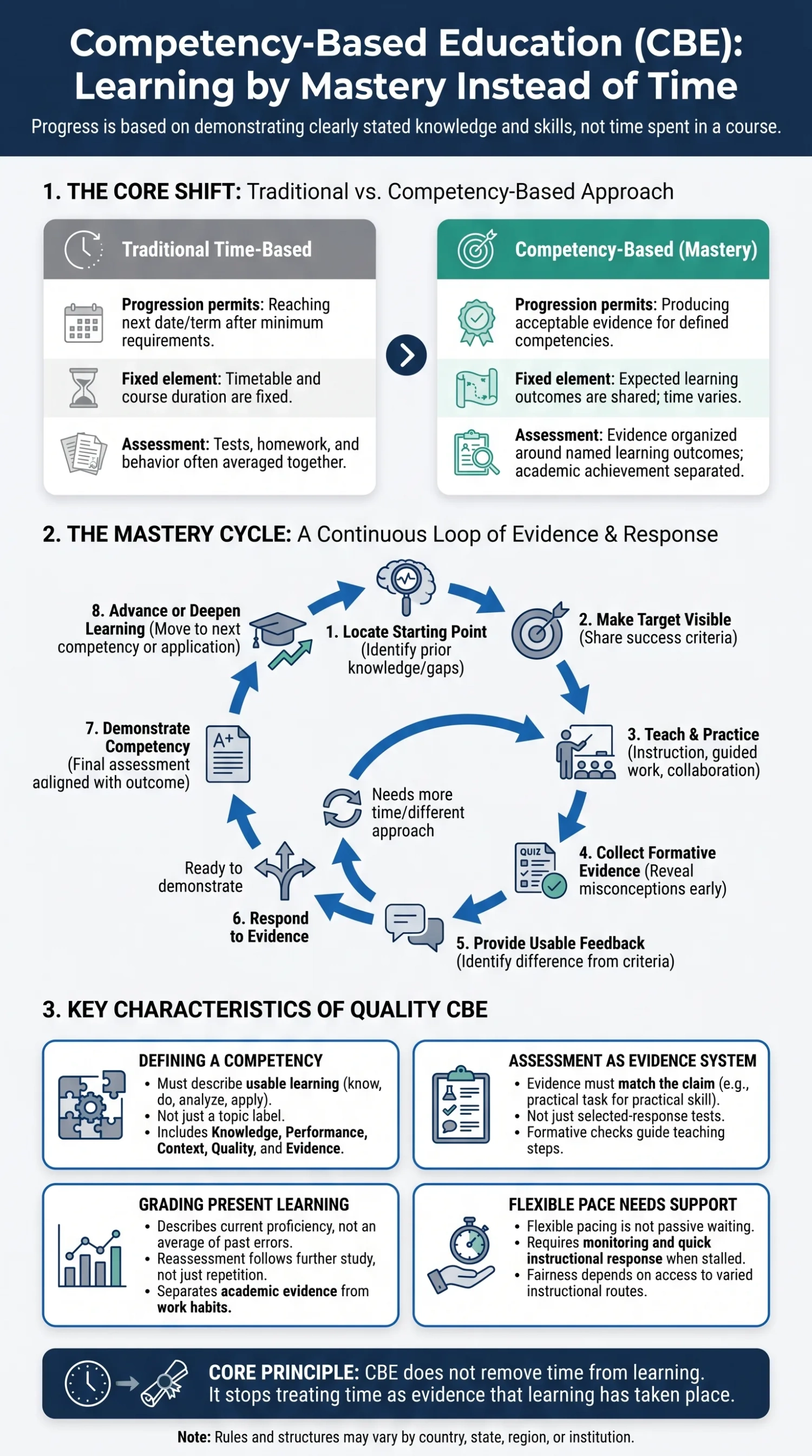
Competency-based education changes the rule used to decide when a learner moves forward. Instead of treating time spent in a course as proof of learning, it asks the learner to demonstrate clearly stated knowledge and skills. The expectations do not become easier. Time, instructional support, practice activities, and sometimes the form of evidence can vary. A learner who is ready may advance or work at greater depth. A learner with an unfinished prerequisite receives more teaching and another opportunity to show learning before later work rests on that gap. The model is also called competency-based learning, mastery-based education, proficiency-based education, or performance-based education, although schools do not always use these terms in exactly the same way.
Learning Moves When Evidence Shows Mastery
A time-based course normally asks whether a student attended, completed assigned work, earned enough points, and reached the end of the term. Those conditions may accompany learning, but none proves that the student can use what the course was intended to teach. In competency-based education, progression is tied to evidence of mastery over explicit learning objectives. The Institute of Education Sciences describes the model as a personalized approach in which students progress through demonstrated learning rather than time spent in a course or topic.[a]
| Decision Point | Predominantly Time-Based Course | Competency-Based Course |
|---|---|---|
| What permits progression? | Reaching the next date, unit, semester, or course after meeting minimum requirements | Producing acceptable evidence for defined competencies |
| What remains fixed? | The timetable and course duration are usually fixed; the learning reached by each student can vary | The expected learning is shared; time and support may vary within stated boundaries |
| What is assessed? | Tests, assignments, participation, homework, and behavior may be combined into one total | Evidence is organized around named learning outcomes, with academic achievement reported separately where possible |
| What happens after an early error? | The score may remain in an average even after later improvement | Feedback, further learning, and reassessment can produce newer evidence of present capability |
| What happens when a learner is already proficient? | The learner may wait for the scheduled next unit | The learner may advance, apply the skill in a harder setting, or study the topic in greater depth |
| What happens when a learner needs longer? | The class may continue while the gap remains | The learner receives targeted instruction and another route to demonstrate the required outcome |
This does not require every learner to follow a private curriculum. A class can share subject content, discussions, laboratories, projects, and deadlines. The change lies in how learning is described, checked, supported, and used in progression decisions.
A Competency Must Describe Usable Learning
A competency is not merely a chapter title or a broad instruction such as “understand fractions.” It should state what a learner is expected to know, do, explain, create, analyze, or apply. It also needs enough detail for students and teachers to recognize acceptable performance.
Anatomy of a Competency
Knowledge identifies what the learner must know. Performance states what the learner must do. Context shows where or under what conditions the learning must be used. Quality describes acceptable work. Evidence identifies the kinds of performance that can support a mastery decision.
From a Topic Label to an Assessable Outcome
“Understand linear equations” offers little guidance about the depth of learning required. A more useful competency might ask the student to represent a real relationship with a linear equation, solve it accurately, and explain what the solution means in context. The second version combines mathematical knowledge, procedure, interpretation, and communication. It can be demonstrated through more than one task.
Competencies can include subject knowledge, practical skills, reasoning, communication, and transferable abilities. The wording should remain precise enough to assess. A label such as “creativity” is too open unless the program explains what creative performance looks like in that subject and how it will be judged.
The Model Requires More Than Flexible Pace
An updated K–12 definition developed through the Aurora Institute identifies several connected features: transparent and transferable expectations, active learning, varied routes and pacing, useful assessment evidence, targeted support, student participation in learning decisions, progression by mastery, and attention to fair access and outcomes.[b] A school that adds self-paced software but leaves learning targets, support, assessment, and progression unchanged has adopted a tool, not a full competency-based model.
The Mastery Cycle Replaces One-Pass Instruction
Traditional course sequences can operate as a one-pass system: teach the unit, test it, record a score, and move to the next unit. A mastery cycle treats the first assessment as information about what should happen next. Students may need different explanations, examples, practice conditions, or forms of feedback before producing new evidence.
- Locate the starting point. A diagnostic task, discussion, observation, or review of earlier work identifies prior knowledge and unfinished prerequisites.
- Make the target visible. Students receive the competency, success criteria, suitable examples, and an explanation of how evidence will be judged.
- Teach and practise. Learning may involve direct instruction, guided work, collaborative activity, investigation, simulation, reading, discussion, or practical performance.
- Collect formative evidence. Short tasks reveal misconceptions before a final mastery decision is made.
- Provide usable feedback. Feedback identifies the difference between the present performance and the stated criteria.
- Respond to the evidence. Some learners need another explanation or focused practice. Others need extension, application, or greater complexity.
- Demonstrate the competency. The learner completes an assessment or submits a body of evidence aligned with the outcome.
- Advance or continue learning. A mastery decision leads to the next competency, while incomplete evidence triggers a planned learning response rather than an unexplained failure mark.
The aim is not repeated testing. The aim is a repeated relationship between evidence, teaching, practice, feedback, and improved performance.
Mastery Is a Decision About Evidence
A mastery decision needs more than a percentage placed beside an assignment. The school must decide what quality is expected, which errors matter, whether the performance must be independent, and whether the student can apply the learning beyond the task used during instruction.
| Performance Level | What the Evidence Shows | Likely Instructional Response |
|---|---|---|
| Beginning | The learner can identify parts of the task but needs substantial prompting or models to proceed | Revisit prerequisite knowledge, provide explicit modelling, and reduce unnecessary task complexity |
| Developing | The learner shows partial understanding but makes errors that affect the meaning, method, or result | Target the specific misconception and provide guided practice with feedback |
| Proficient | The learner performs the defined competency accurately and independently in an appropriate setting | Confirm consistency, then move to the next learning target or a connected application |
| Advanced | The learner adapts, explains, or transfers the competency in an unfamiliar or more demanding setting | Offer greater depth, integration with other knowledge, or a less structured problem |
Completion Is Not Mastery
Submitting a worksheet, attending a lesson, spending an hour on software, completing every slide in a module, or turning in a project on time does not by itself show mastery. These actions may document effort or participation. The learning claim must be supported by the work the student can actually perform.
A Percentage Threshold Is Not a Universal Rule
Some mastery-learning studies have used thresholds around 80 to 90 percent before learners move to new content. The Education Endowment Foundation reports an average effect equivalent to about five additional months of progress across the studies it reviews, while also finding wide variation and weaker results when the approach becomes unsupported self-paced work. Its evidence summary stresses high expectations, progress monitoring, and extra teaching for learners who need longer.[c]
A percentage can be suitable for a set of comparable items, but it can also hide serious differences. A learner might answer eight of ten laboratory-safety questions correctly while missing the two errors most likely to cause harm. A writing competency may require control of evidence, organization, reasoning, and language rather than a single correct-answer percentage. The mastery rule should fit the type of learning being judged.
What Strong Evidence May Require
Depending on the competency, a defensible decision may require independent performance, repeated success, application in a new setting, an explanation of reasoning, or evidence that earlier learning has been retained. One polished task is not always enough.
Flexible Time Still Needs Boundaries
Competency-based education is often described as learning at an individual pace. That phrase can be misleading. Students do not benefit from being left in the same module for an unlimited period with no change in teaching. Pace becomes useful only when the school monitors progress and responds quickly when learning stalls.
A competency-based classroom may still use common lesson times, project dates, reporting periods, attendance expectations, and scheduled examinations. Flexible pacing can occur within those structures. One student may need an extra workshop before reassessment. Another may begin the next competency during an extension period. A third may demonstrate a competency through prior work and spend class time on a harder application.
- Recommended completion windows show whether a learner is moving at a workable pace.
- Teacher conferences identify the reason for delay rather than treating every delay as low effort.
- Intervention periods create time for reteaching without removing all access to current class activity.
- Progress alerts distinguish a temporary difficulty from a pattern that could block course completion.
- Extension tasks deepen learning instead of rewarding early mastery with repetitive extra work.
Flexible Pace Is Not Passive Waiting
When a student is not progressing, the response should change the learning conditions. More time with the same unexplained material rarely solves the underlying problem.
Assessment Becomes an Evidence System
Competency-based education does not require the removal of tests. It changes the role of assessment. A test can supply evidence, but it sits beside other evidence where the competency calls for performance, explanation, design, practical action, or transfer.
Formative Checks Guide Teaching
Formative checks are low-stakes opportunities to see how learning is developing. An exit ticket may show that a student can solve an equation but cannot explain the meaning of the solution. A teacher observation may show that a learner follows a laboratory procedure only when a partner gives reminders. These findings help determine the next teaching step. They do not need to become permanent penalties in a final grade.
Mastery Evidence Supports a Progression Decision
The evidence used for a mastery decision should match the claim. Factual recall can be checked efficiently with selected-response or short-answer items. Scientific investigation may require a practical task and an analysis of results. Argument writing needs an extended response. Collaboration requires observation across a genuine shared task, not a self-rating alone.
| Competency | Suitable Evidence | Evidence That Would Be Too Narrow |
|---|---|---|
| Interpret a data display | Written interpretation, oral explanation, and application to a new dataset | Recalling the name of each chart type |
| Use laboratory equipment safely | Observed practical performance under stated conditions | A multiple-choice quiz alone |
| Construct an evidence-based argument | Written or spoken argument assessed against shared reasoning criteria | Counting the number of paragraphs |
| Communicate in a second language | Listening, interaction, and production tasks suited to the stated proficiency | A vocabulary list completed without communicative use |
| Apply a mathematical model | Model selection, calculation, interpretation, and explanation in context | Correct arithmetic with the model already supplied |
Reassessment Follows Further Learning
Reassessment should not become unlimited repetition of an unchanged test. Before another attempt, a student may complete an error analysis, attend a short lesson, revise a draft, practise a missing subskill, or explain how the earlier misunderstanding has changed. The new task should measure the same competency without merely rewarding memory of the first assessment.
Schools also need rules for timing, task security, group work, and the number of available assessment opportunities. Those rules can protect consistency without treating an early mistake as the final description of a learner’s ability.
Grading Should Describe Present Learning
A traditional course grade can combine subject knowledge with punctuality, homework completion, participation, extra credit, group behavior, and early test scores. The result may be useful as a broad course summary, yet it can be difficult to tell what the student has actually mastered.
Competency-based reporting usually organizes information by learning outcome. Academic achievement can be shown separately from work habits such as preparation, time management, collaboration, and meeting deadlines. This does not make those habits unimportant. It prevents them from concealing the academic evidence.
| Reported Area | Current Status | Evidence Considered | Next Learning Step |
|---|---|---|---|
| Solve linear equations | Proficient | Short assessment and application task | Work with variables on both sides |
| Create equations from situations | Developing | Modelling task and teacher conference | Distinguish fixed and changing quantities |
| Explain mathematical reasoning | Proficient | Written explanation and oral questioning | Use more precise mathematical vocabulary |
| Work habits | Needs more consistency | Preparation and submission records | Use the weekly planning routine |
Why Averaging Can Misrepresent Improvement
Suppose a learner receives 40, 60, and 90 on three attempts measuring the same outcome. A simple average produces about 63, even though the most recent evidence may show competent performance. A competency-based grading policy might use the latest verified evidence, a pattern across recent tasks, or the most consistent level demonstrated. The choice must be stated in advance and applied consistently.
A What Works Clearinghouse review published in April 2026 examined Proficiency-based Assessment and Reassessment of Learning Outcomes, known as PARLO. The study involved 2,736 students in grades eight and nine and found a positive effect on end-of-course algebra and geometry performance. PARLO organized grades around learning outcomes, used formative feedback, allowed full-credit reassessment after further study, and emphasized stronger later evidence rather than averaging all attempts. The review met What Works Clearinghouse standards with reservations, and the result represents one standards-based grading model rather than every form of competency-based education.[d]
Two Learners Can Reach the Same Competency by Different Routes
Consider a mathematics competency requiring students to create, solve, and interpret a linear equation representing a real situation. Both learners are judged against the same outcome. Their evidence shows different needs.
Learner A: Correct Method, Incomplete Interpretation
Learner A identifies the variables, constructs the equation, and solves it accurately. The written response gives the numerical result but does not explain what the value represents in the situation. The teacher does not require the student to repeat the entire unit. A short conference and two interpretation tasks target the missing part. On a new problem, the student explains the result correctly and demonstrates the full competency.
Learner B: An Unfinished Modelling Skill
Learner B performs the algebra correctly after an equation is supplied but cannot translate the situation into that equation. More calculation practice would not address the problem. The teacher uses a table, a diagram, and a comparison of fixed and changing quantities. The student then practises selecting variables and representing relationships before attempting a new modelling task.
The learners reach the same stated expectation. They do not receive different standards, and neither is moved forward merely because the scheduled lesson has ended. Their instruction differs because their evidence identifies different obstacles.
The Teacher’s Role Becomes More Diagnostic
Competency-based education does not reduce teaching to a learning platform that releases the next task. Teachers define or interpret competencies, select suitable evidence, model quality, study student work, group learners by current need, provide feedback, and decide whether evidence is sufficient for progression.
- Curriculum design: connect individual competencies so that learning develops in a coherent sequence rather than a collection of disconnected checkboxes.
- Assessment design: create tasks that reveal the intended knowledge and skill without adding unrelated barriers.
- Calibration: compare samples of student work so that different teachers apply proficiency criteria in a similar way.
- Instructional response: distinguish a missing prerequisite from unclear instructions, limited practice, language demands, or low engagement.
- Progress monitoring: identify students who appear busy but are not producing stronger evidence over time.
- Communication: explain to students and families what each proficiency level means and how it connects with course completion.
This work can increase demands on planning and feedback. A school may need shared assessment tasks, common planning time, moderation meetings, suitable record systems, and scheduled support periods. Changing the report card without providing these conditions leaves teachers to manage incompatible systems at once.
Student Agency Needs Defined Choices
Students may help select examples, set short-term goals, choose among approved evidence formats, track progress, request support, and explain which work best demonstrates a competency. Choice remains tied to the learning claim. A poster, presentation, essay, or recorded explanation cannot be treated as interchangeable unless each option can reveal the same required knowledge and skill.
Agency also develops gradually. Younger learners and students new to self-management may need frequent conferences, visible routines, narrower choices, and direct help with planning. Giving every learner an open calendar and a list of online modules transfers responsibility without necessarily developing independence.
Fairness Depends on Access to Time and Support
The equity argument for competency-based education is straightforward: students should not be promoted with hidden learning gaps, and a learner who needs more instructional time should not be defined permanently by an early failure. The model can also recognize knowledge acquired through different experiences and allow varied ways to demonstrate an outcome.
Those benefits are not automatic. Flexible pacing can widen differences when extra time depends on internet access, paid tutoring, quiet study space, family availability, or transportation to after-school support. A student who needs language assistance or an accessibility adjustment may be judged as lacking the competency when the assessment itself created the barrier.
The Equity Test
Flexible time is fair only when students can also obtain flexible support. A school should examine who receives reteaching, who waits longest for reassessment, who is placed on slower routes, and whether every route still leads toward the same stated expectations.
Rubrics and assessment tasks also require review. Language complexity should not obscure a science competency unless scientific language is part of the outcome. A timed written response should not be the sole evidence for a practical skill. Group projects need individual evidence when the school is making an individual mastery decision.
Research Supports Some Practices More Clearly Than the Whole Model
Research about competency-based education includes several different objects of study. Some studies test mastery-learning cycles. Others examine standards-based grading, formative feedback, reassessment, personalized pacing, or performance assessment. A whole-school CBE system may combine all of these with changes to scheduling, credits, reporting, curriculum, and student support.
A systematic review of K–12 research examined 25 peer-reviewed studies and reports published from 2000 through 2019. It found fairly consistent descriptions of implementation barriers and supports, but mixed findings for academic achievement, progress, motivation, engagement, and other student outcomes. The reviewers also found that assessment—the process through which competence is actually determined—was absent from much of the research they examined. Differences between models made it difficult to isolate a single CBE effect.[e]
How to Read CBE Research
A positive study of feedback and reassessment does not prove that every whole-school competency system will produce the same result. A weak result from unsupported self-paced software does not test every form of mastery-based teaching. The exact practices, subject, age group, support model, assessment quality, and implementation period all matter.
The more dependable lesson is narrower: explicit learning targets, useful feedback, planned responses to incomplete learning, and opportunities to produce improved evidence can strengthen instruction when they are implemented carefully. Claims about system-wide achievement, long-term progression, workload, and equal outcomes need context-specific evidence.
K–12 and Higher Education Use the Model Differently
In schools, competency-based education may affect unit progression, course credit, graduation requirements, report cards, and movement across grade-level material. The calendar often remains visible because students attend scheduled classes and schools must coordinate staffing, transport, activities, and statutory requirements.
In higher education, CBE may be organized through credit-hour courses, subscription periods, non-term structures, or direct assessment. Adult learners may be able to demonstrate prior knowledge quickly, but academic credit, financial aid, accreditation, and institution-provided learning remain separate questions. Current U.S. Department of Education guidance states that competency-based programs must meet applicable approval and accreditation requirements. It also distinguishes academic credit awarded for prior learning from educational activity that can be counted for federal Title IV aid purposes.[f]
For this reason, statements such as “finish a degree as fast as you can prove the skills” need careful examination. Program design, institutional rules, professional licensing expectations, assessment scheduling, tuition structure, and financial aid can all affect the actual route to completion.
A School Must Align More Than Its Grading Scale
Changing percentages to a four-level scale does not by itself create competency-based education. The curriculum, assessments, teaching response, timetable, record system, credit rules, family communication, and student support arrangements must make sense together.
Define a Manageable Set of Outcomes
A course divided into hundreds of tiny skills can become a compliance checklist. A course built around a few broad statements can make assessment unreliable. Competencies should be large enough to represent meaningful learning and specific enough to guide instruction and judgment. Their sequence should make prerequisite relationships visible.
Agree on What Proficiency Looks Like
Teachers need performance descriptors, annotated examples, and opportunities to compare decisions. Without calibration, “proficient” may mean independent transfer in one classroom and basic task completion in another. Flexible evidence does not mean inconsistent expectations.
Build Support Before Expanding Pace Flexibility
Reteaching periods, tutoring, learning conferences, accessible materials, language support, and extension opportunities should exist before students are asked to move on individual timelines. Otherwise, faster learners receive freedom while students with unfinished learning collect delays.
Connect Competencies to Credits and Completion
Students and families need to know how competency records become course grades, credits, transcripts, promotion decisions, and graduation status. A school can retain letter grades or a grade-point average while using competency evidence underneath, but the conversion method should not recreate the same unclear point system under new labels.
Where Implementation Commonly Breaks Down
- Progress bars replace learning evidence. Completing digital modules is counted as mastery without checking what the student can explain or apply.
- Retakes replace reteaching. Students repeat assessments without receiving a different learning opportunity.
- Pace becomes the only form of personalization. Every learner receives the same material in the same order, with only the completion speed changed.
- Standards are fragmented into trivial tasks. Students collect small badges without integrating the knowledge into meaningful performance.
- Proficiency criteria remain private. Teachers know what they expect, but students see the criteria only after a low score.
- Behavior remains mixed into academic levels. Late work or missing practice lowers a competency rating even when the learning evidence is proficient.
- Advanced learners receive more volume rather than more depth. Early mastery leads to extra worksheets instead of richer application.
- Students who fall behind are described as working at their own pace. Delayed progress is accepted without examining access, teaching, or support.
- Teachers apply different mastery standards. The school uses common labels without shared examples or moderation.
- The old and new systems operate together indefinitely. Teachers maintain point totals, competency records, retake logs, and traditional averages without a clear relationship between them.
These failures do not show that time-based schooling is always preferable. They show that mastery-based language cannot compensate for unclear outcomes, weak assessment, insufficient teaching capacity, or unavailable support.
Questions That Reveal How a Program Actually Works
A school or university may use the term competency-based education for a single course, a grading practice, an online delivery system, or an institution-wide design. The following questions help distinguish the label from the operating model:
- Are the competencies written clearly enough for students to explain what they must demonstrate?
- Does each proficiency level have observable performance descriptions and examples?
- Which forms of evidence are accepted, and why are they suitable for the stated outcome?
- How are teachers trained to make consistent mastery decisions?
- What learning must occur before reassessment?
- How quickly can a student obtain reteaching or other support?
- What happens when a learner remains below proficiency for an extended period?
- Can students move faster, study at greater depth, or receive credit for verified prior learning?
- How are work habits reported without distorting academic evidence?
- How do competency records become course credit, transcript entries, promotion, or graduation decisions?
- What data does the institution examine to detect unequal access to progress and support?
This site is an independent informational guide and is not affiliated with any ministry of education, school authority, exam board, university, government agency, or official ranking organization. Competency rules, credit policies, transcript practices, financial aid conditions, and graduation requirements can vary by institution and jurisdiction. Students and families making enrollment or qualification decisions should confirm the current rules with the relevant school, university, accrediting body, education authority, or public agency.
From Course Completion to Demonstrated Learning
Competency-based education separates two ideas that conventional courses can blur: exposure to instruction and evidence of learning. Time remains necessary. Learners still need lessons, discussion, practice, reflection, feedback, and repeated experience. The change is that elapsed time no longer serves as the main proof that the intended learning occurred.
A credible model keeps expectations visible, uses evidence suited to the competency, responds to unfinished learning, permits improvement after further study, and monitors whether flexibility is producing progress for every learner. Common standards can remain stable even when students need different explanations, amounts of practice, or routes to a convincing performance.
Competency-based education does not remove time from learning. It stops treating time as evidence that learning has taken place.
Sources and Verification
- [a] North Carolina Competency-Based Education Partnership — Supports the definition of progression through demonstrated mastery rather than time spent in a course or topic. (Institute of Education Sciences, U.S. Department of Education.)
- [b] What Is Competency-Based Education? An Updated Definition — Describes the connected elements used to distinguish a full K–12 competency-based model from an isolated pacing or technology change. (ERIC record for an Aurora Institute publication.)
- [c] Mastery learning — Summarizes research on mastery thresholds, additional instructional support, average effects, variation between studies, and the limitations of unsupported self-paced work. (Education Endowment Foundation evidence synthesis.)
- [d] The Impacts of a Standards-Based Grading System Emphasizing Formative Assessment, Feedback, and Re-Assessment: A Mixed Methods, Cluster Randomized Control Trial in Ninth Grade Mathematics Classrooms — Provides the April 2026 review details, study sample, PARLO grading practices, research rating, and mathematics outcome. (What Works Clearinghouse, Institute of Education Sciences.)
- [e] Making Sense of K-12 Competency-Based Education: A Systematic Literature Review of Implementation and Outcomes Research from 2000 to 2019 — Supports the discussion of mixed K–12 outcomes, recurring implementation conditions, assessment gaps, and variation between competency-based models. (Peer-reviewed journal record indexed by ERIC.)
- [f] Direct Assessment (Competency-Based) Programs — Supports the distinction between prior-learning credit, institution-provided educational activity, accreditation approval, and Title IV treatment in U.S. higher education. (U.S. Department of Education.)