Complete guide: Education Models
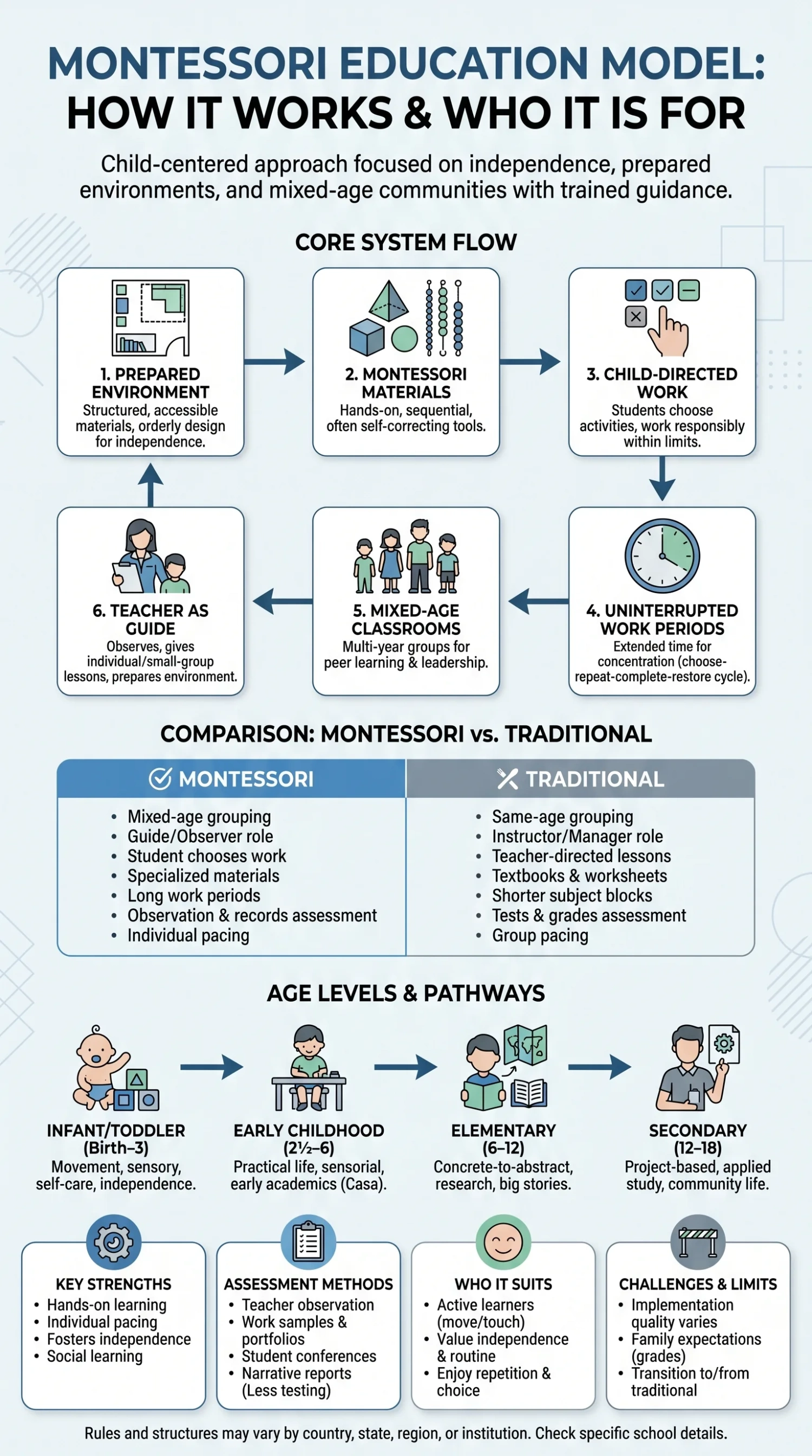
The Montessori education model organizes learning around a prepared environment, mixed-age communities, hands-on materials, guided choice, and long periods of purposeful activity. Children do not simply choose anything they want, and teachers do not withdraw from teaching. The adult prepares the classroom, gives precise individual or small-group lessons, observes progress, and directs children toward work that matches their readiness. Montessori is used from infancy through adolescence, although its best-known form is the Children’s House or Casa dei Bambini for children around ages three to six. Whether it suits a child depends on the quality of the school, the support available, the child’s needs, and the family’s expectations—not on a single personality type.
How the Montessori Model Organizes Learning
Montessori education treats the classroom as an active part of teaching. Furniture, materials, movement routes, routines, lesson timing, and social expectations are arranged so that children can do more without constant adult prompting. The environment is built for a defined developmental range and commonly includes accessible shelves, child-sized furniture, several kinds of workspaces, and materials placed in an intentional sequence. Association Montessori Internationale describes this setting as one that supports mixed-age learning, indoor and outdoor activity, concrete exploration, free choice within limits, and close observation by a trained adult.[a]
The model has five closely connected parts: a trained Montessori teacher, a multi-age class, Montessori materials, child-directed work, and an uninterrupted work period. Remove one part and the daily experience can change sharply. A room may contain low shelves and wooden materials yet still operate through whole-class assignments, frequent transitions, and adult-selected tasks. That would borrow Montessori visual cues without using much of its teaching structure.
Freedom Has Boundaries
A child may choose from suitable work that has been introduced, move purposefully, repeat an activity, work alone or with others when appropriate, and decide how long to continue. The child may not damage materials, interrupt another person’s concentration, use equipment unsafely, or treat the classroom as an unstructured play space.
Independence Is Designed, Not Assumed
A Montessori classroom does not wait for children to arrive already independent. It gives them repeated chances to develop independence through manageable actions: carrying a tray, rolling a work mat, pouring water, selecting a material, following a sequence, checking the result, cleaning the area, and returning each item to its place. The physical order reduces the number of decisions that require adult help. Predictable routines also allow children to direct more attention toward the activity itself.
This approach also changes the meaning of help. An adult may show a child how to fasten a coat rather than fastening it every day, or demonstrate how to move a chair rather than repeatedly correcting the noise. Help is meant to make later independence possible. Giving too much assistance can interrupt the child’s attempt to coordinate movement, remember a sequence, or solve a manageable problem.
Choice Follows Readiness
Choice in Montessori is usually guided choice. Children select from materials and activities available in the room, but the teacher decides what enters the environment, which lessons a child is ready to receive, and when an activity should be removed, repeated, or revisited. A child who repeatedly chooses familiar work may be allowed useful repetition, then invited to a related challenge. A child who wanders without settling may receive a short presentation or a limited choice between two suitable activities.
What Happens During a Montessori Work Cycle
The work cycle is the period in which children choose, carry out, complete, and restore activities while teachers offer lessons and observe. The American Montessori Society identifies uninterrupted work periods as one of the model’s central components. It describes typical multi-age groupings from infant and toddler environments through early childhood, elementary, and secondary levels, and recommends extended daily work periods rather than repeatedly dividing learning into short scheduled segments.[b]
| Stage of the Cycle | What the Child Does | What the Teacher May Do |
|---|---|---|
| Select | Chooses suitable work from the environment or accepts an invitation to a lesson. | Observes the choice, offers a limited choice, or invites the child to new work. |
| Prepare | Carries the material, chooses a table or mat, and arranges the pieces. | Protects the workspace and intervenes only when help or safety requires it. |
| Engage | Follows the demonstrated sequence, explores, repeats, and concentrates. | Gives individual or small-group lessons and records observations. |
| Check | Notices whether the pieces fit, the sequence is complete, or the result matches the material’s built-in feedback. | Allows self-correction where possible and offers another presentation when needed. |
| Restore | Returns every part to its original condition and puts the work back on the shelf. | Models care of the environment and helps only enough to restore order. |
| Continue | Chooses another activity, joins suitable collaborative work, or pauses briefly before restarting. | Tracks patterns across the whole cycle rather than judging one isolated choice. |
A long work period matters because concentration often develops after a child has entered the room, oriented to the environment, chosen an activity, and worked through an initial difficulty. A timetable that interrupts every activity after a few minutes can prevent this sequence from maturing. The Montessori work cycle therefore protects time for repetition and recovery after mistakes.
Repetition is not treated as wasted time. A child who repeats a pouring exercise, a sound game, or a mathematical sequence may be refining control, memory, accuracy, pace, or confidence even when the visible task looks unchanged.
The Teacher’s Work Is Quiet but Highly Active
Montessori teachers are sometimes described as guides, directresses, or facilitators. None of those terms means passive supervision. AMI explains that the teacher links the child with the prepared environment, introduces equipment when the child is ready, observes development, interprets needs, and works with an assistant who helps maintain order and support the class community.[c]
Lessons Are Brief, Exact, and Timed to the Learner
A lesson often shows one clear use of a material. The teacher may slow down hand movements, reduce unnecessary speech, isolate one difficulty, and present the sequence from beginning to end. The child then tries the activity. This differs from leaving materials unexplained and expecting discovery to do all the teaching. It also differs from giving a long verbal explanation before the learner has handled the idea.
Timing matters as much as presentation. A lesson offered too early may produce confusion. One offered too late may miss a period of strong interest. Teachers therefore watch what the child repeats, avoids, completes easily, mishandles, asks about, or observes in peers. Their records may include lessons presented, current practice, emerging mastery, concentration patterns, social participation, and possible next steps.
Correction Is Often Indirect
Many Montessori materials include a control of error: a visible, tactile, spatial, or logical feature that helps the learner notice a mismatch. A cylinder may not fit the remaining socket. A sequence may leave one piece unused. A quantity may not match its numeral. The teacher does not need to announce every mistake because the activity can return information to the child.
Indirect correction is not a rule against feedback. Teachers still intervene when the material is being misused, a misconception cannot be detected through the activity, frustration is rising, or another lesson is needed. The difference is that correction aims to preserve thought and agency rather than making the adult the only source of the right answer.
Why Montessori Materials Are More Than Wooden Toys
Montessori materials form an ordered curriculum rather than a collection selected mainly for appearance. Many isolate one quality or relationship, move from simple to more demanding work, and connect concrete action with later abstraction. Natural materials are common, but wood alone does not make an object Montessori. Its educational purpose, sequence, presentation, and relationship to other work matter more than its color or surface.
| Learning Area | Typical Forms of Work | What the Activity Develops |
|---|---|---|
| Practical Life | Pouring, spooning, fastening, washing, food preparation, plant care, and care of shared spaces. | Coordination, ordered movement, concentration, self-care, and responsibility for the environment. |
| Sensorial | Grading, matching, sorting, and comparing color, shape, dimension, texture, sound, weight, or temperature. | Perceptual discrimination, classification, precise vocabulary, and preparation for later concepts. |
| Language | Spoken-language work, sound analysis, tactile letter forms, movable alphabets, reading, writing, and grammar activities. | Sound-symbol relationships, vocabulary, composition, reading processes, and analysis of language. |
| Mathematics | Quantities, number symbols, bead materials, place value, operations, fractions, geometry, and later abstraction. | Understanding number relationships through visible quantities before relying mainly on symbols. |
| Cultural Studies | Geography, biology, history, science, art, music, and studies of human societies and the natural environment. | Connected knowledge, classification, research habits, and questions that cross subject boundaries. |
Concrete Experience Leads Toward Abstraction
A child may first build a decimal quantity with beads, compare physical lengths, trace a textured letter, or arrange geometric forms. The material makes a relationship visible and touchable. With experience, the learner no longer needs the object for every problem and can work with symbols, mental images, written algorithms, or verbal concepts. Montessori does not reject abstraction; it delays unsupported abstraction until experience gives it meaning.
Materials Have an Intended Use
Open-ended creativity exists in Montessori classrooms, especially in art, writing, research, construction, drama, music, and elementary projects. Many instructional materials, though, have a defined presentation because they isolate a particular concept. Using every item in any imaginable way can blur that purpose or make the material unavailable to another learner. Freedom applies within the educational role of the environment.
Mixed Ages Change the Social and Academic Structure
Montessori classrooms commonly group children across several ages within the same developmental stage. Younger children can observe work they have not yet received, while older children encounter chances to explain, model routines, and take responsibility. The grouping also allows lessons to be formed around readiness rather than assuming every child of one age should work on the same concept at the same moment.
Mixed ages do not guarantee harmonious peer learning. The teacher still has to protect concentration, teach social conduct, form productive groups, and prevent one child from dominating another. A school also needs enough continuity for the age span to work as intended. If enrollment patterns produce a class made almost entirely of one age, much of the peer model is weakened.
Age Bands Are Developmental, Not Universal Enrollment Rules
Montessori organizations describe common groupings, but local licensing rules, school size, public-school grade structures, and national requirements can alter the exact ages. Families should ask how the school’s actual grouping works rather than relying only on a program label.
How the Model Changes From Infancy to Adolescence
Montessori is not one preschool room enlarged for older students. The environment, degree of collaboration, type of material, use of imagination, academic organization, and relationship with the wider community change as children develop.
Birth to Age Three: Movement, Language, and Participation
AMI identifies several formats for the birth-to-three stage, including parent-and-toddler classes, Nido environments for infants who are not yet walking, and Infant Communities for mobile toddlers. These environments emphasize movement, language, belonging, practical participation, and early independence rather than preschool academic acceleration.[d]
Ages Three to Six: The Children’s House
The three-to-six environment is the form most people recognize. AMI describes the Casa dei Bambini as a setting where real-life activity, sensorial experience, movement, language, mathematics, and studies of culture are organized for self-directed discovery. Practical Life and Sensorial work are not side activities; they support the coordination and attention used in later language and mathematics.[e]
Ages Six to Twelve: Research, Imagination, and Connected Subjects
Elementary Montessori expands beyond early-childhood materials. Children work alone and in mixed-age groups, use imagination and reasoning, study subjects in connected ways, and may organize purposeful visits to community resources. AMI describes elementary environments for ages six to twelve, sometimes divided into six-to-nine and nine-to-twelve groups, with integrated study across language, mathematics, geography, history, biology, science, music, and art.[f]
The term cosmic education is often used at this stage. It refers to broad stories and studies that present the universe, life, human societies, language, and mathematics as related fields. The purpose is not to replace detailed subject knowledge with a theme. It is to give children larger questions that lead into sustained research and disciplinary study.
Ages Twelve to Eighteen: Academic Work in a Social Setting
Adolescent Montessori places more weight on social organization, practical responsibility, production, economic activity, nature, and adult-like contribution alongside academic study. AMI describes possible twelve-to-fifteen and fifteen-to-eighteen groupings, or a combined adolescent environment, with real work and shared responsibility forming part of the educational setting.[g]
Erdkinder, a German term often translated as “children of the land” or “children of the earth,” is associated with Montessori’s adolescent vision. Some programs use farms or land-based settings, while others adapt the underlying ideas through enterprises, community projects, ecological work, internships, or practical campus responsibilities. A school’s use of the word does not reveal how fully it follows the model, so the daily program needs closer examination.
How Progress Is Assessed
Montessori assessment begins with observation rather than with constant whole-class testing. Teachers look for evidence in the child’s choices, accuracy, repetition, independence, language, written work, problem-solving, collaboration, and ability to apply a lesson without immediate help. Lesson records and work samples can show where the learner is in a sequence and what presentation may come next.
This does not mean that Montessori schools never use tests, grades, written reports, portfolios, or external assessments. Practices vary by country, school type, student age, and legal requirements. A public Montessori school may need to administer the same mandated assessments as other public schools. A private program may use narrative reporting, conferences, portfolios, conventional grades, or a mixture. Secondary programs also need ways to document achievement for qualifications, transfers, or higher-education applications.
Ask How Mastery Is Documented
“We observe the children” is not a complete assessment policy. A school should be able to explain how observations are recorded, how academic gaps are identified, how families receive evidence of progress, and how support changes when a learner is not advancing.
Montessori and a Conventional Classroom Organize Time Differently
The clearest differences concern who sets the immediate task, how long work continues, how ages are grouped, and how the teacher distributes attention. The table describes common patterns rather than rules that apply to every school.
| Dimension | Montessori Pattern | Common Conventional Pattern |
|---|---|---|
| Daily lesson structure | Individual and small-group presentations occur during a longer work period. | Whole-class lessons often organize the timetable. |
| Immediate task | The learner chooses suitable work within teacher-prepared limits. | The teacher commonly assigns the same or related task to the class. |
| Pacing | Children may repeat, continue, or move ahead according to observed readiness. | Units often follow a shared schedule, with differentiation inside that schedule. |
| Age grouping | Several ages share a developmental-level environment. | One age or grade is more common. |
| Materials | Sequenced, hands-on materials often precede abstract or written work. | Textbooks, digital resources, direct instruction, projects, and manipulatives may be combined. |
| Error response | Self-correcting features, teacher observation, and later presentations are often used. | Direct teacher feedback, marking, model answers, and class review are common. |
| Movement | Purposeful movement is built into selecting and carrying out work. | Movement depends more on lesson design and classroom rules. |
| Assessment | Observation and individual progress records are central; other measures vary. | Shared assignments, tests, grades, and curriculum benchmarks are often more visible. |
Neither column describes every school, and the comparison is not a ranking. Conventional classrooms can include choice, mixed-age projects, manipulatives, long inquiry periods, and individualized instruction. Montessori schools can also use textbooks, technology, assignments, tests, and whole-group meetings when the program or local requirements call for them. The meaningful question is how the pieces work together during an ordinary week.
Who May Respond Well to Montessori
No child needs to match an ideal Montessori personality. The model may be especially supportive when a learner benefits from hands-on experience, predictable order, movement with purpose, repeated practice, choice among bounded options, and time to enter deep concentration. Children who dislike frequent transitions may find the longer work period easier to manage. Learners who move at an uneven pace across subjects may benefit when readiness, rather than a single class schedule, guides some lessons.
Socially, the mixed-age community may suit children who learn through observation, enjoy helping younger classmates, or feel less comfortable in a room where every student is compared against the same age-based task. It can also give a child several roles over time: newcomer, experienced member, model, collaborator, and leader.
- A child who returns to an activity until it feels mastered may benefit from protected repetition.
- A child who learns through touch, movement, sorting, building, measuring, speaking, and making may respond well to concrete materials.
- A child who wants some control over sequence and pace may engage more readily when choice is real but bounded.
- A child who needs calm routines may benefit from a stable environment in which materials and procedures remain predictable.
- A child who is ready for advanced work in one area and needs more time in another may benefit from lessons organized around readiness.
These are possible points of alignment, not admission criteria. A very active child may thrive when movement is purposeful. A cautious child may need time before choosing independently. A child who often seeks adult reassurance may gradually develop confidence through familiar routines. Independence is one of the outcomes the model tries to cultivate, not a trait every new student must already possess.
When Fit Depends on Extra Support or a Careful Transition
Some children need more direct prompting, more visible scheduling, shorter task intervals, explicit group instruction, sensory adjustments, communication supports, or adult feedback than a particular Montessori classroom normally provides. That does not create a universal verdict about Montessori. It creates a question about whether the school can adapt its environment and teaching without leaving the learner unsupported.
Additional Learning, Developmental, or Disability Support
A diagnosis alone cannot determine educational fit. Two schools using the Montessori name may have very different staffing, specialist access, class composition, training, sensory conditions, behavior support, and willingness to coordinate with outside professionals. Families need concrete answers about what happens during difficult moments, who delivers support, how goals are monitored, and whether accommodations are available throughout the day rather than only during selected lessons.
The prepared environment can help some learners because routines are stable, materials are visible, movement is allowed, and tasks are broken into ordered steps. The same environment can be demanding for a learner who struggles to initiate choices, filter visual information, tolerate peers moving around, or sustain independent work. Classroom observation is more informative than a general claim that Montessori is always suitable or never suitable for a particular need.
Entering Montessori After Years in Another System
Older entrants may need to learn how to choose work, manage a longer cycle, use unfamiliar materials, seek lessons, track assignments, and participate in a mixed-age community. A student accustomed to frequent grades or teacher approval may initially interpret independence as a lack of direction. Transition support should make expectations visible rather than assuming the learner will absorb them immediately.
Families Expecting Frequent Homework, Rankings, or Grades
Family expectations can create a mismatch even when the child enjoys the classroom. Parents may want weekly test scores, fixed homework quantities, class rank, rapid acceleration, or daily evidence that resembles conventional worksheets. A Montessori school may provide progress information in a different form. Before enrollment, families should compare what the school reports with what they need to understand and support learning.
How to Tell Whether a School Uses the Model Coherently
The word Montessori does not by itself describe one regulated global program. The 2023 Campbell review notes that implementation varies and that the research literature includes a range of Montessori versions. It analyzed 32 comparatively rigorous studies published from 1970 through 2020 and found positive average effects on academic and nonacademic outcomes, while also reporting variation by study design, age level, and setting.[h]
A coherent program should be able to explain how its teacher preparation, age grouping, curriculum sequence, work period, materials, observation records, student support, and local academic requirements fit together. Families should observe an ordinary classroom when possible. A staged tour can show the room; regular practice shows whether children can actually choose work, concentrate, receive lessons, collaborate respectfully, and restore the environment.
| What to Examine | Evidence to Look For | Question to Ask |
|---|---|---|
| Teacher preparation | The lead teacher has Montessori training for the age level being taught. | Which Montessori credential or training route has each lead teacher completed? |
| Work period | Children have enough uninterrupted time to choose, engage, repeat, and finish. | How long is the daily work cycle, and what normally interrupts it? |
| Mixed ages | The class contains a meaningful spread across its stated age band. | What is the current age distribution, and how long do students usually remain with the class? |
| Materials | Materials are complete, orderly, actively used, and connected to a lesson sequence. | How do teachers decide when a child receives a new presentation? |
| Choice | Children make real choices, while teachers redirect avoidance or unproductive wandering. | What happens when a child repeatedly chooses only familiar work? |
| Assessment | The school can show how observations become records, goals, support, and family reporting. | How will I know what my child can do independently and where help is needed? |
| Inclusion | Supports are specific, staffed, monitored, and available during the full school day. | Who provides accommodations or specialist support, and how is progress reviewed? |
| External requirements | The program explains how it meets local curriculum, assessment, qualification, and transfer rules. | How do students transfer out, earn required credentials, or prepare for later admissions? |
The School Matters as Much as the Label
A strong fit can fail when implementation is weak, communication is vague, or needed support is absent. A child who appears poorly matched to one Montessori program may respond differently in another with better-trained staff, a calmer room, clearer transition support, or stronger learning services.
What Research Can and Cannot Say About Outcomes
Research on Montessori is more informative than a simple collection of school testimonials, but it still requires careful interpretation. The Campbell systematic review found that Montessori students averaged about one-quarter of a standard deviation higher on academic outcomes and about one-third higher on nonacademic outcomes than comparison groups in the included studies. The nonacademic measures included self-regulation, school well-being, social skills, and creativity. The authors also found larger effects in randomized studies and in preschool and elementary samples than in older age groups.[i]
A 2025 national randomized controlled trial followed children who entered lotteries for places in 24 public Montessori schools at age three. By the end of kindergarten, children offered Montessori places had higher reading, short-term memory, theory-of-mind, and executive-function scores after baseline scores and demographic characteristics were taken into account. The study found no notable effects at the end of the first two preschool years, and only about half of the treatment group still attended Montessori in kindergarten. Its cost analysis also estimated lower per-child costs for three years of public Montessori preschool, largely because the studied programs used higher child-to-teacher ratios in the preschool years.[j]
Why the Evidence Does Not Guarantee an Individual Result
Average group differences cannot predict one child’s experience. Outcomes may depend on implementation, teacher preparation, time in the program, age of entry, peer group, family circumstances, available support, and the quality of the comparison school. Studies also measure selected outcomes at selected times. A gain in reading or executive function does not describe every aspect of student life, and it does not prove that every feature of Montessori caused the result.
The evidence is best read as support for taking Montessori seriously as an education model with promising academic and nonacademic results. It is not a reason to ignore school quality, child-specific needs, or local requirements. Research on a well-implemented public preschool cannot validate every program using the same name.
Common Misreadings of Montessori Practice
“Children Do Whatever They Want”
Children choose within a prepared set of activities and social limits. The teacher controls what is available, presents its use, watches readiness, and redirects choices when work is unsafe, disruptive, persistently avoidant, or no longer developmentally useful.
“The Teacher Does Not Teach”
Teaching is distributed across observation, environmental design, precise presentations, material sequences, conversations, small groups, records, and timely intervention. The adult may speak less to the whole class, yet make many instructional decisions during the day.
“Montessori Has No Curriculum”
The material sequences and lesson progressions create an organized curriculum. What changes is the pacing and grouping. Children are not always introduced to the same lesson on the same day, and one student’s work may look very different from a classmate’s while both follow a planned progression.
“Any Wooden Activity Is Montessori”
A commercially labeled toy may be attractive and educational without belonging to a Montessori sequence. Montessori materials have defined learning purposes, presentations, relationships with earlier and later work, and a place in the prepared environment.
“It Is Only for Preschool”
Early childhood is the most visible level, but Montessori programs also exist for infants, elementary students, and adolescents. The model changes with development; older students do more group research, writing, abstraction, community work, and organized academic study.
“It Is Only for Calm, Self-Directed Children”
Children develop self-direction through practice. Some need more transition support, more direct invitations, or a smaller set of choices at first. The relevant issue is whether the classroom can help the child move toward productive independence without withholding needed guidance.
Montessori at Home Without Recreating a Classroom
Families do not need a replica classroom or a large collection of branded materials. The most transferable ideas concern access, order, real participation, patient demonstration, and appropriate independence. A child can have a reachable place for clothing, a stable location for personal items, a small set of usable cleaning tools, and regular responsibility for tasks that matter to family life.
- Place a limited number of suitable choices where the child can reach and restore them.
- Demonstrate one routine slowly, then allow time for practice before stepping in.
- Invite participation in cooking, sorting laundry, watering plants, setting a table, cleaning spills, and organizing belongings.
- Choose real tools that are safe and manageable rather than toys that only imitate useful activity.
- Reduce unnecessary correction when the child can notice and repair a small error independently.
- Keep expectations matched to age, ability, safety, and the time available.
Home life also differs from school. Families have limited space, siblings of different ages, work schedules, and emotional relationships that are not the same as classroom relationships. The goal is not to turn the parent into a Montessori teacher. It is to make daily life more accessible and allow the child to contribute meaningfully.
A Sound Fit Decision Uses Three Sources of Evidence
A decision should bring together the child’s observed needs, the school’s actual practice, and the family’s expectations. None is enough alone. A child may enjoy hands-on learning, but the school may lack needed language support. A school may follow Montessori practice closely, but its reporting style may leave a family unable to understand progress. A family may value independence, yet the child may need a more gradual entry into long work periods.
Useful evidence comes from observing the classroom, speaking with teachers, reviewing sample progress reports, understanding the daily timetable, asking how support is delivered, and discussing how students move into later school stages. Trial visits or transition periods can help where schools offer them, but one unusually quiet or busy visit should not be treated as a complete picture.
The site is an independent informational guide and is not affiliated with any ministry of education, school authority, exam board, university, government agency, Montessori organization, accreditation body, or official ranking organization. Program rules, teacher credentials, public-school requirements, assessment policies, and admission arrangements differ by location and may change. Families making enrollment or qualification decisions should confirm current details with the school and the relevant education authority.
The most useful question is not whether Montessori is good for a broad category of children. It is whether a particular classroom can provide this child with purposeful work, suitable challenge, clear boundaries, skilled teaching, needed support, and a credible path into the next stage of education.
Sources and Verification
- [a] Montessori Environments — Supports the description of the prepared environment, mixed-age organization, accessible materials, free choice, concrete exploration, and trained-adult observation. (Association Montessori Internationale is an international Montessori education organization.)
- [b] 5 Core Components of Montessori Education — Supports the five-part description of Montessori practice, common multi-age groupings, the work-cycle sequence, and recommended uninterrupted work periods. (The American Montessori Society publishes teacher education and school-practice standards.)
- [c] Montessori Educators — Supports the explanation of the trained teacher as observer, guide, lesson presenter, and link between the child and the environment. (Association Montessori Internationale provides international training and practice guidance.)
- [d] Montessori 0-3 — Supports the description of parent-and-toddler formats, Nido environments, Infant Communities, and developmental priorities from birth to age three. (Association Montessori Internationale provides age-level program descriptions.)
- [e] Montessori 3-6 — Supports the description of the Children’s House and its Practical Life, Sensorial, language, mathematics, and cultural areas. (Association Montessori Internationale provides age-level program descriptions.)
- [f] Montessori Elementary 6-12 — Supports the elementary age range, mixed-age options, integrated subjects, group projects, research, and learning beyond the classroom. (Association Montessori Internationale provides age-level program descriptions.)
- [g] Montessori 12-18 — Supports the adolescent age range and the emphasis on academic interests, practical work, social responsibility, economics, and nature. (Association Montessori Internationale provides age-level program descriptions.)
- [h] Montessori education’s impact on academic and nonacademic outcomes — Supports the discussion of variation in Montessori implementation and the scope, dates, and composition of the 2023 systematic review. (Campbell Collaboration publishes systematic evidence reviews in social policy and education.)
- [i] Montessori education’s impact on academic and nonacademic outcomes: A systematic review — Supports the reported average effects across academic and nonacademic outcomes and the review’s findings by research design and age level. (Campbell Systematic Reviews is a peer-reviewed academic journal.)
- [j] A national randomized controlled trial of the impact of public Montessori preschool at the end of kindergarten — Supports the 2025 lottery-based public Montessori study, its school sample, kindergarten outcomes, attendance limitation, and cost analysis. (Proceedings of the National Academy of Sciences is a peer-reviewed research journal.)
Related Topics
- → Waldorf Education Model: Philosophy, Schools, and Learning Approach
- → IB Education Model: Curriculum, Exams, and Global Recognition
- → Project-Based Learning: How This Education Model Works
- → Online Learning Model: Virtual Schools, Digital Classes, and Hybrid Education
- → Homeschooling Model: How Home Education Works in Different Countries
- → Traditional Education Model: Structure, Strengths, and Limitations