Complete guide: Education Models
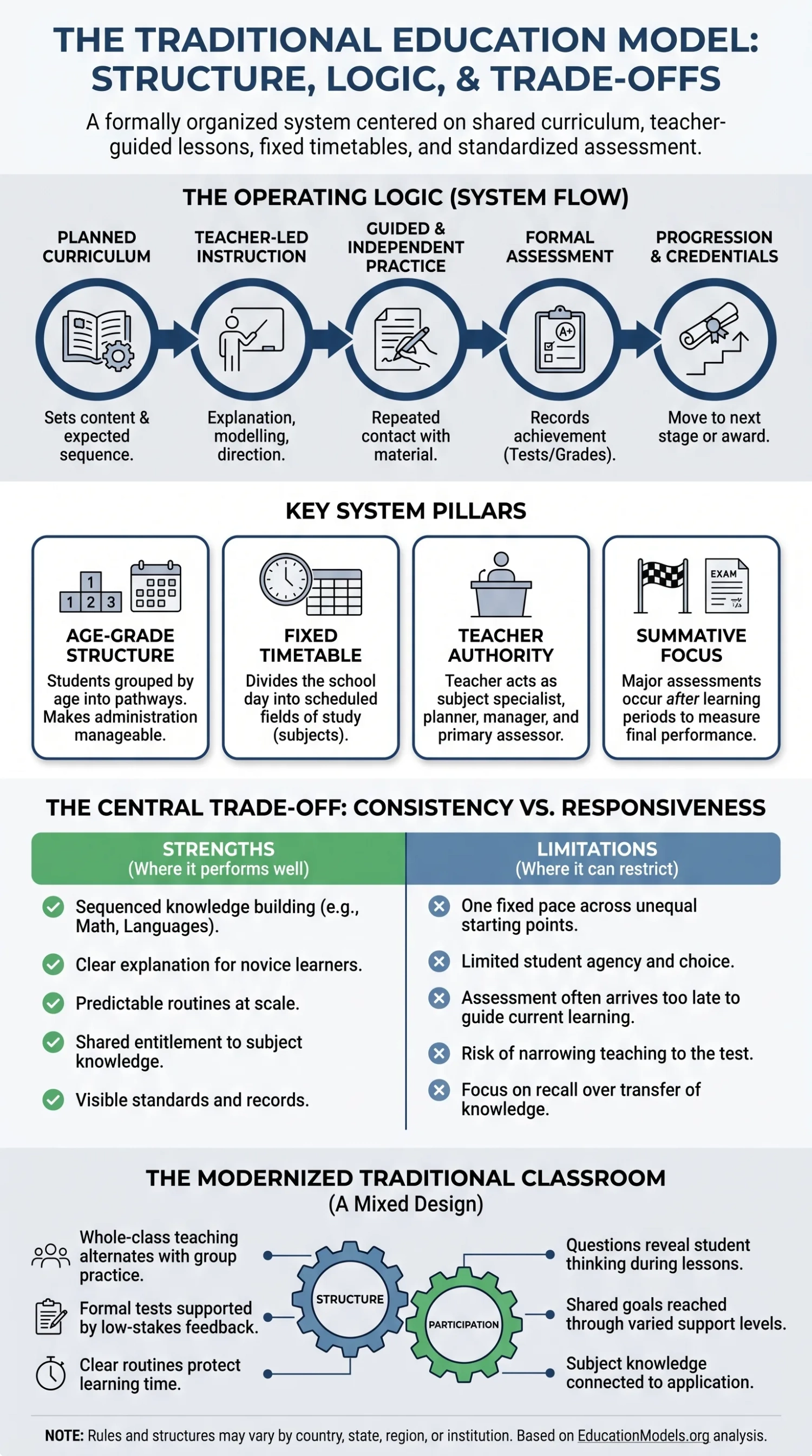
The traditional education model organizes learning around a planned curriculum, teacher-guided lessons, age- or grade-based classes, fixed timetables and formal assessment. Its main strength is coordination: a school can teach shared content to many learners through an ordered sequence. Its main limitation is the same feature viewed from another direction. A common pace, common task and common assessment may not respond well to differences in prior knowledge, language, learning needs or readiness. Traditional education is therefore best understood as a system of organization, not as a single classroom technique and not as another name for memorization.
What Makes an Education Model Traditional?
There is no universal rulebook called “traditional education.” The term describes a family of arrangements that became common in formal schooling: students are grouped into classes, subjects are divided across a timetable, teachers lead scheduled lessons, a curriculum sets expected content, and tests or graded assignments record progress. National systems differ in how centrally these arrangements are controlled, while schools differ in how strictly they apply them.
The word traditional can cause confusion because it is used for both school organization and teaching style. A school may follow an age-grade structure and a prescribed curriculum yet use discussion, experiments, projects and digital tools during lessons. Another school may give teachers wide curriculum freedom while retaining formal examinations and promotion by grade. The model appears in degrees rather than as a pure category.
Working Definition
Traditional education is a formally organized approach in which shared curriculum goals, teacher-led instruction, scheduled subject lessons, class-based progression and recorded assessment provide the main order for learning.
UNESCO’s International Standard Classification of Education does not label systems as traditional or progressive, but it helps explain the institutional side of the model. ISCED classifies formal education programmes by their place in an ordered sequence of levels, making it possible to compare primary, secondary and tertiary pathways across countries without assuming that their local school names are identical.[a]
The Operating Logic of the Model
Traditional schooling links several elements that are often discussed separately. The curriculum establishes what should be learned. The timetable allocates teaching time. The teacher turns the planned content into lessons. Practice gives students repeated contact with the material. Assessment records performance, and promotion moves learners to the next class, year or qualification stage.
UNESCO describes curriculum as the design, planning and sequencing of teaching and learning, including purposes, content, activities and the ways achievement is assessed. That broad meaning matters here. A traditional curriculum is not merely a list of topics; it connects content, order, classroom activity and evaluation.[b]
| System Element | How It Organizes Learning | Educational Benefit | Possible Cost |
|---|---|---|---|
| Shared curriculum | Sets common content and expected progression | Supports continuity across classes and schools | May leave limited room for local interests or individual pacing |
| Age- or grade-based classes | Places a group on a common yearly pathway | Makes staffing, scheduling and progression manageable | Age does not guarantee equal readiness or prior knowledge |
| Subject timetable | Divides the day into scheduled fields of study | Protects time for several academic disciplines | Can separate ideas that are better understood across subjects |
| Teacher-led lessons | Gives one person responsibility for explanation and direction | Allows orderly modelling, correction and guided practice | Can reduce student decision-making when used without participation |
| Formal assessment | Records achievement through tests, assignments and grades | Creates visible standards and progression decisions | Can narrow teaching when scores dominate other evidence |
| Promotion and credentials | Connects completed study to the next stage or award | Makes educational pathways legible to institutions and employers | May treat borderline performance as a fixed divide |
This sequence can be represented as curriculum → lesson planning → explanation and modelling → guided practice → independent work → assessment → progression. Real classrooms move backward as well as forward. A teacher may reteach a concept after an assessment, change an example during a lesson or provide extra practice before the class advances.
Inside a Traditional Classroom
A typical lesson begins with a shared objective. The teacher may recall prior knowledge, explain a new concept, demonstrate a process, ask questions and supervise practice. Students listen, respond, take notes, solve assigned tasks or read a common text. The lesson often ends with work that allows the teacher to judge whether the class is ready to continue.
Physical layout often supports this pattern. Desks may face a board or presentation area, resources are selected before the lesson, and transitions are controlled by the teacher. These features are not required in every traditional classroom, but they reflect its preference for shared attention and coordinated activity.
The Teacher’s Role
The teacher acts as subject specialist, planner, explainer, classroom manager and assessor. Good teacher-led instruction does more than transmit information. It selects examples, places ideas in a useful order, models expert thinking, checks understanding and adjusts support. Weak implementation reduces the role to uninterrupted talk and delayed marking.
The Student’s Role
Students are expected to attend, follow explanations, practise, complete assignments and demonstrate what they know. This role can involve real intellectual effort. Listening to a worked explanation, retrieving knowledge, comparing answers and practising a difficult procedure are active mental tasks even when the teacher controls the lesson. Student passivity becomes a concern when learners rarely explain, question, choose, create or apply knowledge beyond a familiar exercise.
The Place of Classroom Authority
Traditional classrooms usually make authority visible. The teacher sets routines, decides when activities begin and end, allocates turns to speak and applies behavioural rules. Clear authority can protect teaching time and make expectations predictable. It becomes restrictive when order is treated as silence, compliance replaces understanding, or students cannot challenge an interpretation respectfully.
Traditional Education Is Not the Same as Direct Instruction
Three ideas are often merged: the traditional education model, direct instruction and rote learning. They overlap in some classrooms but describe different things.
| Term | What It Describes | What It Does Not Automatically Mean |
|---|---|---|
| Traditional education model | The wider organization of curriculum, classes, timetables, teaching authority, assessment and progression | Every lesson must be a lecture or every student must learn identically |
| Direct instruction | An explicit teaching approach using clear explanation, modelling, guided practice, checking and feedback | A whole school system or a refusal to use discussion and inquiry |
| Rote learning | Repetition aimed mainly at recall, sometimes with limited attention to meaning | All memorisation, retrieval practice or factual knowledge |
OECD education material describes direct instruction and constructivist practice as two broad classroom approaches and notes that teachers commonly draw on both according to the learning goal and context. A mathematics teacher might explicitly model a new method, then ask students to compare solutions. A history teacher might provide background knowledge before students evaluate sources. The presence of teacher direction does not rule out active participation.[c]
Structure and participation are separate design choices. A lesson can be tightly sequenced and intellectually active, or loosely organized and still offer little meaningful student thought.
Where the Model Performs Well
The traditional model is strongest when shared order solves a real instructional problem. New learners often need a clear sequence. Large classes need routines. Subjects with cumulative knowledge need earlier concepts to support later work. Schools also need a dependable way to record progress and communicate what a student has completed.
Sequenced Knowledge and Cumulative Subjects
Mathematics, reading, grammar, science and second-language learning contain dependencies. A learner may struggle with algebra because fractions are insecure, or with a scientific explanation because the underlying vocabulary is missing. A planned sequence helps teachers identify assumed knowledge and reduces accidental gaps.
The benefit does not come from prescription alone. Sequence must be sensible, materials must match the curriculum, and teachers need room to slow down, revisit or extend learning. A crowded syllabus can produce superficial coverage even when its order looks logical.
Clear Explanation for Novices
Students cannot independently discover every concept efficiently. Teacher explanation is useful when a topic is unfamiliar, technical, safety-sensitive or easy to misunderstand. Modelling also makes hidden processes visible: how to plan an essay, check a calculation, pronounce an unfamiliar word or evaluate evidence.
Predictable Routines
Stable routines reduce the amount of time spent deciding what happens next. Students know where materials are, how work is submitted, when questions can be asked and what standards apply. This predictability can help younger learners and students who benefit from clear transitions. It also allows teachers to direct more attention toward explanation and feedback.
Shared Entitlement to Subject Knowledge
A common curriculum can ensure that access to history, literature, mathematics, science, arts and other fields does not depend entirely on a student’s existing interests or family resources. It gives schools a public account of what all learners should have an opportunity to study. The quality of that entitlement still depends on whose knowledge is selected, how material is updated and whether students can access it.
Delivery at School-System Scale
Common materials, lesson sequences and teacher support can help a system extend instruction across many classrooms. The World Bank’s work on structured lesson plans treats lesson materials as one part of a larger package that includes teacher training and coaching. This illustrates an important boundary: written structure may support teaching, but a script or textbook cannot replace teacher knowledge, feedback or adaptation.[d]
Where the Design Can Restrict Learning
The model’s limitations usually appear when coordination becomes rigidity. Shared goals can remain useful while the route, pace or evidence of learning needs to vary. Problems arise when the system treats common provision as proof that every learner received an equal opportunity to understand.
One Pace Across Unequal Starting Points
Students in the same class may differ in prior teaching, home language, confidence, disability, attendance and subject knowledge. A fixed pace can leave one group behind while another repeats material it has already mastered. Grade placement by age is administratively clear, but it is an imperfect measure of readiness.
The issue is not solved by lowering expectations for selected students. More responsive practice may keep the same learning goal while changing examples, time, scaffolding, reading support, task difficulty or the route used to demonstrate understanding.
Limited Student Agency
Traditional arrangements often give students little control over content, pace, method or product. This can make learning efficient when novices need direction, but constant external control may provide too few chances to plan, make decisions, monitor progress and recover from mistakes. These capacities develop through guided responsibility, not through complete freedom or complete dependence.
Assessment That Arrives Too Late
End-of-unit tests, term grades and final examinations are summative assessments: they record achievement after a period of learning. They can support certification and comparison, but they do not help much when misconceptions are discovered after teaching has moved on.
Formative assessment works during learning. Short questions, observation, low-stakes quizzes, draft feedback and student explanations help a teacher decide what to reteach or extend. OECD’s 2025 synthesis of teaching research treats assessment, feedback, cognitive engagement, interaction and classroom support as connected aspects of teaching quality rather than rival methods.[e]
Teaching to the Test
Formal tests can clarify standards, but high consequences may reshape the curriculum around what is easiest to score. Extended inquiry, oral reasoning, practical work, artistic production and collaborative problem-solving may receive less time when they carry little weight in promotion decisions. A broad curriculum can become narrow in practice even when official documents remain unchanged.
Recall Without Transfer
Memorisation is not automatically shallow. Students need vocabulary, number facts, symbols and reference knowledge available in memory. The limitation appears when recall is the endpoint. A learner may reproduce a definition but fail to recognize the concept in a new example, explain why it matters or use it to solve an unfamiliar problem.
A Better Test of Depth
Ask students to explain, compare, apply, justify or revise. These actions show whether remembered knowledge can support reasoning rather than merely repeat a familiar answer.
How Traditional Education Differs From Other Models
Education models are often presented as opposing camps, yet schools combine them. The comparison below describes typical tendencies, not fixed rules. Montessori schools differ from one another, progressive education covers several traditions, and blended learning may preserve a highly traditional curriculum while changing where practice occurs.
| Dimension | Traditional Education | Progressive Education | Montessori Education | Blended Learning |
|---|---|---|---|---|
| Main source of order | Shared curriculum, timetable and teacher planning | Experience, inquiry and purposeful activity | Prepared environment, sequenced materials and developmental readiness | Combination of classroom teaching and digital activity |
| Teacher role | Instructor, manager and assessor | Designer, facilitator and discussion leader | Observer, guide and presenter of materials | Instructor and learning coordinator |
| Student choice | Usually limited within a common lesson | Often present in questions, tasks or products | Structured choice within available work | Varies from fixed digital assignments to individual pathways |
| Pace | Mainly class-paced | May vary by project or group | Often more individual within a mixed-age setting | May combine class pace with self-paced practice |
| Assessment | Tests, assignments, grades and examinations | Observation, projects, portfolios and performance | Observation and demonstrated mastery | Teacher assessment combined with digital records |
| Recurring risk | Rigidity and weak response to learner variation | Uneven content coverage or unclear progression | Implementation demands and uneven access | Poor tool selection, unequal access or activity without learning |
The most useful comparison concerns decision-making. Who decides the learning goal, content, method, pace and form of assessment? OECD analysis of curriculum flexibility treats these as separate dimensions. A system can keep national goals while allowing teachers flexibility in pedagogy, or retain common examinations while offering students more choice in assignments.[f]
Why the Model Looks Different Across Countries
Traditional education is not a national school system with one set of ages, grades or examinations. It is a descriptive model that can appear within centralized and decentralized systems, public and private schools, selective and non-selective pathways, and both academic and vocational programmes.
A centrally governed system may prescribe content, textbooks, lesson time and national examinations. A decentralized system may let states, provinces, municipalities, districts or individual schools make many of those decisions. Both may still use class timetables, teacher-led instruction, grade promotion and formal credentials. The location of control changes, while the recognizable school form remains.
School culture also matters. In one classroom, teacher authority may coexist with frequent questioning and open discussion. In another, the same timetable and curriculum may be delivered through copying and recitation. Labels reveal less than observed practice.
The Modernized Traditional Classroom
Traditional education has not disappeared. Many schools retain common curricula, classes, timetables, teachers, grades and qualifications while changing how lessons operate. The result is often a structured but responsive classroom rather than a complete move to another model.
- Clear explanations are followed by questions that reveal student thinking.
- Shared learning goals are reached through tasks with different levels of support.
- Whole-class teaching alternates with pairs, groups and independent practice.
- Formal tests are supported by low-stakes checks and feedback during learning.
- Subject knowledge is connected to application, investigation and discussion.
- Teacher authority protects learning time while students gain bounded choices.
This mixed design avoids a false choice between order and participation. It also recognizes that methods should follow the learning purpose. Beginners may need more modelling. Students with secure background knowledge may benefit from a less directed task. A safety demonstration calls for close control; a seminar requires room for interpretation.
Technology Does Not Define the Model
Digital boards, learning platforms, tablets and artificial intelligence can all sit inside a traditional structure. A digital worksheet assigned to every student at the same time may reproduce the old lesson pattern on a screen. Technology changes the education model only when it changes decisions about access, pace, feedback, content, participation or assessment.
Generative AI in Structured Schooling
OECD data published in 2026 report that 37% of lower-secondary teachers used AI for their work in 2024. The same publication reports that 57% agreed AI can help write or improve lesson plans, while 72% believed it can harm academic integrity by enabling students to present generated work as their own. The instructional issue is therefore not simply access to AI, but whether its use produces learning, useful feedback and accountable student work.[g]
UNESCO’s global report on technology in education makes a similar distinction between availability and educational value. It examines technology through problems of access, equity, inclusion, quality and system management, and identifies access, governance and teacher preparation as conditions that shape results.[h]
How to Judge a Traditional Education Programme
The label alone cannot show whether a programme is effective. A highly ordered classroom may offer excellent explanation, rich subject knowledge and attentive feedback. It may also rely on copying, rushed coverage and tests that reveal little about understanding. Evaluation should focus on how the structure is used.
| Area to Examine | Restrictive Implementation | Responsive Implementation |
|---|---|---|
| Curriculum | Coverage is valued even when students do not understand | Content is sequenced, revisited and adjusted when evidence shows a gap |
| Teacher explanation | Long presentation with little checking or response | Clear modelling with questions, examples and guided practice |
| Student participation | Students mainly copy, repeat and wait for directions | Students explain, compare, apply and ask informed questions |
| Assessment | Grades arrive after learning and dominate decisions | Formal results are combined with feedback during learning |
| Learner differences | Identical task, pace and support are treated as fairness | Shared goals are supported through varied scaffolding and challenge |
| Classroom order | Compliance and silence are treated as evidence of learning | Routines protect concentration, dialogue and safe participation |
| Technology | Devices replace paper without changing the learning process | Tools are selected for a defined purpose and checked for learning value |
Evidence of quality should include what students can explain and apply, not only whether lessons appear orderly or examination scores rise. Attendance, course access, student work, classroom interaction, support for different needs and the quality of feedback provide a fuller view.
Independent Information Notice
This site is an independent informational guide and is not affiliated with any ministry of education, school authority, exam board, university, government agency or official ranking organization. Curriculum rules, qualifications, assessment policies and school requirements can change. Decisions about enrolment, recognition or progression should be checked with the responsible official institution.
The Central Trade-Off: Consistency and Responsiveness
Traditional education solves the problem of organizing shared learning across classes, years and institutions. It creates visible expectations, protects subject time, supports cumulative teaching and produces records that other institutions can read. These functions remain useful.
Its weaknesses appear when common structure becomes the goal rather than a means. A timetable cannot guarantee attention. A curriculum cannot guarantee understanding. A test cannot represent every form of learning, and equal time cannot remove unequal starting points. The strongest version of the model keeps a clear academic sequence while allowing teachers to respond to evidence, students to participate in thought, and assessment to improve learning before it merely records the result.
Sources and Verification
- [a] International Standard Classification of Education (ISCED) 2011 — Supports the explanation of formal education levels and internationally comparable programme progression. (UNESCO Institute for Statistics.)
- [b] Curriculum — UIS Data Browser Glossary — Supports the description of curriculum as planned content, learning processes and assessment. (UNESCO Institute for Statistics.)
- [c] Review Education Policies: Teacher Practices — Supports the distinction between direct instruction and constructivist classroom practice, including their combined use. (OECD Education GPS.)
- [d] Compendium of Structured Lesson Plans — Supports the discussion of structured materials combined with teacher training and coaching. (World Bank.)
- [e] Unlocking High-Quality Teaching — Supports the treatment of teaching quality as a combination of assessment, feedback, interaction, cognitive engagement and classroom support. (OECD.)
- [f] Curriculum Flexibility and Autonomy — Supports the analysis of flexibility in goals, content, pedagogy, assessment and learning time. (OECD.)
- [g] OECD Digital Education Outlook 2026 — Supports the cited 2024 teacher AI-use figures and the distinction between task performance and learning. (OECD.)
- [h] Technology in Education: GEM Report 2023 — Supports the discussion of access, governance and teacher preparation in educational technology. (UNESCO Global Education Monitoring Report.)
Related Topics
- → Online Learning Model: Virtual Schools, Digital Classes, and Hybrid Education
- → Project-Based Learning: How This Education Model Works
- → Waldorf Education Model: Philosophy, Schools, and Learning Approach
- → Vocational Education Model: Skills, Careers, and School Pathways
- → Montessori Education Model: How It Works and Who It Is For
- → IB Education Model: Curriculum, Exams, and Global Recognition