Complete guide: Education Models
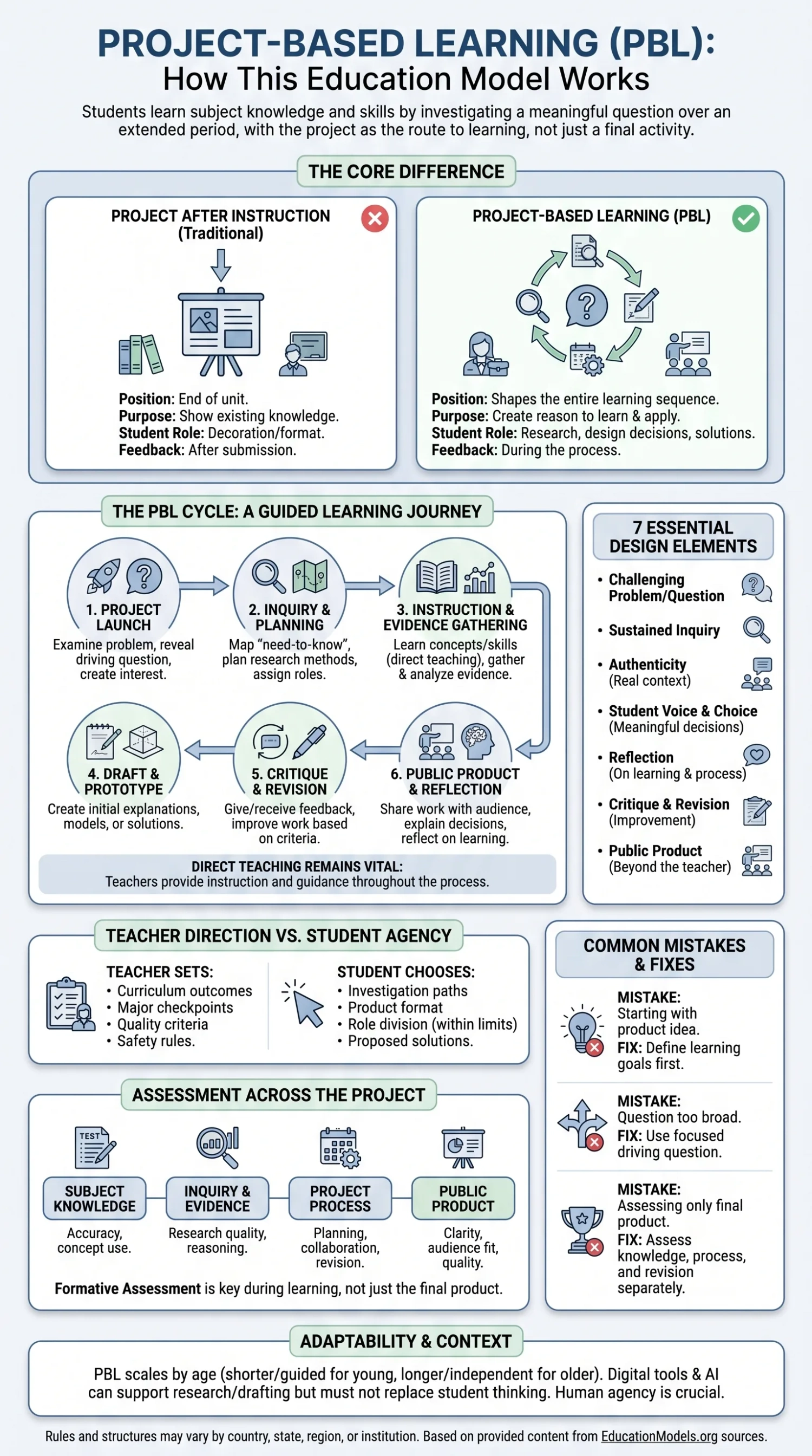
Project-based learning is an education model in which students learn subject knowledge and transferable skills by investigating a meaningful question or problem over an extended period. The project is not an activity added after the teaching has finished. It is the route through which much of the teaching, inquiry, practice, feedback, and assessment takes place. Students may produce a report, design, exhibition, campaign, experiment, performance, or policy proposal, but the visible product is only one part of the model. The deeper purpose is to make students use academic knowledge to explain evidence, make decisions, test ideas, revise work, and communicate with an audience.
What Makes a Project the Learning Process?
Many schools use projects without using project-based learning. A teacher may complete a unit on ecosystems and then ask students to make a poster. Students may create an attractive display, yet the poster mainly shows information that was taught beforehand. In a project-based unit, students might investigate why biodiversity is changing in a local habitat, study the scientific concepts needed to interpret the evidence, and prepare a conservation proposal for an audience that can respond to their findings.
The difference lies in where the learning occurs. A conventional project often follows instruction. Project-based learning organizes instruction around the project question, the inquiry it creates, and the knowledge students need to answer it.
| Feature | Project After Instruction | Project-Based Learning |
|---|---|---|
| Position in the unit | Usually appears near the end as an application or display task | Shapes the sequence of teaching and learning from the beginning |
| Main purpose | Shows information already covered | Creates a reason to acquire, use, test, and connect knowledge |
| Student decisions | Often limited to decoration, format, or presentation style | May include research questions, methods, design choices, evidence, and proposed solutions |
| Feedback | Frequently arrives after submission | Appears during research, drafting, prototyping, and revision |
| Assessment | May focus heavily on the finished product | Examines subject learning, inquiry, reasoning, process, and product quality |
| Audience | Usually the teacher or class | May include people who can use, question, or respond to the work |
A Useful Test
Remove the final product from the unit and ask what remains. If almost all subject teaching would continue unchanged, the activity may be a project assignment rather than project-based learning. If removing the project would remove the reason for the inquiry, evidence gathering, application, and revision, the project is functioning as the main learning process.
The Design Logic Behind a PBL Unit
A well-designed project begins with learning goals, not with a product idea. Teachers first identify the knowledge, concepts, methods, and disciplinary practices students must learn. They then select a problem or question that requires students to use those outcomes in a purposeful way.
PBLWorks describes seven connected project design elements: a challenging problem or question, sustained inquiry, authenticity, student voice and choice, reflection, critique and revision, and a public product. These elements surround academic knowledge and skills rather than replacing them.[a]
| Design Element | Its Function in Learning | A Weak Version |
|---|---|---|
| Challenging problem or question | Gives the unit a purpose that cannot be met through simple recall | A broad topic such as “oceans” with no problem to investigate |
| Sustained inquiry | Requires repeated questioning, research, interpretation, and application | A single internet search followed by copied facts |
| Authenticity | Connects the work to a real context, practice, audience, concern, or method | A fictional scenario that has no effect on the decisions students make |
| Student voice and choice | Allows students to make meaningful decisions within clear learning boundaries | Choosing only the font, colour, or slide template |
| Reflection | Helps students examine their learning, decisions, obstacles, and next steps | A final prompt asking only whether the project was enjoyable |
| Critique and revision | Treats the first attempt as material for improvement | Submitting one draft and receiving comments after the unit has ended |
| Public product | Asks students to explain work to people beyond the grading relationship | Displaying work where no audience will read, use, or discuss it |
From Learning Goal to Driving Question
The main project question is often called a driving question. It should be open enough to support investigation but focused enough to guide a coherent unit. A question that can be answered in one sentence will not sustain much inquiry. A question that is too broad may leave students unsure about what evidence they need.
A driving question should also lead toward the intended curriculum. An interesting question is not automatically a useful teaching question. Students may be highly engaged by designing an amusement park, for example, but the project only serves mathematics learning if the required decisions genuinely depend on measurement, scale, geometry, cost analysis, or data interpretation.
| Limited Question | Stronger Driving Question | Learning It Can Generate |
|---|---|---|
| What is recycling? | How can our school reduce the amount of recyclable material sent to general waste? | Waste audits, percentage calculations, material science, persuasive communication |
| How do earthquakes happen? | How can we design a clear earthquake-preparation plan for families in our area? | Earth science, risk interpretation, mapping, procedural writing |
| What is local history? | How can we preserve and verify community stories that are missing from the public record? | Primary sources, oral history, corroboration, archival description |
| Why is water important? | How can we measure and reduce unnecessary water use on the school site? | Measurement, data displays, environmental science, proposal writing |
How a Project Moves Through the Classroom
Projects do not need to follow an identical sequence, but most effective units move through several recognisable phases. Inquiry and revision may send students back to earlier stages, so the process is better understood as a guided cycle than as a straight production line.
| Phase | Student Activity | Teacher Activity | Evidence of Learning |
|---|---|---|---|
| 1. Project launch | Examine an event, object, dataset, case, request, or local problem | Create interest, reveal the driving question, and clarify the intended outcome | Initial explanations, questions, misconceptions, and prior knowledge |
| 2. Need-to-know mapping | Separate what is known from what must be investigated | Help students turn broad curiosity into workable questions | Question maps, initial claims, research priorities |
| 3. Planning | Choose methods, assign responsibilities, identify resources, and schedule tasks | Set checkpoints, approve feasible methods, and protect time for subject teaching | Research plans, role records, calendars, method proposals |
| 4. Knowledge and skill instruction | Learn concepts and methods needed for the next stage of the project | Teach short lessons, model procedures, address misconceptions, and provide guided practice | Practice tasks, concept checks, worked examples, short assessments |
| 5. Inquiry and evidence gathering | Read, observe, measure, interview, test, compare, calculate, or analyse | Monitor source quality, reasoning, safety, feasibility, and inclusion | Research notes, data records, source evaluations, interim explanations |
| 6. Draft or prototype | Create an early version of the explanation, product, model, or solution | Make quality criteria visible and diagnose gaps before final production | Drafts, models, diagrams, scripts, preliminary recommendations |
| 7. Critique and revision | Give, receive, select, and apply feedback | Teach students how to make feedback specific, evidence-based, and usable | Annotated drafts, revision plans, comparison between versions |
| 8. Public presentation | Share the work, explain decisions, and answer questions | Prepare the audience, protect student dignity, and assess the quality of the explanation | Product, presentation, demonstration, oral defence, audience response |
| 9. Reflection | Explain what changed in their knowledge, strategy, or judgement | Separate reflection on learning from simple opinions about enjoyment | Learning journals, individual responses, conferences, self-assessment |
Direct teaching remains part of the process. Students should not be expected to discover every concept, procedure, safety rule, or disciplinary method independently. The project creates a reason to learn; it does not remove the teacher’s responsibility to teach.
Teacher Direction and Student Agency
Project-based learning changes the teacher’s work rather than reducing it. Teachers design the unit, connect it to curriculum expectations, plan assessments, organize resources, anticipate misconceptions, manage deadlines, and decide where students need instruction. PBLWorks identifies design, curriculum alignment, classroom culture, activity management, learning support, assessment, and coaching as central teaching practices within the model.[b]
Student agency means that learners can influence meaningful parts of the work. It does not mean that every requirement becomes optional. The teacher may fix the learning goals, safeguarding rules, deadline, evidence standard, and assessment criteria while students choose an investigation route, data source, product form, proposed solution, or way of dividing responsibilities.
OECD work on cognitive engagement describes a similar balance: students can help shape questions and real-world connections, while teachers supervise the work to keep it aligned with prior learning and intended outcomes.[c] Too little choice can turn the project into a long sequence of teacher instructions. Too little direction can reward students who already know how to plan, research, and manage uncertainty.
| Usually Set by the Teacher | Possible Areas of Student Choice |
|---|---|
| Curriculum outcomes | Which sub-question to investigate more closely |
| Required evidence of individual learning | How to divide responsibilities within agreed limits |
| Safety, ethics, and source requirements | Which approved research method best suits the question |
| Major checkpoints | How to represent findings for the intended audience |
| Minimum quality criteria | Which proposed solution to develop and defend |
Group Work Without Hiding Individual Learning
Collaboration is common in PBL because many projects involve several kinds of work. It can also create one of the model’s clearest assessment problems. A polished group product does not show whether every member understands the subject, contributed fairly, or can explain the decisions behind the work.
Roles work best when they reflect the actual demands of the project. A data analyst, source verifier, prototype coordinator, interview lead, editor, or quality reviewer has a clearer responsibility than a permanent “leader” or “secretary.” Roles may rotate so that one student does not control the reasoning while others complete only routine tasks.
Teachers can make individual learning visible through personal research notes, brief conferences, individual concept questions, annotated task records, short written explanations, oral defence, and reflection on how evidence changed the student’s thinking. The group may submit one product, but the academic judgement should draw on more than that product.
One Group Grade Can Distort the Result
A shared mark may reward a student who cannot explain the work or penalize a student whose strong reasoning was weakened by group production problems. Subject understanding, individual contribution, and the shared product should be recorded through separate evidence.
Assessment Across the Project
Assessment in project-based learning should capture what students know, what they can do with that knowledge, and how their thinking develops. A final display cannot reveal all three. OECD work on assessments for complex skills argues for tasks that show performance in authentic contexts and for evidence that captures both what learners do and how they approach the work.[d]
This makes formative assessment especially useful. Formative assessment refers to checks used during learning so that teaching and student action can change before the final judgement. A source conference may reveal weak research methods. A concept question may show that students can repeat a term but cannot apply it. A prototype review may expose a design that looks plausible but conflicts with the data.
| Assessment Layer | What It Examines | Possible Evidence |
|---|---|---|
| Subject knowledge | Accuracy, concept use, explanation, method, and transfer | Short tests, oral questions, written analysis, calculations, individual explanations |
| Inquiry and evidence | Question quality, source judgement, data collection, interpretation, and reasoning | Research logs, source evaluations, method notes, data records, claim-evidence links |
| Project process | Planning, response to feedback, time management, and collaboration | Checkpoints, revision records, meeting notes, peer feedback, teacher observations |
| Public product | Usefulness, clarity, accuracy, audience fit, and quality of final decisions | Report, model, exhibition, performance, presentation, demonstration, proposal |
Rubrics Need Subject-Specific Criteria
A rubric that gives equal weight to creativity, teamwork, presentation, research, and content may hide major academic errors. The criteria should reflect the purpose of the subject. A science project may assess the validity of the method, control of variables, interpretation of uncertainty, and relationship between evidence and conclusion. A history project may examine source provenance, corroboration, chronology, contextual reasoning, and the distinction between evidence and interpretation.
Visual quality can matter when communication is part of the task, but it should not substitute for knowledge. A well-designed infographic containing inaccurate claims should not receive the same academic judgement as a less polished product supported by reliable evidence.
A Full Classroom Example: Reducing Food Waste
A food-waste project shows how several subjects can contribute to one investigation without turning the unit into a loose collection of activities. The project begins with a measurable problem: food is being discarded in the school dining area, but the amount, causes, costs, and practical responses are not yet known.
Driving Question and Intended Learning
How can our school measure food waste and develop a fair, workable plan to reduce it?
The mathematics may include sampling, units, averages, percentages, graph selection, and comparison over time. Science may address decomposition, resources, food systems, or environmental effects. Language work may include survey design, explanatory writing, interviewing, evidence-based recommendations, and oral presentation.
Inquiry and Data Collection
Students first decide what must be measured. Total weight alone may not explain the problem, so they might classify waste by food type, day, menu, serving size, or reason for disposal. They can compare direct observation with anonymous survey responses and staff interviews. The teacher checks that the sample period is long enough to support cautious claims and that data collection does not identify or embarrass individual students.
Short lessons appear when the project needs them. Students may require instruction on biased survey wording, selecting an appropriate graph, calculating percentage change, distinguishing correlation from cause, or writing recommendations that acknowledge limits in the evidence.
Prototype, Trial, and Public Product
Groups compare possible responses, such as adjusted serving options, clearer menu information, a share table where permitted, or a short awareness campaign. They evaluate cost, practicality, likely effect, and unintended consequences. A small trial can then test one proposal. Students collect a second set of data and determine whether the apparent change is large enough and consistent enough to support a recommendation.
The final work may include a data report for school leaders, a presentation to dining staff and student representatives, and communication material for pupils. The audience can question the sampling method, feasibility, or fairness of the proposal. Students must then defend their decisions with evidence rather than relying on the appearance of the product.
What the Example Reveals
The project does not replace mathematics, science, or writing instruction. It creates a shared reason to use them. The quality of the project depends on whether students learn those subjects more accurately and apply them more thoughtfully, not on whether the campaign materials look professional.
How PBL Changes by Age and Setting
The model can appear in early childhood, primary education, secondary education, vocational programmes, and higher education. The level of independence, length of inquiry, type of evidence, and public product should change with student development and prior experience.
| Setting | Typical Form of the Project | Teacher Support | Suitable Evidence |
|---|---|---|---|
| Early childhood | Short investigations based on visible objects, places, living things, or shared questions | Close modelling, guided observation, repeated discussion, and limited choices | Drawings, constructions, photographs of process, conversation, teacher observation |
| Primary education | Clearly bounded questions using selected sources, local observations, and simple data | Visual schedules, prepared source sets, explicit roles, frequent checkpoints | Models, simple reports, labelled diagrams, oral explanations, short reflections |
| Lower secondary | Longer interdisciplinary or subject-based projects with stronger source evaluation | Mini-lessons, research approval, group monitoring, individual accountability | Research files, data analysis, prototypes, reports, presentations, individual checks |
| Upper secondary | Open-ended investigations using disciplinary methods and competing explanations | Method coaching, advanced source support, ethics review, staged assessment | Extended analysis, technical products, oral defence, public presentation |
| Higher education and vocational learning | Projects resembling professional, technical, research, design, or client work | Specialist feedback, industry or community input, project supervision | Design portfolios, research reports, demonstrations, client briefs, professional presentations |
Younger students can still make real decisions, but those decisions should sit inside a narrower and more visible structure. Older students can manage broader questions only when they have been taught the necessary research, planning, subject, and collaboration skills. Age alone does not create readiness for independent inquiry.
Access, Inclusion, and Unequal Starting Points
Open-ended work can expose differences that remain less visible in tightly directed lessons. Some students have prior experience with research, public speaking, digital tools, or long-term planning. Others may have limited access to devices, quiet study space, transport, materials, or adult help outside school.
A fair project should not depend on families purchasing materials or completing the most demanding work at home. Core research, collaboration, and production time should be available during scheduled learning. Digital and printed alternatives may be needed when access differs.
- Divide long projects into visible stages with clear completion criteria.
- Provide models that show quality without giving students a product to copy.
- Offer sources in varied formats and reading levels while preserving the same academic goal.
- Teach research, discussion, planning, and feedback routines directly.
- Use individual conferences to find students whose understanding is hidden by group dynamics.
- Allow different communication formats when the format itself is not the assessed outcome.
- Plan roles so that language confidence or presentation skill does not determine who performs the intellectual work.
Choice also requires care. Giving every student the same task may restrict access, but unlimited choice can place a heavy planning burden on learners who need more structure. A bounded menu of questions, methods, or product forms can preserve agency while keeping the work manageable.
What Research Can and Cannot Support
Research findings on project-based learning should be read in relation to the design that was studied. Projects differ in subject, duration, teacher preparation, student age, assessment, group size, and the amount of direct instruction provided. Studies using the same label may therefore examine quite different classroom experiences.
A 2019 meta-analysis in Educational Research Review combined studies comparing project-based learning with conventional instruction and reported an average positive effect on academic achievement. The authors also found variation across subject and study context, which means the overall result should not be treated as a guarantee for any individual programme.[e]
A separate Education Endowment Foundation trial examined a particular cross-subject model used with Year 7 pupils in England. It found no evidence of a positive effect on literacy or school engagement and reported a possible negative literacy result for pupils eligible for free school meals. Several schools left the trial, weakening confidence in the estimate. The evaluation also recorded substantial demands on timetable design, teacher training, planning time, staffing, and school leadership.[f]
Evidence Applies to Particular Designs
A positive result from one project model does not show that any activity labelled PBL will work. A disappointing result does not show that every project-based unit fails. The useful question is which design was tested, what support teachers received, what outcome was measured, and whether the school can reproduce the conditions.
The safest interpretation is that PBL can support academic learning when projects are carefully connected to subject content, instruction, assessment, and student support. Engagement may improve in some settings, but interest alone is not proof of learning. Schools still need direct evidence that students know more, reason more accurately, and can apply what they have learned.
Common Failure Patterns and Their Fixes
| Failure Pattern | What It Produces | A Better Response |
|---|---|---|
| Starting with a product idea | An attractive activity with weak curriculum coverage | Define the learning evidence before choosing the product |
| Using a question that is too broad | Unfocused research and unrelated facts | Set a focused driving question and develop smaller inquiry questions |
| Expecting independent discovery | Misconceptions, copied information, and widening gaps | Insert explicit teaching and guided practice when students need them |
| Allowing one student to control the group | Unequal participation and hidden individual learning | Rotate meaningful roles and collect individual evidence |
| Assessing only the final product | Design quality masks weak academic reasoning | Assess knowledge, inquiry, process, revision, and product separately |
| Giving feedback after completion | Comments that cannot improve the submitted work | Schedule critique before major decisions become fixed |
| Creating a false public audience | A classroom display presented as real-world impact | Select people who can question, use, test, or respond to the work |
| Moving most production outside school | Results shaped by family time, money, equipment, or expertise | Protect school time and provide the necessary materials and access |
| Launching too many projects at once | Planning overload and inconsistent teaching | Begin with a bounded pilot and examine student learning before expansion |
Digital Tools and Generative AI
Digital tools can help students collect data, collaborate, organize sources, build models, edit media, and present work. Generative AI can also suggest research questions, reorganize notes, produce draft explanations, simulate audience questions, or propose ways to display information. These uses can save production time, but they can also remove the thinking the project was designed to reveal.
UNESCO guidance on generative AI in education calls for a human-centred approach that protects human agency, develops the ability to evaluate AI output, and gives attention to privacy, ethics, inclusion, and age-appropriate use.[g] In a PBL setting, this means AI output should be treated as material to inspect rather than as evidence by itself.
Students who use AI to generate a polished final report may produce less evidence of learning than students who submit a rougher document with traceable research and defensible decisions. Assessment can respond by examining source records, prompts where appropriate, draft history, data, revision notes, and individual oral explanations.
| Use That May Support Learning | Use That May Replace the Learning |
|---|---|
| Generating possible sub-questions for students to evaluate | Accepting generated questions without judging relevance or feasibility |
| Comparing several explanations and checking them against sources | Submitting an explanation the student cannot defend |
| Testing how a message changes for different audiences | Allowing the tool to make all communication decisions |
| Organizing student-collected data for later verification | Using invented or unverified data supplied by a tool |
| Receiving language suggestions on a student-written draft | Replacing the student’s reasoning with generated prose |
A Project Design Test
The following scale can help distinguish a project assignment from a unit in which the project genuinely organizes learning. Each dimension can be rated from 0 to 2: 0 means absent, 1 means partly developed, and 2 means clearly built into the project.
| Dimension | Question for Evaluation |
|---|---|
| Academic purpose | Does the project require students to learn and apply defined subject knowledge? |
| Problem or question | Is the work organized around a meaningful question that cannot be answered through recall alone? |
| Inquiry | Do students investigate over time by gathering, comparing, interpreting, and applying evidence? |
| Student decisions | Can students make choices that affect the intellectual direction or final response? |
| Teacher instruction | Are concepts and methods taught when students need them? |
| Critique and revision | Must students improve a draft, model, explanation, or method before completion? |
| Individual evidence | Can the teacher determine what each student understands and contributed? |
| Audience and purpose | Will the work reach people who can question, use, or respond to it? |
| Reflection | Do students examine how their knowledge, evidence, or strategy changed? |
A low score does not mean the activity has no educational value. A short model-building task, poster, experiment, or presentation may be useful without being PBL. The result simply shows whether the project is acting as the main teaching structure or as one activity within another form of instruction.
Where PBL Fits in an Education System
Project-based learning is usually one part of a wider teaching approach. Some knowledge is efficiently introduced through explanation, modelling, reading, demonstration, deliberate practice, or worked examples. Projects are most useful where learners need to connect several ideas, investigate evidence, make decisions under constraints, create something for a purpose, or communicate with an audience.
Its place can differ by curriculum, subject, age group, assessment system, timetable, teacher preparation, and available resources. A school working under tightly specified external examinations may use bounded projects within selected units. A vocational programme may organize more learning around extended design or client tasks. An early-years setting may use short shared investigations rather than long independent projects.
Whole-school adoption requires more than asking teachers to create engaging projects. Staff need shared expectations for academic quality, time to plan across subjects where necessary, access to suitable materials, reliable individual assessment methods, and agreement on how projects fit with required curriculum coverage. Starting with a limited pilot allows a school to compare intended outcomes with the work students actually produce.
The site is an independent informational resource and is not affiliated with any ministry of education, school authority, exam board, university, government agency, or official ranking organization. Schools and families should check current curriculum, assessment, safeguarding, technology, and qualification requirements with the relevant education authority or institution before relying on a particular project model.
Project-based learning is strongest when the project creates a genuine need for knowledge and students can show how that knowledge shaped their work. The finished product matters, but so do the questions, lessons, evidence, revisions, and individual explanations that produced it. A classroom has not adopted the model merely because students are busy making something. The defining evidence is that they are learning through the decisions the project requires.
Sources and Verification
- [a] Gold Standard PBL: Essential Project Design Elements — Defines the seven connected elements used in the article to explain high-quality project design. (PBLWorks specializes in project-based teaching resources and professional learning.)
- [b] Gold Standard PBL: Project Based Teaching Practices — Supports the explanation of teacher planning, curriculum alignment, activity management, learning support, assessment, and coaching. (PBLWorks publishes research-informed guidance developed specifically for PBL practice.)
- [c] Ensuring Cognitive Engagement: Unlocking High-Quality Teaching — Supports the balance between student agency, authentic purposes, prior knowledge, and teacher supervision. (OECD education publications synthesize international research and system evidence.)
- [d] Innovating Assessments to Measure and Support Complex Skills — Supports the discussion of authentic assessment and evidence about both performance and learning processes. (The OECD report examines assessment design for complex knowledge and skills.)
- [e] Revisiting the Effects of Project-Based Learning on Students’ Academic Achievement: A Meta-Analysis Investigating Moderators — Supports the account of average achievement effects and variation between subjects and study settings. (Published in the peer-reviewed journal Educational Research Review.)
- [f] Project-Based Learning – Trial — Provides the findings, limitations, implementation demands, and equity concerns from an independently evaluated Year 7 trial. (The Education Endowment Foundation commissions and publishes independent education evaluations.)
- [g] Guidance for Generative AI in Education and Research — Supports the human-centred, ethical, privacy-aware, and evaluative approach to generative AI use in project work. (UNESCO develops international education guidance with input from researchers and education systems.)
Related Topics
- → Competency-Based Education: Learning by Mastery Instead of Time
- → Montessori Education Model: How It Works and Who It Is For
- → Waldorf Education Model: Philosophy, Schools, and Learning Approach
- → Traditional Education Model: Structure, Strengths, and Limitations
- → Online Learning Model: Virtual Schools, Digital Classes, and Hybrid Education