Complete guide: Education Models
A public education model converts a legal entitlement to education into schools that can admit students, employ teachers, deliver an approved course of learning, provide support services, and report results to public authorities. The school building is the visible end of that process. Behind it sit education law, tax revenue, funding formulas, ministries or education departments, regional and local authorities, curriculum bodies, teacher licensing systems, school leaders, inspectorates, and student data systems. The exact arrangement differs by country. Some governments manage schools directly from the centre; others give wide powers to states, provinces, municipalities, school districts, boards, or individual schools. International human-rights rules place the principal responsibility for providing the right to education on states, while allowing national systems to organize delivery in different ways.[a]
What Makes an Education System Public?
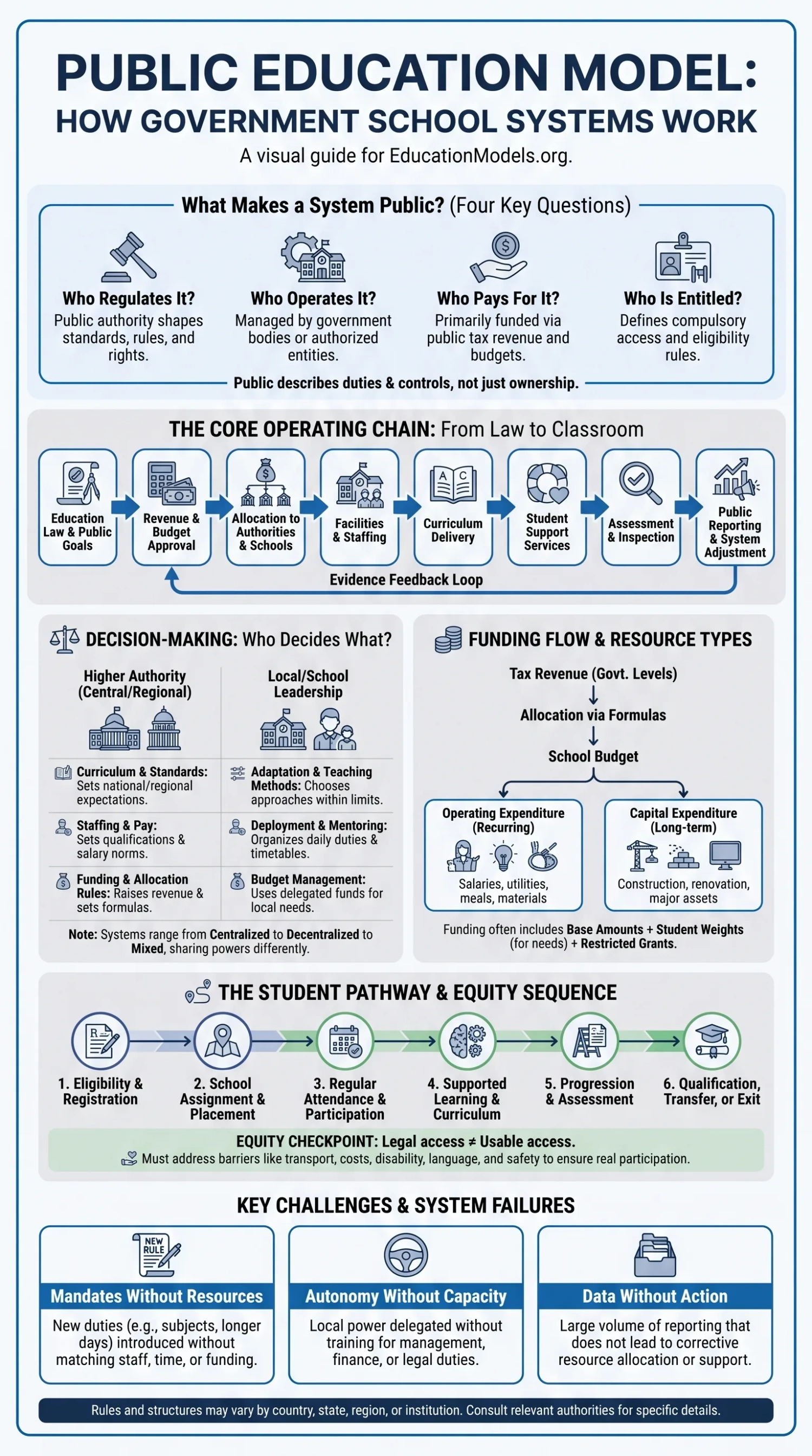
A school system is public because public authority shapes its purpose, access rules, financing, standards, and accountability. Public describes a set of duties and controls, not only the identity of the organization running a building. Government ownership of every building is not required. A country may operate traditional state schools, locally managed schools, autonomous public schools, and privately operated schools that receive public money. These arrangements belong to the same public system only when the state sets enforceable rules and remains responsible for access, quality, rights, and the use of public funds.
Four questions reveal more than the label attached to a school: Who operates it? Who pays for it? Who regulates it? Who is entitled to attend? The answers may point to different institutions. A municipality might own the building, a school board might employ the principal, a national ministry might set learning standards, and a regional authority might distribute the budget.
| School Arrangement | Operator | Main Funding Source | Public Control |
|---|---|---|---|
| Direct government school | A ministry, state department, municipality, or local authority | Public budgets | Rules, staffing, finance, admissions, and oversight may all be public |
| District or board-managed public school | A school district or governing board | National, regional, and local public revenue | Higher authorities set legal limits while the board manages local delivery |
| Autonomous publicly funded school | An independent governing body or contracted organization | Public allocation, sometimes with other permitted income | Public regulation applies even when daily management is independent |
| Fee-funded private school | A private organization | Household fees and private income, sometimes with public support | The state normally applies registration, safety, curriculum, or qualification rules |
Publicly Operated and Publicly Funded Are Different Tests
A school can receive public money without being run by a government office. It can also be government-operated while relying on several layers of public revenue. The operating body, funding source, regulatory authority, and admissions duty should be examined separately.
From Law to Classroom: The Operating Chain
Government school systems work through a chain of dependent decisions. A promise in education law has little effect unless the budget pays for staff and facilities. A funded school cannot teach reliably without qualified personnel. A national curriculum has limited force unless teachers receive time, materials, training, and usable assessments. Public accountability also depends on data that can distinguish a school-level issue from a wider funding, staffing, transport, or curriculum problem.
The Public Education Operating Chain
Education law and public goals → revenue and budget approval → allocation to authorities and schools → facilities and staffing → curriculum delivery → student support → assessment and inspection → public reporting and system adjustment.
Each link answers a different operational question. Law defines entitlement and duties. Budget decisions determine the resource ceiling. Allocation rules decide which schools receive what. Workforce systems recruit, license, place, and pay teachers. Curriculum authorities describe expected learning. School leaders organize the available people, time, rooms, and services. Assessment and inspection show what happened. The final stage should feed evidence back into funding, staffing, curriculum, and school-support decisions.
A weak result at the classroom end does not automatically identify the cause. The problem may have begun much earlier in the chain.
Who Decides What?
There is no universal division of power. A national education ministry may control the curriculum but not teacher recruitment. A state or province may issue qualifications while districts manage buildings and transport. A school may choose teaching materials yet have no authority to change class size or staff numbers. OECD work separates education decisions into areas such as instructional organization, personnel management, planning and structures, and resource management. It also shows that central authorities commonly retain planning, regulation, allocation, qualifications, accreditation, and national assessment functions, while schools often have more room over teaching methods, materials, and daily instruction.[b]
| Decision Area | Higher-Level Public Authority | Local or Regional Body | School Leadership and Teachers |
|---|---|---|---|
| Legal entitlement | Defines compulsory participation, rights, and system duties | Implements local procedures | Applies attendance and safeguarding rules |
| Curriculum | Sets national or regional learning expectations | May adapt or supplement them | Sequences lessons and chooses teaching approaches within permitted limits |
| Staffing | May set qualifications, salaries, staffing norms, or appointments | May recruit and place personnel | Organizes duties, timetables, mentoring, and classroom deployment |
| Funding | Raises revenue and sets allocation rules | Transfers funds or adds local revenue | Uses delegated budgets and identifies unmet needs |
| Facilities | Sets safety rules and may finance large projects | Plans sites, transport, construction, and maintenance | Manages daily use and reports defects or capacity pressure |
| Assessment and oversight | May run national tests, inspection, audit, or data systems | Monitors local results and support needs | Assesses students, keeps records, and carries out improvement plans |
Centralized, Decentralized, and Mixed Systems
A centralized system places more decisions with a national ministry or central agency. This can make legal standards, teacher conditions, textbooks, and examinations more consistent across the country. It may also make local adaptation slow when schools face different languages, geography, enrolment patterns, or labour markets.
A decentralized system gives more authority to states, provinces, municipalities, school districts, boards, or schools. Local bodies may respond faster to community needs, but unequal tax bases and uneven administrative capacity can produce different services. Most systems are mixed: they centralize some decisions and decentralize others. School autonomy therefore describes a range of delegated powers, not the absence of public control.
How Public Money Reaches a School
Public school funding usually begins with tax revenue collected by one or more levels of government. The money may then move through transfers before it reaches a local authority, district, board, or school. OECD analysis reports that central governments provide the largest share of initial public funding for non-tertiary education across OECD countries on average, while regional and local authorities also raise revenue and become major actors after transfers.[c]
The route matters because the institution that raises money may not be the institution that spends it. A central government can collect most revenue and distribute it according to a national formula. A local authority can add property, municipal, or other permitted revenue. A school may receive a delegated operating budget while salaries, transport, special education, or building projects remain controlled elsewhere.
Base Allocations, Student Weights, and Restricted Funds
A basic per-student amount is simple, but student numbers alone do not capture the cost of providing education. Governments may add weights for disability, socioeconomic disadvantage, language support, remote location, small-school operation, year level, or specialist programmes. They may also use separate grants for meals, transport, technology, teacher development, or building work.
Equal Amounts Do Not Always Meet Equal Rights
Two schools with the same enrolment may face very different costs. OECD analysis identifies two common ways to respond: adding weights to the regular allocation for particular student groups, or directing grants and programmes to particular students, schools, or areas.[d]
Operating and capital budgets should also be separated. Operating expenditure covers recurring costs such as salaries, utilities, cleaning, materials, meals, and routine services. Capital expenditure pays for construction, major renovation, laboratories, accessibility work, and other assets expected to serve the school over many years. A school can appear adequately funded for daily operation while its building continues to deteriorate because capital funding follows a different approval route.
Publicly funded does not always mean cost-free in every practical sense. Families may still face expenses for transport, meals, uniforms, devices, supplies, activities, or tutoring, depending on the country and school. Education Finance Watch tracks government, aid, and household spending because national budgets alone do not show the full financial burden of participation.[h]
Why School Networks Change
A government school system must decide where schools are needed, how large they should be, which programmes they should offer, and how students will reach them. Planners use birth trends, migration, housing development, enrolment records, travel time, building condition, land availability, teacher supply, and the capacity of nearby schools. A fast-growing urban area may require new campuses. A remote region with falling enrolment may need transport support, a protected small school, shared specialist staff, or consolidation.
The authority to open or close schools is often shared or conditioned by higher-level rules. OECD comparisons show that these decisions may sit with central, state, regional, or local bodies, and that enrolment projections are one reason governments create new schools or alter existing networks.[e]
Capacity planning is not only a building exercise. Opening a school without a staffing plan can create empty classrooms. Closing a school without examining transport times, disability access, local language provision, or community services can reduce practical access even when another school has available seats. Programme distribution matters too: a secondary school may have space but lack the laboratory, specialist teachers, or vocational facilities required for a particular pathway.
The Student Path Through a Government System
For a student, the system begins with eligibility and registration. The responsible authority determines which documents establish identity, age, residence, prior schooling, language needs, or eligibility for support. Admission may depend on a neighbourhood boundary, a municipality, a district assignment, family choice, available capacity, a lottery, or a regulated priority rule.
Placement is a separate decision. A student may be assigned by age, prior grade, completed credits, assessment evidence, or a review of previous records. Systems also need procedures for children whose records are missing, whose education has been interrupted, or whose previous curriculum does not align neatly with the receiving school.
A Student Passes Through Several Administrative Gates
Eligibility → registration → school assignment → grade or programme placement → attendance → progression → qualification, transfer, or exit. A barrier at any stage can limit access even when schooling is legally available.
Progression rules vary. Some systems promote students mainly by age, some require subject completion or credits, and others use examinations at transition points. Secondary education may branch into general, technical, vocational, or mixed programmes. The public system must explain how movement works between routes, which qualification each route leads to, and whether students can later transfer to another programme or higher education.
How a Curriculum Becomes Daily Teaching
A ministry or curriculum body may publish learning standards, subject programmes, approved materials, instructional time rules, or qualification specifications. Those documents describe the intended curriculum. The taught curriculum is what teachers can cover with the time, class conditions, materials, and student support available to them. The assessed curriculum is the portion examined through classroom tasks, school tests, national examinations, or sample-based studies.
These layers do not always align. An overloaded programme may force teachers to move quickly or omit depth. A narrow high-stakes examination may draw attention toward tested content. A locally designed course can satisfy national outcomes while using different examples, texts, languages, or teaching sequences. The amount of teacher discretion depends on what the system fixes centrally and what it leaves to professional judgment.
| Curriculum Layer | What It Contains | Where Variation Appears |
|---|---|---|
| Intended curriculum | Required subjects, outcomes, content, and instructional expectations | National, regional, qualification, or school-system rules |
| Written curriculum | Programmes of study, textbooks, teacher guides, and digital materials | Approved providers, local adaptation, and school selection |
| Taught curriculum | Lessons actually delivered in class | Teacher choices, available time, student needs, staffing, and resources |
| Assessed curriculum | Knowledge and skills measured through tasks, tests, projects, or examinations | Classroom, school, regional, national, or qualification-level assessment |
Teachers Determine Whether Capacity Exists
Teacher policy connects national rules with classroom supply. Governments or authorized professional bodies may set entry qualifications, licensing rules, probation requirements, salary scales, working time, and professional standards. Recruitment can be national, regional, local, or school-based. Placement may follow vacancies and applicant choice, a central assignment process, transfer rules, incentives, or temporary contracts.
A country can have enough teachers in total and still face shortages in rural areas, special education, mathematics, sciences, languages, or vocational subjects. Retention is as important as initial recruitment. Workload, leadership, pay, housing, safety, class conditions, career progression, and access to professional learning affect whether qualified staff remain.
Teacher Supply Is a System Capacity Limit
UNESCO’s Global Report on Teachers projects a worldwide deficit of 44 million primary and secondary teachers by 2030. The estimate covers both the need for additional posts and the replacement of teachers who leave, showing why workforce planning cannot be separated from access and school expansion.[f]
Professional development should connect to the work teachers are expected to perform. A new curriculum, assessment platform, inclusion policy, or digital system changes daily practice. Training that arrives without protected time, coaching, usable materials, or technical support may satisfy an administrative requirement without changing instruction.
The Services That Make Attendance Possible
Teaching occupies the centre of the school day, but attendance and learning depend on services around the classroom. Public systems may organize transport, meals, nursing, counselling, disability support, speech and language services, social work, libraries, devices, connectivity, security, maintenance, and emergency planning. Some services are school-based; others are shared across several schools or delivered by another public agency.
This division can create gaps. A ministry may control teachers while a municipality controls buses. A health agency may provide nurses. A separate unit may assess disability-related support. When responsibilities are unclear, families can face several offices for one schooling problem. Good administration identifies who authorizes a service, who pays, who delivers it, and how a school can escalate an unmet need.
One School Day Depends on Several Public Systems
Transport → attendance records → classroom teaching → meals and health support → specialist services → assessment → safe return home. A failure outside the lesson can still reduce learning time.
Assessment, Inspection, and Public Accountability
Public accountability operates at several levels. Teachers assess individual learning. Schools examine attendance, progression, behaviour, course completion, and student support. Inspectorates or local authorities may review safety, leadership, teaching, financial controls, legal compliance, and school improvement. National agencies may use examinations, sample assessments, administrative records, and audits to judge system performance.
The measure should match the question. A graduation rate says little about early reading. A national test may show subject performance but not explain why some students were absent, lacked language support, or studied in unstable staffing conditions. Inspection can identify weak processes, yet it does not by itself supply additional teachers, repair a building, or correct an unsuitable funding rule.
Upward accountability connects schools to public authorities. Public accountability gives families and communities understandable information. Professional accountability relies on standards of practice among educators. An improvement-oriented system links findings to support, deadlines, responsible officials, and follow-up. Punishment without diagnosis can move pressure downward while leaving the original system fault untouched.
Equity Is a Sequence, Not a Single Access Rule
A public place at a school is only the first step. Legal access and usable access are not always the same. The student must be able to reach the school, attend regularly, participate in lessons, receive support when barriers arise, learn the expected material, and complete a recognized stage or qualification. Legal access can exist alongside practical exclusion caused by transport, disability barriers, language, hidden household costs, unsafe facilities, weak attendance support, or a shortage of suitable programmes.
The Equity Sequence
Legal entitlement → available place → physical and financial access → regular participation → supported learning → progression → completion. Systems should examine where students leave this sequence rather than treating enrolment as the only measure.
Equity measures can include weighted funding, free meals, transport, accessible buildings, language support, special education, smaller groups, additional teaching time, devices, counselling, and alternative pathways. The correct response depends on the barrier. Giving every school the same item or amount may look equal while failing to address different needs.
When Public Funding Meets Non-State Provision
Government school systems often work with organizations outside the state. A non-state body may operate a publicly funded school, provide transport or meals, build facilities, run a digital platform, publish learning materials, offer specialist services, or support vocational training. The presence of a contractor or independent operator does not remove the state’s duty to regulate access, safety, quality, finance, and student rights.
UNESCO’s Global Education Monitoring work describes non-state participation as broader than private-school ownership and notes that publicly funded education does not always have to be publicly provided. It also calls for all institutions, students, and teachers to be treated as parts of one system, with standards, information, incentives, and accountability applying across providers.[g]
Contracts need measurable service duties, data-protection rules, access requirements, complaint routes, financial reporting, and consequences for failure. Public authorities also need enough expertise to evaluate what they buy. Outsourcing a task does not outsource responsibility for the result.
Where Government School Systems Commonly Fail
System failures often appear first as school problems. A crowded classroom may reflect old population forecasts. Missing courses may reflect teacher-allocation rules. Poor attendance may come from transport or household costs. Repeated curriculum changes may consume training time without giving schools a stable period for implementation. Diagnosis should trace the visible problem back through the operating chain.
| Visible Problem | Possible System Cause | What a Useful Response Examines |
|---|---|---|
| Overcrowded classes | Outdated enrolment forecasts, delayed construction, or rigid staffing norms | Local population data, available rooms, teacher allocation, and nearby capacity |
| Frequent teacher turnover | Temporary contracts, workload, weak leadership, remote placement, or poor retention incentives | Vacancy patterns, departure reasons, working conditions, and replacement time |
| Low attendance | Transport, health, safety, household cost, disability access, or weak follow-up | Which students are absent, when absence occurs, and which service can remove the barrier |
| Low assessment results | Curriculum overload, interrupted teaching, unmet learning needs, or assessment mismatch | Student progress over time, taught content, staffing stability, support, and test design |
| Unspent or delayed budgets | Late transfers, complex procurement, restricted grants, or limited local management capacity | Cash-flow timing, approval stages, purchasing rules, and authority to move funds |
| Services fall between agencies | Fragmented responsibility and no escalation route | Who authorizes, funds, delivers, records, and reviews the service |
Mandates Without Resources
A government may introduce a new subject, longer school day, inclusion duty, technology platform, or assessment rule without matching staff, time, facilities, and operating money. The policy then becomes an unfunded or partly funded mandate. Schools may comply on paper while reducing another service to make room.
Autonomy Without Administrative Capacity
Delegating budgets or staffing decisions can improve local response, but only when school leaders and governing bodies can manage procurement, employment law, data, safeguarding, facilities, and financial reporting. Authority without training and support can transfer risk rather than solve it.
Data Collection Without Corrective Action
Schools may submit large volumes of attendance, finance, staffing, assessment, and student-support data. The value appears only when the responsible authority can interpret the records, identify patterns, assign action, and provide resources. Repeated reporting that does not change decisions becomes administrative load.
What Families and Researchers Should Verify
A general model explains how public systems operate, but it cannot replace current national or local rules. Compulsory education ages, school-entry cutoffs, catchment boundaries, enrolment documents, curriculum requirements, examinations, qualifications, transport eligibility, and support procedures may differ by region, school type, or year.
Check the Authority Responsible for the Decision
For an individual enrolment, qualification, transfer, or support decision, consult the relevant ministry of education, state or provincial department, local education authority, school district, examination body, qualification authority, or school. The site is an independent informational guide and is not affiliated with any ministry of education, school authority, exam board, university, government agency, or official ranking organization.
The most useful official source depends on the question. A ministry may explain national law, while a district controls local registration. A curriculum authority may publish subject requirements, while a qualification body sets examination specifications. A school can confirm timetable and service delivery but may not have power to change the rule itself.
When the Model Delivers What It Promises
A functioning public education model keeps its legal duties, revenue, staffing, curriculum, services, and oversight aligned. Responsibilities are clear enough that a problem reaches the authority able to act. Funding arrives predictably and reflects different needs. Teachers are available where programmes require them. School leaders have enough discretion to organize daily work and enough support to manage public duties. Assessment identifies learning needs without reducing school quality to one score.
The classroom remains the point where students experience the system, but classroom outcomes are produced by decisions made across the chain. A school cannot permanently compensate for unreliable funding, missing personnel, unsuitable facilities, fragmented services, or unstable rules. Public education works when the wider system gives schools the capacity to turn a legal entitlement into regular attendance, supported teaching, real learning, progression, and a recognized route forward.
Sources and Verification
- [a] State obligations and responsibilities on the right to education — Supports the explanation of state responsibility and the duties to respect, protect, and fulfil the right to education. (UNESCO official right-to-education resource.)
- [b] Education organisation and governance — Supports the division of education decisions among central, regional, local, and school levels. (OECD official education governance resource.)
- [c] Governing and distributing school funding: Effectively connecting resources and learning — Supports the explanation of central, regional, and local roles in raising and transferring school funds. (OECD official publication.)
- [d] Towards equity in school funding policies — Supports the use of weighted allocations and targeted grants to respond to different student and school needs. (OECD official policy paper.)
- [e] Governing the school network: Responsive School Systems — Supports the discussion of authority over school openings, closures, programme distribution, and enrolment-led planning. (OECD official publication.)
- [f] Global report on teachers: addressing teacher shortages and transforming the profession — Supports the projected worldwide deficit of 44 million primary and secondary teachers by 2030. (UNESCO official report page.)
- [g] Non-state actors in education — Supports the distinction between public funding and public provision and the need for oversight across providers. (UNESCO Global Education Monitoring Report.)
- [h] Education Finance Watch 2024 — Supports the use of government, aid, and household spending data when assessing education finance. (World Bank publication produced with UNESCO partners.)
Related Topics
- → Private Education Model: Schools, Fees, Curriculum, and Access
- → Education Systems Around the World: How School Systems Differ by Country
- → United States Education System: Grades, Schools, and College Pathways
- → Canada Education System: Provinces, Schools, and Higher Education
- → Compulsory Education Age by Country: How Long Students Must Attend School