Complete guide: Education Systems
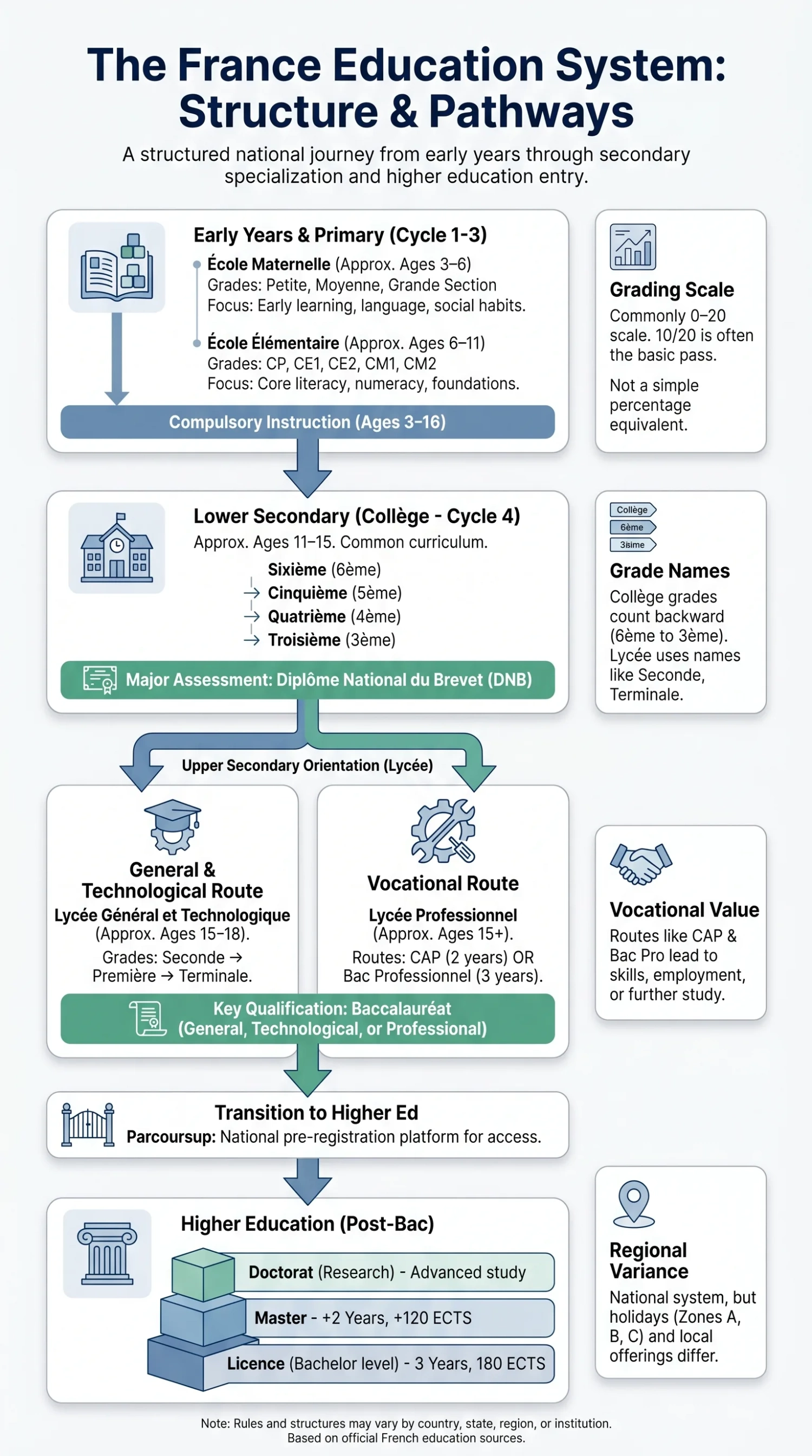
The France education system begins with compulsory education at age three, moves through nationally defined school stages, and reaches its first major branching point after 3e, the final year of collège. Students then enter a general and technological lycée or a vocational route. The Diplôme national du brevet marks the end of collège, the baccalauréat completes upper secondary education, and Parcoursup handles applications to many post-bac programmes. French higher education is broader than the university sector: BTS, BUT, CPGE, grandes écoles and specialist schools sit beside the licence–master–doctorat structure.
The clearest way to read the system is as a sequence of transitions rather than a list of institutions. Class names such as CP, 6e and terminale identify a student’s place in that sequence, while national diplomas and orientation decisions determine which options open next.
The Student Route From Maternelle to Higher Education
| Typical Age | French Stage | Classes or Years | Main Transition |
|---|---|---|---|
| 3–5 | École maternelle | Petite section, moyenne section, grande section | Preparation for elementary learning |
| 6–10 | École élémentaire | CP, CE1, CE2, CM1, CM2 | Progression into collège |
| 11–14 | Collège | 6e, 5e, 4e, 3e | DNB and orientation toward lycée |
| 15–17 | Lycée | Seconde, première, terminale | Baccalauréat or vocational qualification |
| 18+ | Enseignement supérieur | BTS, BUT, licence, CPGE, schools and other programmes | Degree, diploma or professional qualification |
These ages are typical rather than fixed placement rules. A student may be older or younger because of a birth date, an accelerated or repeated year, a previous school record abroad, or an individual placement decision. French class numbering can also confuse readers: collège starts with 6e and counts down to 3e, then lycée continues with seconde, première and terminale. [a]
Two Different Obligations
Instruction is compulsory for children residing in France from age 3 until age 16. From 16 to 18, a separate obligation de formation requires young people to remain in education, training, an apprenticeship, employment or another recognised support route. The two rules should not be described as a single school-attendance requirement lasting to age 18. [b] [c]
A National System Delivered Through Académies
France uses national curricula, nationally recognised diplomas and central rules for major examinations. Administration is distributed through 18 régions académiques, 30 académies and departmental education services. An académie is not a university or a group of elite schools; it is an administrative area led by a rectorat that applies national education policy within its territory. [d]
Local and regional authorities also have defined roles. Communes are closely associated with primary-school premises, départements with collèges, and régions with lycées. This division affects buildings, equipment, transport and local provision, while the state retains control over matters such as national programmes, teacher status and national qualifications.
Public education is the main route, but private schools operate in two different legal categories. Schools sous contrat have an agreement with the state and follow tighter public requirements. Schools hors contrat do not have that agreement, though they remain subject to opening rules, inspection and the duty to provide the common base of knowledge and skills. “Private school” therefore does not describe one uniform relationship with the French state. [e]
Primary Education Is Organised by Cycles, Not Only by Classes
École Maternelle: Petite, Moyenne and Grande Section
École maternelle is the first stage of compulsory education, not an optional preschool attached loosely to the formal system. It usually covers petite section, moyenne section and grande section. These three years form Cycle 1, where oral language, early literacy, number sense, movement, artistic activity and learning to work within a group prepare children for elementary school.
École Élémentaire: CP to CM2
Elementary school contains five class levels: CP (cours préparatoire), CE1, CE2, CM1 and CM2. CP, CE1 and CE2 form Cycle 2. CM1 and CM2 begin Cycle 3, which continues into 6e, the first year of collège. This cross-school cycle is a distinctive feature: the transition to collège occurs inside the same pedagogical cycle rather than at its end. [f]
French and mathematics occupy a central place in elementary education. Pupils also study a modern language, physical education, arts, science-related topics, history, geography and moral and civic education. National programmes define expected learning, but teachers decide how to organise lessons and classroom activities within those requirements.
Collège Keeps a Common Route Until the End of 3e
Collège covers four years: 6e, 5e, 4e and 3e. Most students continue through a shared lower-secondary curriculum before choosing a lycée pathway. The first year, 6e, completes Cycle 3. The remaining years form Cycle 4, where subject teaching becomes more specialised and orientation work grows in importance.
The curriculum includes French, mathematics, history-geography, moral and civic education, modern languages, science, technology, arts and physical education. From the 2026–2027 school year, the new French programme for Cycle 4 starts in 5e, then extends to 4e in 2027–2028 and 3e in 2028–2029. The staged introduction matters because students in different collège years may temporarily follow different programme versions. [g]
The Diplôme National du Brevet in 2026
At the end of 3e, school candidates take the Diplôme national du brevet, commonly called the brevet or DNB. From the 2026 session, the former 800-point calculation is replaced by a final average out of 20. Annual results in compulsory 3e subjects account for 40%, and final examinations account for 60%. A final average of at least 10/20 is required for the diploma. The final assessment includes written examinations and an oral examination. [h]
The Brevet Does Not Decide Entry to Seconde
Passing the DNB is not a legal condition for progression into seconde. The move to lycée continues to depend on the orientation and class-council process. A student can therefore be admitted to seconde without having obtained the brevet.
The Decision After 3e Creates Three Main Lycée Routes
During 3e, students and families express orientation preferences, teachers assess progress and suitability, and the school’s class council issues proposals. Placement also depends on the requested programme and available capacity. The choice is not made by the brevet score alone.
| Route After 3e | Main Structure | Typical Qualification | Usual Next Options |
|---|---|---|---|
| General route | Seconde générale et technologique, then première and terminale générale | Baccalauréat général | University, CPGE, selective schools and other post-bac programmes |
| Technological route | Common seconde, then one of the technological series | Baccalauréat technologique | BUT, BTS, university and specialist schools |
| Vocational route | Lycée professionnel or apprenticeship with occupational teaching and workplace learning | CAP, baccalauréat professionnel or BNMA | Employment, BTS and other further study routes |
General and Technological Lycée
Students entering seconde générale et technologique follow a common first year before moving toward the general route or a technological series. In the general route, students normally choose three specialty subjects in première and continue two of them in terminale. In the technological route, the student enters one of eight series, including STMG, STI2D, ST2S, STL, STD2A, STHR, S2TMD and STAV. Each combines general subjects with applied study in a defined field. [i]
The technological route should not be treated as a weaker version of the general baccalauréat. It is organised around areas such as management, industrial technology, laboratory sciences, health and social sciences, design, hospitality, performing arts or agriculture. Its programmes often lead naturally toward applied higher education, especially BUT and BTS, while other destinations remain possible.
Vocational Lycée, CAP and Apprenticeship
The vocational route combines general education with occupational subjects and periods of workplace training. A CAP usually prepares for a specific occupation and direct entry to work, though further study remains possible. The baccalauréat professionnel is normally prepared over three years after 3e and can lead either to employment or to post-secondary study, especially a BTS. Programmes may be followed in a lycée professionnel or through apprenticeship arrangements that divide learning between an education provider and an employer.
From the start of the 2026–2027 school year, the Brevet national des métiers d’art (BNMA) adds a three-year arts and crafts route after 3e leading to a qualification at baccalauréat level. It sits alongside the CAP and bac professionnel rather than replacing them. [j]
How the Baccalauréat Is Built and Assessed
France has three main forms of the baccalauréat: general, technological and professional. The word bac may refer to the diploma, the examination process or the school-leaving level itself. Holding a bac normally gives access to higher education, but it does not guarantee admission to every programme.
| Baccalauréat | Educational Emphasis | Assessment Pattern | Common Post-Bac Direction |
|---|---|---|---|
| General | Broad academic study shaped by specialty subjects | Continuous assessment plus national final examinations | Licence, CPGE, selective schools and other programmes |
| Technological | General study combined with an applied technological field | Continuous assessment plus national final examinations | BUT, BTS, licence and specialist schools |
| Professional | Occupational preparation, general subjects and workplace training | Rules vary by subject units, school-based assessment and examinations | Employment, BTS and related further study |
For the general and technological baccalauréats, continuous assessment supplies 40% of the final result and terminal examinations supply 60%. Terminal assessment includes anticipated French examinations, two specialty examinations in terminale, philosophy and the Grand oral. A student without optional subjects has coefficients totalling 100: 40 from continuous assessment and 60 from terminal examinations. [k]
Mathematics Became an Anticipated Examination
Students in première générale and première technologique now take an anticipated written mathematics examination at the end of the year, beginning in the 2025–2026 school year for the 2027 bac session. The examination is two hours, marked out of 20, has coefficient 2 and is taken without a calculator. [l]
A final average of 10/20 is the normal pass level. Candidates with a first-group result from 8/20 up to but below 10/20 may enter oral control examinations under the applicable rules. Mentions recognise higher first-group results: assez bien, bien, très bien, and très bien avec les félicitations du jury. These labels describe examination performance; they are not separate diplomas. [m]
Parcoursup Connects the Bac to Many Post-Secondary Programmes
Parcoursup is a national application platform, not a single university entrance examination. It is used for many first-year post-secondary programmes, including university licences, BTS, BUT, CPGE and numerous school-based courses. Applicants create a file, choose programmes, provide the requested academic and personal information, and respond to offers during the admission period.
Each programme publishes its expected profile and file-review criteria. A commission, usually made up mainly of teaching staff, examines applications against those criteria. School reports, grades, subject choices, teacher comments, the applicant’s study plan and programme-specific documents may all be considered. The platform coordinates applications and offers; the institutions still evaluate the files. [n]
The calendar changes each year. In the 2026 cycle, candidates could create files and submit main-phase wishes from 19 January to 12 March, with additional time to complete and confirm files by 1 April. The main admission phase ended in July, while a complementary phase continued into September. Readers applying in another year should check the live official calendar rather than reuse earlier dates. [o]
Admission Is Not Identical Across Higher Education
A licence, a BTS, a BUT, a CPGE and a specialist school may all appear on Parcoursup, but they do not use one common selection rule. Some programmes are selective, some manage capacity through file review and support conditions, and some require portfolios, interviews, auditions or additional procedures.
Higher Education Extends Beyond the University Licence
French higher education combines universities, courses taught in lycées, university institutes of technology, grandes écoles and specialist institutions. The route a student chooses affects teaching style, selectivity, professional focus and the qualification awarded.
| Programme | Normal Length | Qualification or Result | Main Character |
|---|---|---|---|
| BTS | 2 years | Brevet de technicien supérieur, 120 ECTS | Professionally focused course, often taught in a lycée |
| BUT | 3 years | Bachelor universitaire de technologie, 180 ECTS | Applied university programme delivered through an IUT |
| Licence | 3 years | National licence, 180 ECTS | University first-cycle degree |
| CPGE | Usually 2 years | Preparatory study with recognised ECTS, not usually a stand-alone final diploma | Preparation for competitive admission to grandes écoles |
| Grande école programme | Varies, often to bac+5 | School diploma, sometimes carrying a state-recognised grade | Selective academic or professional education |
| Master | 2 years after licence | National master, 120 further ECTS | Advanced academic or professional specialisation |
| Doctorat | Usually 3 years after master | Doctoral degree | Research training and thesis |
The BTS is short, specialised and closely linked to employment. The BUT lasts three years and is taught in an institut universitaire de technologie (IUT). A CPGE, usually located in a lycée, prepares students for competitive entrance routes to grandes écoles. Grandes écoles include engineering, business and other specialist institutions, but entry is not limited to the traditional CPGE route; admissions may also exist after a BUT, BTS, licence or integrated preparatory programme. [p]
Licence, Master, Doctorat and ECTS
The university structure follows the LMD sequence: licence, master and doctorat. A national licence normally represents six semesters and 180 ECTS. A national master adds four semesters and 120 ECTS, bringing the cumulative total to 300. Doctoral study usually follows a master or an equivalent recognised qualification and centres on supervised research and a thesis. ECTS records academic workload and supports transfer and recognition; it is not a mark of how difficult a course is. [q]
Admission to the first year of a national master is commonly handled through Mon Master, a separate national platform. This means Parcoursup should not be treated as the universal application system for every level of French higher education. [r]
International Students Use Different Entry Procedures
Children Entering a French School From Abroad
A child arriving from abroad is not placed only by age. At primary level, children aged six or older may have their school knowledge assessed to determine the appropriate class. At collège or lycée, previous schooling and current academic level are considered, and newly arrived students who need intensive French may receive support through a UPE2A unit while also joining ordinary classes. [s]
Applying to French Higher Education From Another Country
There is no single application route for every international applicant. The procedure depends on nationality, country of residence, previous diploma and intended programme. An applicant may use Parcoursup, the Études en France procedure, a prior admission request, Mon Master or a direct institutional application. Language evidence and document requirements also vary by course. [t]
Verify the Live Rule Before Applying
Exam arrangements, admission calendars, programme capacity and international application procedures can change. Applicants should confirm the current requirement with the relevant ministry, examination authority, platform, school or university before making an academic, financial or immigration decision.
This site is an independent informational guide and is not affiliated with any ministry of education, school authority, exam board, university, government agency or official ranking organisation.
Reading French School and Qualification Terms Correctly
| French Term | Meaning in the System | Frequent Misreading |
|---|---|---|
| Collège | Lower-secondary school, covering 6e to 3e | It does not mean a university college |
| Lycée | Upper-secondary school | It is not a post-secondary institution |
| Brevet | National diploma taken at the end of collège | It does not by itself determine entry to seconde |
| Baccalauréat | Upper-secondary leaving diploma and examination route | It is not the same as a university bachelor’s degree |
| Licence | Three-year university degree worth 180 ECTS | It is the French first-cycle degree, despite the English meaning of “licence” |
| Bachelor | A label used by many schools for varied programmes | The name alone does not prove national-diploma or grade status |
| Grande école | A selective school category with varied missions and admission routes | It is not simply another term for a private university |
| Parcoursup | National application and offer-management platform for many post-bac courses | It is not one national entrance test |
Recognition also requires careful reading. A diplôme national, a diploma carrying the grade de licence or grade de master, a diplôme visé and an RNCP registration describe different forms of recognition. A private school’s use of the words “bachelor” or “master” does not automatically give the qualification the status of a French national licence or master. Prospective students should check the exact recognition attached to the named programme, not only the marketing label. [u]
Sources and Verification
- [a] Table of School System Structure — Maps the official school stages and typical ages from nursery school through upper secondary education. (Éduscol, Ministry of National Education.)
- [b] Instruction obligatoire — Confirms compulsory instruction from age 3 through age 16 for children residing in France. (Service-Public.fr, the French government public-information service.)
- [c] L’obligation de formation — Explains the separate education, training or support obligation applying to young people aged 16 to 18. (Éduscol, Ministry of National Education.)
- [d] Les régions académiques, académies et services départementaux de l’Éducation nationale — Verifies the territorial administration through 18 régions académiques, 30 académies and departmental services. (French Ministry of National Education.)
- [e] Les établissements d’enseignement scolaire privés — Explains the distinction and state controls applying to private schools under contract and outside contract. (French Ministry of National Education.)
- [f] Programmes et horaires à l’école élémentaire — Defines Cycles 1 to 4 and confirms that Cycle 3 joins CM1, CM2 and 6e. (French Ministry of National Education.)
- [g] Les programmes du collège — Gives the staged introduction schedule for the new Cycle 4 French programme from September 2026. (French Ministry of National Education.)
- [h] Le diplôme national du brevet — Sets out the 2026 DNB calculation, 10/20 pass level, examination structure and the rule that the brevet is not required for progression to seconde. (French Ministry of National Education.)
- [i] L’orientation en seconde générale et technologique — Confirms the three-to-two specialty pattern in the general route and the eight technological series. (French Ministry of National Education.)
- [j] La voie professionnelle au lycée — Describes CAP and bac professionnel routes and the BNMA introduced from the 2026 school year. (French Ministry of National Education.)
- [k] Comment calculer votre note au baccalauréat — Verifies the 40% continuous-assessment and 60% terminal-examination weighting for the general and technological bac. (French Ministry of National Education.)
- [l] Épreuve anticipée de mathématiques en classe de première pour l’année scolaire 2025-2026 — Provides the duration, coefficient, marking and calculator rule for the new anticipated mathematics examination. (French Ministry of National Education.)
- [m] Tout savoir sur le baccalauréat, les réponses à vos questions — Verifies the pass threshold, oral control range and main examination components for the baccalauréat. (French Ministry of National Education.)
- [n] Comment les formations examinent les candidatures ? — Explains institutional application-review commissions and published assessment criteria. (Official Parcoursup platform.)
- [o] Calendrier Parcoursup 2026 — Supplies the official application and admission dates for the 2026 Parcoursup cycle. (Official Parcoursup platform.)
- [p] Finding the Program for You Is Easy — Outlines BTS, CPGE, university degrees and other routes within French higher education. (Campus France, the national agency supporting French higher education abroad.)
- [q] La reconnaissance des diplômes dans l’Union européenne — Confirms 180 ECTS for the licence, 120 further ECTS for the master and the LMD credit sequence. (French Ministry of Higher Education.)
- [r] Mon Master — S’informer, candidater, se décider — Identifies Mon Master as the national platform for applications to the first year of programmes leading to the national master. (Official Mon Master platform.)
- [s] Scolarisation au collège ou lycée d’un élève venant de l’étranger — Explains placement and French-language support for pupils arriving from another country. (Service-Public.fr, the French government public-information service.)
- [t] Étudiants étrangers : inscriptions dans l’enseignement supérieur français — Shows how application procedures vary by nationality, residence, previous diploma and intended study. (French Ministry of Higher Education.)
- [u] Labels des formations contrôlées par l’État — Clarifies that state-controlled labels apply to authorised programmes rather than automatically to every course offered by an institution. (French Ministry of Higher Education.)
Related Topics
- → Netherlands Education System: Schools, Tracks, and Learning Pathways
- → Japan Education System: Schools, Exams, and Student Life
- → Finland Education System: How Schools Work in Finland
- → South Korea Education System: Schools, Exams, and Academic Pressure
- → Canada Education System: Provinces, Schools, and Higher Education
- → Germany Education System: Schools, Tracks, and Vocational Pathways