Complete guide: Education Systems
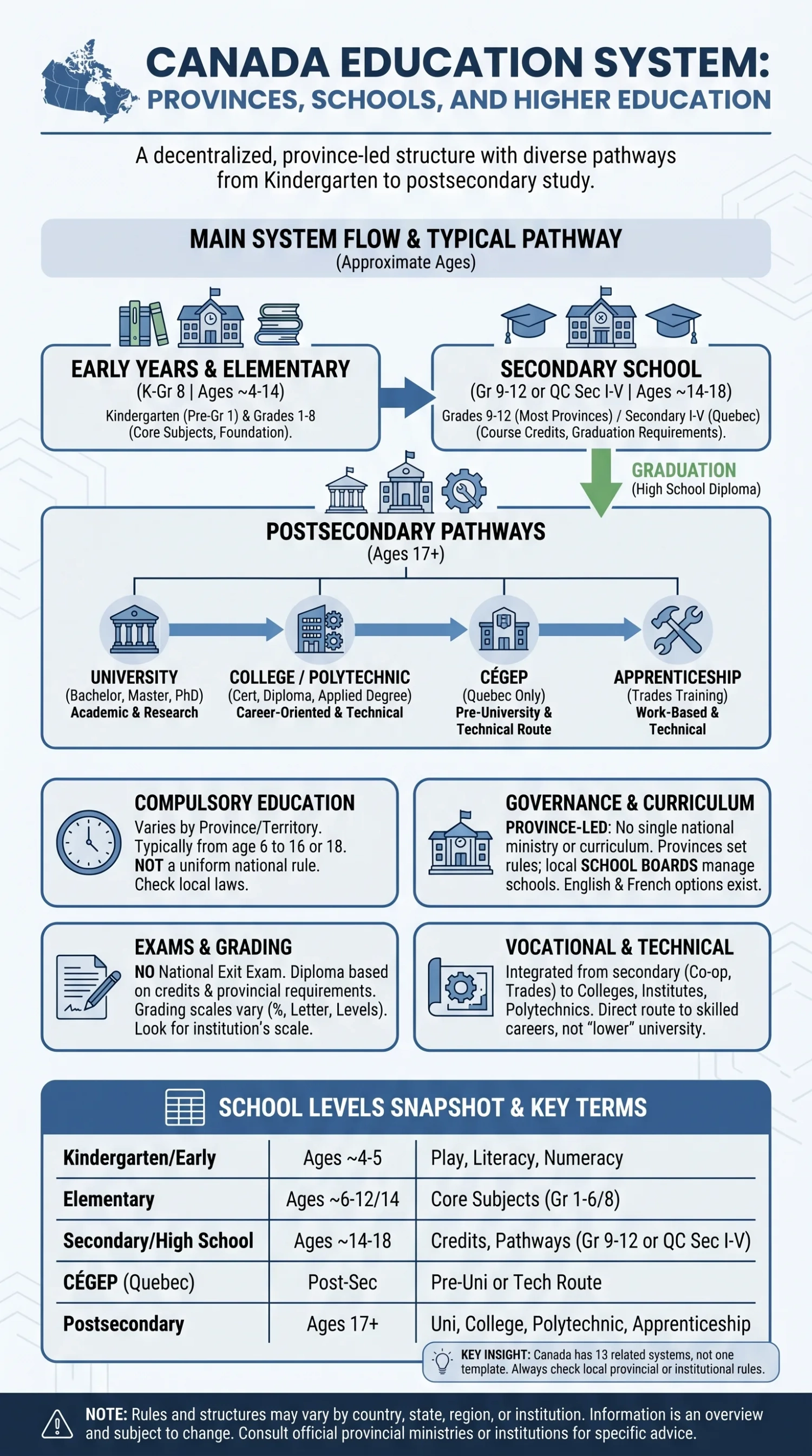
The Canada education system is not run as one single national school system. Education is mainly organized by Canada’s 10 provinces and 3 territories, which means school ages, curriculum details, graduation rules, language options, and postsecondary pathways can vary by location. Even with these differences, the usual route is clear: children move through Kindergarten or early years, elementary school, secondary school, and then choose among university, college, CÉGEP in Quebec, vocational training, apprenticeships, or work.
How the Canada Education System Works
Canada is a federal country, but education is not controlled by one federal ministry of education. Provinces and territories have the main legal responsibility for education, and they set many of the rules that shape schools and postsecondary institutions. The Council of Ministers of Education, Canada explains that Canada’s education structure is province-led, with compulsory schooling ages and school organization varying across jurisdictions.[a]
This province-led model affects daily school life. A student in Ontario, British Columbia, Alberta, Quebec, Nova Scotia, Yukon, or Nunavut may follow a similar broad path, but the exact curriculum documents, report cards, course codes, graduation credits, school board rules, and language options may not be identical.
For readers comparing Canada with more centralized systems, the most useful starting point is this: Canada has shared patterns, not one national school template. Elementary and secondary education are usually public, locally administered, and province-regulated. Higher education is also province-regulated, with universities, colleges, institutes, polytechnics, and specialized schools offering different credentials.
A Practical Way to Understand the System
Think of Canada as 13 related education systems rather than one uniform system. The national picture is useful, but exact decisions about enrolment, graduation, course selection, language of instruction, or university admission should always be checked in the relevant province, territory, school board, school, college, or university.
School Levels and Typical Ages
Most Canadian students move through Kindergarten, elementary school, and secondary school before graduating with a high school diploma or a province-specific equivalent. Canada.ca notes that schools usually start with Kindergarten and continue through Grades 1 to 12, while also explaining that the start and finish points depend on the province or territory.[b]
| School Level | Typical Age | Typical Grade/Year | What It Usually Covers |
|---|---|---|---|
| Kindergarten / Early Years | About 4–5 | Pre-Grade 1 | Early literacy, numeracy, social development, routines, play-based learning, and preparation for formal schooling. |
| Elementary School | About 6–12 | Often Grades 1–6 or 1–8 | Core subjects such as language, mathematics, science, social studies, arts, health, and physical education. |
| Middle School / Junior High | About 11–14 | Often Grades 6–8, 7–8, or 7–9 | A transition stage in some provinces or school boards, with broader subject exposure and more subject-specialist teaching. |
| Secondary School / High School | About 14–18 | Often Grades 9–12 | Compulsory and elective courses, graduation credits, academic preparation, career pathways, and sometimes technical or vocational options. |
| Quebec Secondary School | About 12–17 | Secondary I–V | Quebec students generally finish secondary school after Secondary V, then often move to CÉGEP before university or technical study. |
| Postsecondary Education | Usually 17+ | After secondary graduation | University, college, institute, polytechnic, CÉGEP, apprenticeship, certificate, diploma, degree, or other training routes. |
The table gives a useful national pattern, not a rule for every child. Some provinces use middle schools; others move directly from elementary to high school. Quebec has its own structure, where students normally finish secondary education earlier than students in many other provinces and then move into CÉGEP, a college-level stage that can prepare students either for university or technical employment.
Compulsory Education
Compulsory education in Canada is set by province or territory. CMEC states that most provinces and territories require school attendance from about age 6 to age 16, while some start compulsory schooling at age 5 and others extend it to age 18 or to graduation from secondary school.[c]
This is why a single sentence such as “Canadian children must attend school from age 6 to 18” is too simple. It may describe a broad expectation, but it does not capture local law. A family moving to Canada needs to check the exact age rules, school calendar, residence requirements, and enrolment process in the province or territory where the child will live.
Compulsory education means the legal duty to receive schooling. It is not exactly the same as the full school pathway that most students follow. Many children attend Kindergarten before compulsory schooling begins, and many students continue beyond the minimum leaving age to earn a high school diploma.
Academic Year and Grade Structure
The Canadian school year usually runs from late August or September to June, with schools operating Monday to Friday during the school year, apart from holidays. Canada.ca describes this as the common pattern while still pointing readers back to the province, territory, ministry, department, or school board for local details.[d]
Grade names are usually simple: Grade 1, Grade 2, Grade 3, and so on. The final year of secondary school is often Grade 12, except in Quebec, where secondary education ends after Secondary V. In most provinces and territories, high school begins in Grade 8, 9, or 10 and continues to Grade 12; Quebec starts secondary school in Grade 7 and ends in Grade 11, followed by CÉGEP for many students.[e]
This structure can be confusing for readers from countries where grade levels are nationally fixed. In Canada, the school label may change even when the child’s age is similar. For example, one district may use “middle school,” another may use “junior high,” and another may keep Grades 7 and 8 inside an elementary school.
Curriculum and School Governance
Curriculum in Canada is usually set at the provincial or territorial level. That means there is no single national curriculum for all students. Provincial and territorial ministries or departments decide learning expectations, graduation rules, assessment policies, language education rules, and many school standards. Local school boards, districts, divisions, or district education councils then manage schools in their area.
Canada.ca explains that school boards may also be called school districts, school divisions, or district education councils. These bodies can manage school buildings, staff administration, student enrolment, and local public meetings. This creates a local layer between the provincial ministry and the individual school.
Language is another major part of school governance. Canada has English-language and French-language schooling, and many areas offer options connected to official-language rights, local demand, and provincial rules. Some provinces also have separate school systems, public Catholic systems, Francophone boards, immersion programs, or other arrangements shaped by law and local history.
Where Official Details May Vary
A Canadian school board’s name, language options, attendance boundaries, registration process, special education services, and transportation rules can change by location. For any real enrolment decision, the local school board or provincial education department is the source to check.
Main Exams, Qualifications, and Assessments
Canada does not use one national school-leaving examination like the baccalauréat, Abitur, Gaokao, or CSAT. Secondary graduation is normally based on meeting provincial or territorial requirements, which may include required courses, credits, literacy requirements, examinations, community involvement, or other local rules. CMEC describes secondary school as a stage where students complete required and optional courses, with diplomas awarded after students meet the relevant course requirements.
| Exam or Qualification | Typical Stage | Purpose | Notes |
|---|---|---|---|
| High School Diploma | End of secondary school | Shows completion of provincial or territorial graduation requirements. | The name and requirements vary by province or territory. |
| Provincial Assessments | Elementary or secondary school | Measure learning in areas such as literacy, numeracy, mathematics, or science. | Not all provinces use the same assessments or the same stakes for students. |
| Secondary Course Credits | High school | Count toward graduation and postsecondary admission. | Credit rules are province-specific and may include compulsory and elective courses. |
| CÉGEP Diploma / DEC | Quebec postsecondary stage | Prepares students for university or technical employment. | CÉGEP is specific to Quebec and sits between secondary school and many university routes. |
| College Certificate or Diploma | Postsecondary | Provides career-oriented or technical preparation. | Colleges may offer certificates, diplomas, post-graduate diplomas, applied degrees, and transfer programs. |
| Bachelor’s Degree | University undergraduate study | First university degree for many academic and professional routes. | Admission is usually based on high school completion plus institution and program requirements. |
| Master’s Degree / PhD | Graduate studies | Advanced academic, research, or professional study. | Admission is set by each university and program. |
For international readers, the central idea is that Canada is diploma-and-course based rather than one-exam based. A student’s grades, completed courses, language readiness, program prerequisites, and local credential rules often matter more than a single national final exam.
Grading System
There is no one national grading scale used in every Canadian school, college, and university. Many schools use percentages, letter grades, achievement levels, rubrics, written teacher comments, or a mix of these. In secondary school, marks in senior courses can matter for university or college admission, especially when a program requires specific courses such as English, mathematics, biology, chemistry, physics, or French.
Universities and colleges also set their own grading policies. Some use a 4.0 GPA-style scale, some use percentages, and some publish conversion tables for applicants from other systems. The same percentage may not have the same meaning in every province or institution, so grade conversion should not be guessed.
A useful rule for readers: when comparing Canadian grades internationally, look for the institution’s own admission scale, not a generic online conversion table.
Public, Private, and International Schools
Canada’s school options usually include public schools, private schools, home education routes, and schools with English or French as the main language of instruction. Canada.ca describes free public schools, paid private schools, at-home education, and English or French schools as options that may be available depending on where a family lives.
Public schools are funded and regulated through provincial or territorial systems. They usually serve students based on residence, school catchment, language rights, program availability, and board rules. Private schools operate outside the regular public system, although they may still be subject to provincial rules about registration, inspection, teacher requirements, curriculum, or credit-granting authority.
International schools in Canada may offer Canadian provincial credits, the International Baccalaureate, Advanced Placement courses, a national curriculum from another country, or a blend of programs. Their recognition depends on the school’s authorization, the credential offered, and the destination institution. Families should check whether the school can grant recognized Canadian credits or whether it mainly offers a private international program.
Vocational and Technical Education
Vocational and technical education in Canada appears in several places. Some secondary schools offer career education, technical courses, co-operative education, trades exploration, or dual-credit options. After high school, students may choose colleges, institutes, polytechnics, vocational schools, apprenticeships, or specialized training providers.
EduCanada describes Canadian colleges and vocational schools as career-oriented institutions that may offer certificates, diplomas, post-graduate diplomas, university transfer programs, apprenticeship programs, and applied degrees. It also notes that colleges may be known as colleges of applied arts and technology, community colleges, career colleges, institutes of technology, technical institutes, polytechnics, or vocational schools.[f]
This part of the Canadian system is often misunderstood. A college route is not simply a “lower” version of university. It may be the direct route into fields such as engineering technology, health support roles, skilled trades, design, early childhood education, hospitality, information technology, business, media, or applied research.
| Pathway | Typical Route | Common Outcome |
|---|---|---|
| University | High school diploma, required senior courses, language proof if needed, and institution-specific admission. | Bachelor’s degree, followed by possible graduate or professional study. |
| College / Institute / Polytechnic | High school diploma or equivalent, program prerequisites, and possible portfolio, interview, or language proof. | Certificate, diploma, post-graduate diploma, applied degree, or transfer credit. |
| CÉGEP in Quebec | After Quebec secondary school, students enter pre-university or technical programs. | University preparation or technical employment route. |
| Apprenticeship | Work-based trades training combined with technical instruction, regulated by province or territory. | Trade certification or progression toward skilled employment. |
| Adult Secondary / Equivalency | Adult education, upgrading, or equivalency route for learners who did not finish secondary school. | High school diploma, equivalency credential, or access to further training. |
| Direct Employment with Later Study | Work after secondary school, followed by later college, university, or workplace training. | Flexible return-to-study route for mature learners. |
Higher Education and University Entrance
Higher education in Canada is usually called postsecondary education. It includes universities, colleges, institutes, polytechnics, CÉGEPs in Quebec, and other recognized providers. CICIC explains that Canada’s postsecondary systems are organized by provinces and territories and that there is no federal ministry or department of education in Canada.[g]
University admission is not handled through one national placement exam. Each university sets its own admission requirements. EduCanada states that Canadian universities offer bachelor’s, master’s, doctorate, and PhD-level programs, and that each university sets its own admission requirements. Applicants may also need to prove English or French language ability, depending on the language of study.[h]
EduCanada’s pathway guidance explains that students normally need a high school diploma to study at a Canadian college or university. It also describes typical credential routes: bachelor’s degrees often require a high school diploma, master’s degrees require a bachelor’s degree, and doctoral studies usually require previous graduate preparation. College programs may lead to certificates, diplomas, professional degrees, or applied bachelor’s degrees, depending on the institution and program.[i]
For international students, admission may also involve credential assessment, translated transcripts, course equivalency checks, proof of language ability, portfolio review, auditions, interviews, or program-specific prerequisites. A strong school record may not be enough if a student lacks required senior courses for a competitive program.
How This System Compares Internationally
Compared with more centralized education systems, Canada is more decentralized. It does not rely on one national curriculum, one national school-leaving exam, or one national university admission test. Compared with highly exam-focused systems, Canadian progression often places more weight on course completion, teacher-assessed marks, credits, local graduation requirements, and institution-level admission rules.
International data can help readers compare broad outcomes, but it should be read carefully. OECD’s PISA country note for Canada reports that Canadian students scored higher than the OECD average in mathematics, reading, and science in 2022. PISA measures the skills of 15-year-old students; it does not explain every province’s curriculum, every classroom experience, or every student pathway.[j]
A Useful Way to Read the Data
International comparisons show broad patterns, not a full picture of school quality for one child. In Canada, province, school board, language program, urban or rural location, student support, teacher availability, and course access can shape the daily experience.
Canada is also more pathway-based than many systems. Students can move from high school to university, from high school to college, from college to university, from CÉGEP to university, from apprenticeship to trade certification, or from adult upgrading back into postsecondary study. This flexibility is one reason the word pathway appears often in Canadian education information.
What Readers Often Confuse
Province-Led Does Not Mean Unregulated
Canada does not have one national education ministry, but that does not mean schools operate without rules. Provinces and territories regulate curriculum, teacher certification, graduation, public funding, school administration, and many postsecondary matters.
Grade 12 Is Common, but Quebec Is Different
Many Canadian students finish secondary school in Grade 12. Quebec students usually finish secondary school after Secondary V and then attend CÉGEP before many university routes. This does not mean Quebec students are simply “one year behind” or “one year ahead”; the structure is different.
Public School and School Board Are Not the Same Thing
A public school is a school. A school board, district, division, or council is the local body that manages a group of schools. Families often deal with both: the board for registration rules and the school for day-to-day matters.
College Does Not Always Mean University
In Canada, college often means a career-oriented or applied postsecondary institution. It is not automatically the same as a university, although some colleges offer degrees, transfer pathways, and advanced applied programs.
A High School Diploma Is Not One National Credential
The diploma is awarded through a provincial or territorial system. Requirements can include different courses, credits, assessments, literacy rules, or local expectations. A diploma from one province may be widely understood across Canada, but its requirements are not identical everywhere.
Common Terms Readers Should Know
| Term | Meaning | Why It Matters |
|---|---|---|
| Province / Territory | Canada’s main education jurisdictions. | Most school rules, curriculum details, and graduation requirements are set here. |
| School Board / District / Division | Local body that manages schools in a defined area. | Controls many practical matters such as enrolment, boundaries, staffing, and local administration. |
| Kindergarten | Early school year before Grade 1. | Often part of formal schooling, but compulsory status and format vary. |
| Elementary School | Primary years of schooling. | Grade range can vary, especially where middle school exists. |
| Secondary School / High School | Later school years leading to graduation. | Course choices and marks often affect postsecondary options. |
| High School Diploma | Credential awarded after secondary graduation requirements are met. | Usually needed for college, university, or many training routes. |
| CÉGEP | Quebec college stage after secondary school. | Can lead to university preparation or technical employment. |
| College | Applied, technical, career-oriented, or transfer-focused postsecondary institution. | Can lead to certificates, diplomas, degrees, apprenticeships, or university transfer. |
| University | Degree-granting institution offering undergraduate and graduate programs. | Usually awards bachelor’s, master’s, doctoral, and professional degrees. |
| Co-op Education | Study route that includes paid or structured work experience. | Common in many Canadian college and university programs. |
| Credits | Units earned by completing courses. | Used in secondary graduation and postsecondary program progress. |
| Language of Instruction | The main language used for teaching, often English or French. | Can affect school choice, eligibility, admission, and student support. |
What Can Change Over Time
Education rules in Canada can change through provincial or territorial policy. Graduation requirements, curriculum documents, report-card language, assessment rules, international student policies, study permit requirements, tuition rules, college program names, and university admission conditions may be updated over time.
Readers should treat this article as an educational overview, not as official placement, admission, immigration, legal, or visa advice. The site is an independent informational guide and is not affiliated with any ministry of education, school authority, exam board, university, government agency, or official ranking organization.
For decisions that affect a real student, check the relevant official source: the provincial or territorial ministry, local school board, school registrar, college admissions office, university admissions office, apprenticeship authority, or official Canadian government page.
Sources and Verification
- [a] Education in Canada: An Overview — Used for the province-led structure of Canadian education, compulsory schooling variation, elementary and secondary organization, curriculum context, diplomas, and vocational routes. (Reliable because CMEC represents provincial and territorial ministers of education.)
- [b] Education in Canada: Elementary and secondary school — Used for the general K–12 pattern, public and private school options, school boards, language options, and school-year context. (Reliable because it is an official Canada.ca government page.)
- [c] Understand the Canadian education system — Used for the broad explanation that education is the responsibility of provincial and territorial governments and that school is mandatory from about age six to age eighteen depending on jurisdiction. (Reliable because EduCanada is a Government of Canada education information source.)
- [d] High school in Canada — Used for high school grade ranges, Quebec’s different secondary pattern, and common school-year details. (Reliable because EduCanada is a Government of Canada education information source.)
- [e] High school in Canada — Used for the statement that high school begins in Grades 8, 9, or 10 through Grade 12 in most provinces and territories, while Quebec runs from Grade 7 to Grade 11. (Reliable because EduCanada is a Government of Canada education information source.)
- [f] Colleges and vocational schools — Used for Canadian college and vocational school credentials, apprenticeship programs, applied degrees, and institution names such as polytechnics and institutes of technology. (Reliable because EduCanada is a Government of Canada education information source.)
- [g] Postsecondary education systems in Canada: An overview — Used for postsecondary governance, provincial and territorial responsibility, and the absence of a federal education ministry. (Reliable because CICIC is a pan-Canadian credential and education information body connected with CMEC.)
- [h] Universities — Used for Canadian university degree levels, admission responsibility, and language proficiency context. (Reliable because EduCanada is a Government of Canada education information source.)
- [i] Common pathways to college and university in Canada — Used for postsecondary pathways, typical entry credentials, degree durations, college credential routes, transfer possibilities, and CÉGEP context. (Reliable because EduCanada is a Government of Canada education information source.)
- [j] PISA 2022 Results (Volume I and II) – Country Notes: Canada — Used for international comparison context and Canada’s 2022 PISA performance relative to the OECD average. (Reliable because OECD runs PISA and publishes country notes based on its assessment data.)
Related Topics
- → United States Education System: Grades, Schools, and College Pathways
- → Netherlands Education System: Schools, Tracks, and Learning Pathways
- → Germany Education System: Schools, Tracks, and Vocational Pathways
- → South Korea Education System: Schools, Exams, and Academic Pressure
- → Japan Education System: Schools, Exams, and Student Life
- → United Kingdom Education System: GCSEs, A-Levels, and School Stages