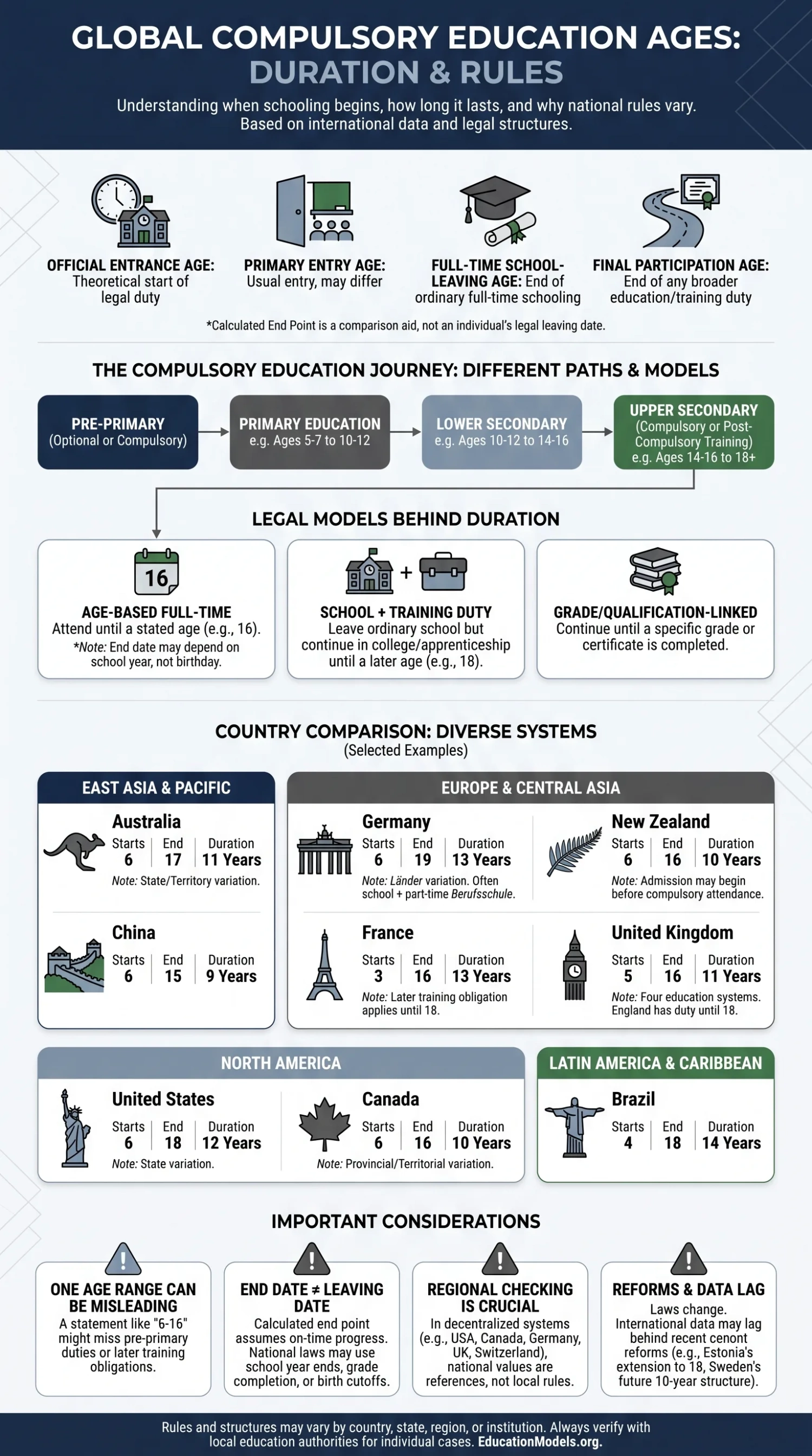
Compulsory education age by country does not follow one global rule. In many systems the legal duty begins between ages five and seven, but some countries include one or more years of pre-primary education. The duty may end when a student reaches a stated age, completes a school year, finishes a grade or qualification, or moves into an approved apprenticeship or training route. The country tables below therefore separate the official entrance age to compulsory education, the reported number of compulsory years, and a calculated theoretical end point. That end point is a comparison aid, not a substitute for the school-leaving law that applies to an individual child.
Why One Age Range Can Give the Wrong Answer
A statement such as “school is compulsory from 6 to 16” may describe full-time attendance, yet leave out a later duty to remain in education or training. Another country may let children enter primary school at five even though attendance does not become compulsory until six. A third may begin the legal duty in preschool, several years before primary education.
Four measurements need to remain separate:
- Official entrance age to compulsory education: the theoretical age at which the legal education duty begins.
- Official primary entry age: the usual age for entering primary education, which may be later than compulsory preschool or earlier than compulsory attendance.
- Full-time school-leaving age: the point at which ordinary full-time school attendance may end.
- Final participation age: the point at which any broader duty covering school, college, apprenticeship, vocational education or approved training ends.
How the End Point Is Calculated
The theoretical end point in the tables is the compulsory entrance age plus the reported duration. It represents the point at which the prescribed period would end for a student who enters on time and progresses without interruption. Birthday cutoffs, end-of-year rules, grade completion, regional law and later training duties can produce a different practical answer.
The Data Behind the Country Comparison
The entrance-age column uses the 2025 UNESCO Institute for Statistics series presented on the data page for Official entrance age to compulsory education.[a] The duration column uses the World Bank indicator Compulsory education, duration (years), whose definition is the number of years children are legally obliged to attend school and whose underlying provider is UNESCO UIS.[b] The February 2026 UIS release supplies the current international education-structure data used across these series.[c]
International comparison requires a standard theoretical model. OECD material shows why the result still varies widely: across the systems it covers, the theoretical starting age ranges from three to seven and the ending age from fourteen to eighteen.[d] Legal coverage has also expanded over time. UNESCO reports that, among 182 countries with data, the number providing at least one compulsory pre-primary year rose from 20 in 1998 to 44 in 2023; among 158 countries, the share with twelve compulsory years rose from 8% to 26% over the same period.[e]
Coverage and Missing Values
“Not reported” means that a comparable 2025 value was not available in the selected international series. It does not mean that the country has no compulsory education law. Values below ordinary school age are legal-entry data fields and should not be read as primary-school admission ages. The tables cover 193 UN member states, Palestine, Kosovo and Vatican City; some separately reported territories are not included.
Compulsory Education Ages and Duration by Country
The values are arranged by broad geographic region to make a long country list easier to scan. The calculated end point should be read as a data relationship, not automatically as the legal day on which a student may leave school. Eurydice uses a similar distinction in its European education diagrams by separating full-time and part-time compulsory education and training and by treating displayed ages as notional ages.[f]
East Asia and the Pacific
| Country | Starts at Age | Theoretical End Age | Duration (Years) | System Note |
|---|---|---|---|---|
| Australia | 6 | 17 | 11 | State and territory variation |
| Brunei | 6 | 15 | 9 | — |
| Cambodia | Not reported | Not reported | Not reported | — |
| China | 6 | 15 | 9 | — |
| Federated States of Micronesia | 6 | 14 | 8 | — |
| Fiji | Not reported | Not reported | Not reported | — |
| Indonesia | 7 | 16 | 9 | — |
| Japan | 6 | 15 | 9 | — |
| Kiribati | 6 | 15 | 9 | — |
| Laos | 6 | 15 | 9 | — |
| Malaysia | 6 | 12 | 6 | — |
| Marshall Islands | 5 | 18 | 13 | — |
| Mongolia | 6 | 18 | 12 | — |
| Myanmar | 5 | 10 | 5 | — |
| Nauru | 4 | 18 | 14 | — |
| New Zealand | 6 | 16 | 10 | Admission may begin before compulsory attendance |
| North Korea | 6 | 18 | 12 | — |
| Palau | 6 | 18 | 12 | — |
| Papua New Guinea | Not reported | Not reported | Not reported | — |
| Philippines | 5 | 18 | 13 | — |
| Samoa | 5 | 13 | 8 | — |
| Singapore | 6 | 12 | 6 | — |
| Solomon Islands | Not reported | Not reported | Not reported | — |
| South Korea | 6 | 15 | 9 | — |
| Thailand | 6 | 15 | 9 | — |
| Timor-Leste | 6 | 15 | 9 | — |
| Tonga | 4 | 19 | 15 | — |
| Tuvalu | 6 | 15 | 9 | — |
| Vanuatu | Not reported | Not reported | Not reported | — |
| Vietnam | 5 | 15 | 10 | — |
South Asia
| Country | Starts at Age | Theoretical End Age | Duration (Years) | System Note |
|---|---|---|---|---|
| Bangladesh | 6 | 11 | 5 | — |
| Bhutan | Not reported | Not reported | Not reported | — |
| India | 6 | 14 | 8 | — |
| Maldives | 4 | 16 | 12 | — |
| Nepal | 4 | 13 | 9 | — |
| Sri Lanka | 5 | 16 | 11 | — |
Europe and Central Asia
| Country | Starts at Age | Theoretical End Age | Duration (Years) | System Note |
|---|---|---|---|---|
| Albania | 6 | 15 | 9 | — |
| Andorra | 6 | 16 | 10 | — |
| Armenia | 6 | 18 | 12 | — |
| Austria | 5 | 18 | 13 | — |
| Azerbaijan | 6 | 15 | 9 | — |
| Belarus | 6 | 17 | 11 | — |
| Belgium | 5 | 18 | 13 | Education-community variation |
| Bosnia and Herzegovina | 6 | 15 | 9 | Entity and canton variation |
| Bulgaria | 4 | 16 | 12 | — |
| Croatia | 7 | 15 | 8 | — |
| Cyprus | 5 | 15 | 10 | — |
| Czechia | 5 | 15 | 10 | — |
| Denmark | 6 | 16 | 10 | — |
| Estonia | 7 | 16 | 9 | Recent reform is newer than this comparable value |
| Finland | 6 | 18 | 12 | — |
| France | 3 | 16 | 13 | A later training obligation applies |
| Georgia | 6 | 15 | 9 | — |
| Germany | 6 | 19 | 13 | Länder variation |
| Greece | 5 | 15 | 10 | — |
| Hungary | 4 | 17 | 13 | — |
| Iceland | 6 | 16 | 10 | — |
| Ireland | 6 | 16 | 10 | — |
| Italy | 6 | 18 | 12 | — |
| Kazakhstan | 6 | 15 | 9 | — |
| Kosovo | Not reported | Not reported | Not reported | No comparable 2025 value reported |
| Kyrgyzstan | 6 | 16 | 10 | — |
| Latvia | 5 | 16 | 11 | — |
| Liechtenstein | 7 | 16 | 9 | — |
| Lithuania | 6 | 17 | 11 | — |
| Luxembourg | 4 | 16 | 12 | — |
| Moldova | 6 | 16 | 10 | — |
| Monaco | 6 | 17 | 11 | — |
| Montenegro | 6 | 15 | 9 | — |
| Netherlands | 5 | 18 | 13 | — |
| North Macedonia | 6 | 19 | 13 | — |
| Norway | 6 | 16 | 10 | — |
| Poland | 6 | 15 | 9 | — |
| Portugal | 6 | 18 | 12 | — |
| Romania | 7 | 17 | 10 | — |
| Russia | 7 | 18 | 11 | — |
| San Marino | 6 | 16 | 10 | — |
| Serbia | 7 | 15 | 8 | — |
| Slovakia | 5 | 16 | 11 | — |
| Slovenia | 6 | 15 | 9 | — |
| Spain | 6 | 16 | 10 | — |
| Sweden | 6 | 16 | 10 | Future ten-year structure adopted for 2028 |
| Switzerland | 4 | 15 | 11 | Cantonal variation |
| Tajikistan | 7 | 16 | 9 | — |
| Turkiye | 6 | 18 | 12 | — |
| Turkmenistan | 6 | 18 | 12 | — |
| Ukraine | 6 | 17 | 11 | — |
| United Kingdom | 5 | 16 | 11 | Four education systems |
| Uzbekistan | 7 | 18 | 11 | — |
| Vatican City | Not reported | Not reported | Not reported | No comparable 2025 value reported |
Middle East and North Africa
| Country | Starts at Age | Theoretical End Age | Duration (Years) | System Note |
|---|---|---|---|---|
| Afghanistan | 7 | 16 | 9 | — |
| Algeria | 6 | 16 | 10 | — |
| Bahrain | 6 | 15 | 9 | — |
| Djibouti | 6 | 16 | 10 | — |
| Egypt | 6 | 18 | 12 | — |
| Iran | 6 | 15 | 9 | — |
| Iraq | 6 | 12 | 6 | — |
| Israel | 3 | 18 | 15 | — |
| Jordan | 6 | 16 | 10 | — |
| Kuwait | 6 | 15 | 9 | — |
| Lebanon | 6 | 16 | 10 | — |
| Libya | 6 | 15 | 9 | — |
| Malta | 5 | 16 | 11 | — |
| Morocco | 6 | 15 | 9 | — |
| Oman | 6 | 16 | 10 | — |
| Pakistan | 5 | 17 | 12 | — |
| Palestine | 6 | 16 | 10 | — |
| Qatar | 6 | 18 | 12 | — |
| Saudi Arabia | 6 | 15 | 9 | — |
| Syria | 6 | 15 | 9 | — |
| Tunisia | 6 | 15 | 9 | — |
| United Arab Emirates | 6 | 18 | 12 | — |
| Yemen | 6 | 15 | 9 | — |
Sub-Saharan Africa
| Country | Starts at Age | Theoretical End Age | Duration (Years) | System Note |
|---|---|---|---|---|
| Angola | 5 | 15 | 10 | — |
| Benin | 6 | 12 | 6 | — |
| Botswana | Not reported | Not reported | Not reported | — |
| Burkina Faso | 6 | 16 | 10 | — |
| Burundi | Not reported | Not reported | Not reported | — |
| Cabo Verde | 6 | 16 | 10 | — |
| Cameroon | 6 | 12 | 6 | — |
| Central African Republic | 6 | 16 | 10 | — |
| Chad | 6 | 16 | 10 | — |
| Comoros | 6 | 12 | 6 | — |
| Cote d'Ivoire | 6 | 16 | 10 | — |
| Democratic Republic of the Congo | 6 | 12 | 6 | — |
| Equatorial Guinea | 7 | 13 | 6 | — |
| Eritrea | 6 | 14 | 8 | — |
| Eswatini | 6 | 13 | 7 | — |
| Ethiopia | 7 | 15 | 8 | — |
| Gabon | 6 | 16 | 10 | — |
| Ghana | 4 | 15 | 11 | — |
| Guinea | 7 | 13 | 6 | — |
| Guinea-Bissau | 6 | 15 | 9 | — |
| Kenya | 6 | 18 | 12 | — |
| Lesotho | 6 | 13 | 7 | — |
| Liberia | 6 | 12 | 6 | — |
| Madagascar | 6 | 11 | 5 | — |
| Malawi | 6 | 14 | 8 | — |
| Mali | 7 | 16 | 9 | — |
| Mauritania | 6 | 15 | 9 | — |
| Mauritius | 5 | 17 | 12 | — |
| Mozambique | Not reported | Not reported | Not reported | — |
| Namibia | 7 | 14 | 7 | — |
| Niger | Not reported | Not reported | Not reported | — |
| Nigeria | 6 | 15 | 9 | — |
| Republic of the Congo | 6 | 16 | 10 | — |
| Rwanda | 6 | 12 | 6 | — |
| Sao Tome and Principe | 6 | 12 | 6 | — |
| Senegal | 6 | 17 | 11 | — |
| Seychelles | 6 | 17 | 11 | — |
| Sierra Leone | 6 | 15 | 9 | — |
| Somalia | 6 | 14 | 8 | — |
| South Africa | 7 | 16 | 9 | — |
| South Sudan | 6 | 14 | 8 | — |
| Sudan | 6 | 14 | 8 | — |
| Tanzania | 7 | 14 | 7 | — |
| The Gambia | 7 | 16 | 9 | — |
| Togo | 6 | 16 | 10 | — |
| Uganda | 6 | 13 | 7 | — |
| Zambia | 7 | 14 | 7 | — |
| Zimbabwe | 6 | 13 | 7 | — |
North America
| Country | Starts at Age | Theoretical End Age | Duration (Years) | System Note |
|---|---|---|---|---|
| Canada | 6 | 16 | 10 | Provincial and territorial variation |
| United States | 6 | 18 | 12 | State variation |
Latin America and the Caribbean
| Country | Starts at Age | Theoretical End Age | Duration (Years) | System Note |
|---|---|---|---|---|
| Antigua and Barbuda | 5 | 16 | 11 | — |
| Argentina | 4 | 18 | 14 | — |
| Bahamas | 5 | 17 | 12 | — |
| Barbados | 5 | 16 | 11 | — |
| Belize | 5 | 13 | 8 | — |
| Bolivia | 4 | 18 | 14 | — |
| Brazil | 4 | 18 | 14 | — |
| Chile | 6 | 18 | 12 | — |
| Colombia | 5 | 17 | 12 | — |
| Costa Rica | 4 | 17 | 13 | — |
| Cuba | 6 | 15 | 9 | — |
| Dominica | 5 | 17 | 12 | — |
| Dominican Republic | 3 | 18 | 15 | — |
| Ecuador | 3 | 18 | 15 | — |
| El Salvador | 1 | 16 | 15 | Very early legal-entry value; check national definitions |
| Grenada | 5 | 17 | 12 | — |
| Guatemala | 0 | 16 | 16 | Age 0 is a legal-entry data value, not primary entry |
| Guyana | 6 | 12 | 6 | — |
| Haiti | 6 | 12 | 6 | — |
| Honduras | 5 | 17 | 12 | — |
| Jamaica | 6 | 12 | 6 | — |
| Mexico | 4 | 18 | 14 | — |
| Nicaragua | 5 | 12 | 7 | — |
| Panama | 4 | 15 | 11 | — |
| Paraguay | 5 | 18 | 13 | — |
| Peru | 3 | 17 | 14 | — |
| St. Kitts and Nevis | 5 | 17 | 12 | — |
| St. Lucia | 5 | 15 | 10 | — |
| St. Vincent and the Grenadines | 5 | 17 | 12 | — |
| Suriname | 7 | 13 | 6 | — |
| Trinidad and Tobago | 5 | 12 | 7 | — |
| Uruguay | 4 | 18 | 14 | — |
| Venezuela | Not reported | Not reported | 17 | — |
What the Same Numbers Can Mean in Different Countries
A global table can align legal structures, but it cannot fit every national rule into one pair of ages. The following examples show why a country’s start, duration and end point need a legal note before they are used for enrolment, withdrawal or relocation decisions.
School Can Begin Before Attendance Becomes Compulsory
In New Zealand, primary and secondary education is available from ages five to nineteen, and many children start school at five. The legal attendance period is six to sixteen. This is why the age of first admission should not be copied into a compulsory-schooling table as though the two rules were identical.[g]
Compulsory Education Can Begin in Preschool
France places children under the instruction obligation from age three to sixteen. Young people from sixteen to eighteen then have a separate training obligation that can be met through schooling, apprenticeship, employment, civic service or an approved support route. A simple “3–18 school age” label would merge two different legal duties.[h]
Leaving School May Not End the Participation Duty
The United Kingdom cannot be reduced to one school-leaving rule because England, Scotland, Wales and Northern Ireland use different dates and conditions. In England, a young person who may leave school at sixteen must still remain in education or training until eighteen through full-time study, an apprenticeship, or work combined with part-time education or training.[i]
Full-Time and Part-Time Duties Can Form One Longer Period
Germany generally begins compulsory schooling in the year a child turns six. General full-time compulsory schooling normally lasts nine years. Young people who do not continue in a full-time general or vocational school are then usually subject to part-time Berufsschule attendance for three years. The Länder control school legislation, so a national duration value can conceal differences in timing and route.[j]
Legal Models Behind Compulsory Education Duration
| Legal Model | What the Student Must Do | Why the Age Range Needs Explanation |
|---|---|---|
| Age-based full-time schooling | Attend an approved school or another legally accepted full-time form of education until a stated age. | The final date may depend on the school year rather than the student’s birthday. |
| Compulsory pre-primary plus school | Begin the legal education duty before entering primary school. | Primary entry age is later than compulsory entry age. |
| School followed by education or training | Leave ordinary school but continue in college, apprenticeship, vocational education or approved training. | School-leaving age and final participation age are different. |
| Grade- or qualification-linked duty | Continue until a stated grade, certificate or upper-secondary qualification is completed, sometimes subject to an age ceiling. | Two students of the same age may have different legal positions. |
| Subnational legislation | Follow rules made by a state, province, territory, canton, Land, community or constituent education system. | A national figure may be a reference value rather than the rule for every locality. |
Why the Legal End Date May Differ From the Table
The calculated end point assumes on-time entry and uninterrupted progression. National law may instead use the final day of an academic year, the last Friday of a given month, completion of a grade, or the award of a qualification. A student who starts late, repeats a grade or follows a different approved pathway may therefore be older than the displayed end point when the duty finishes.
Birth-date cutoffs also matter. A rule written as “until sixteen” may allow departure at the end of the school year in which the student turns sixteen, after a nationally fixed date, or only after a later term. The practical span can differ by several months even when two countries publish the same start and end ages.
Alternative provision does not automatically remove the duty. Home education, distance learning, hospital education, special education arrangements, apprenticeship and vocational study may satisfy it when national or regional law recognises the route. Eligibility, registration and oversight rules are country-specific.
Countries Where a National Figure Needs Regional Checking
Education legislation is decentralised in several countries. The United States uses state compulsory-attendance laws. Canada relies on provincial and territorial rules. Australia has state and territory legislation, Switzerland has cantonal rules, Belgium’s education communities operate separate systems, and Bosnia and Herzegovina has entity and canton variation. The United Kingdom contains four education systems rather than one uniform national structure.
A National Value Is Not Always the Local Rule
For a child’s actual position, check the authority that governs the home address and school. Entry cutoffs, withdrawal dates, exemptions, home-education registration and approved post-school pathways may be set below national level.
Recent Reforms and Data Lag
International datasets are released on a schedule, while education laws can change during an academic year. Estonia illustrates the gap. Its learning-obligation reform applies from the 2025/26 academic year and extends the duty from seventeen to eighteen, or until the learner completes secondary or vocational education. A child who completed basic school before the reform’s cutoff is treated under the earlier rule.[k]
Future reforms should not be inserted into a current table before they take effect. Sweden has adopted a ten-year compulsory-school structure for autumn 2028, when the preschool class for six-year-olds is due to be replaced by a new Year 1 and the compulsory school sequence extended by one year. Until implementation, the current structure remains the proper basis for present decisions.[l]
What Compulsory Education Years Do Not Measure
A longer legal duration does not by itself show that students attend every required year, complete upper secondary education, receive more classroom hours or achieve stronger learning results. It also does not state whether every year is free, whether transport and materials are covered, or whether enough school places are available.
- Actual enrolment and attendance
- Completion and early school-leaving rates
- Instruction hours per academic year
- Curriculum content and assessment
- Learning outcomes
- Public, private or household education costs
- Availability of vocational and apprenticeship routes
- Enforcement, exemptions and alternative education
Compulsory education duration is a legal-structure indicator. It should not be used as a ranking of education quality or as evidence that every child remains enrolled for the full period.
Checking the Rule for an Individual Student
For relocation, school withdrawal, home education, early leaving or post-sixteen planning, confirm the rule with the relevant ministry, regional education authority, school district, municipality or recognised school. The questions that matter are the child’s date of birth, current grade, place of residence, school type, qualification status and intended education or training route.
This site is an independent informational guide and is not affiliated with any ministry of education, school authority, exam board, university, government agency or official ranking organisation. Country rules and data releases can change, so the responsible public authority remains the source for a binding decision.
Sources and Verification
- [a] Official entrance age to compulsory education — Presents the 2025 entrance-age series sourced from UNESCO UIS and explains the theoretical-entry assumption. (Our World in Data documents the original UIS source and processing.)
- [b] Compulsory education, duration (years) — Supplies the country-level duration values and identifies UNESCO UIS as the data provider. (World Bank World Development Indicators.)
- [c] Background information on statistics in the UIS database — Documents the February 2026 UIS education-data release and country structure notes. (UNESCO Institute for Statistics.)
- [d] Review education policies — Provides the reported range of theoretical compulsory-education starting and ending ages across covered systems. (OECD Education GPS.)
- [e] Access and equity — Reports changes in compulsory pre-primary provision and twelve-year compulsory education between 1998 and 2023. (UNESCO Global Education Monitoring Report.)
- [f] The structure of European education systems — Distinguishes full-time and part-time compulsory education and training and presents notional ages for European systems. (Eurydice network.)
- [g] Primary and secondary education — States New Zealand’s school availability ages and the compulsory attendance period from six to sixteen. (New Zealand Ministry of Education.)
- [h] Instruction obligatoire — Sets out France’s instruction obligation from three to sixteen and training obligation from sixteen to eighteen. (Official French public-service portal.)
- [i] School leaving age — Explains the different UK school-leaving rules and England’s education or training duty until eighteen. (GOV.UK.)
- [j] Germany: Overview — Describes Länder responsibility, nine years of general full-time compulsory schooling and later Berufsschule attendance. (Eurydice national-system description.)
- [k] Reform of the obligation to learn — Explains Estonia’s 2025/26 extension of the learning obligation to eighteen or completion of secondary or vocational education. (Estonian Ministry of Education and Research.)
- [l] National reforms in school education — Records the adopted ten-year compulsory-school change scheduled for autumn 2028. (Eurydice Sweden.)