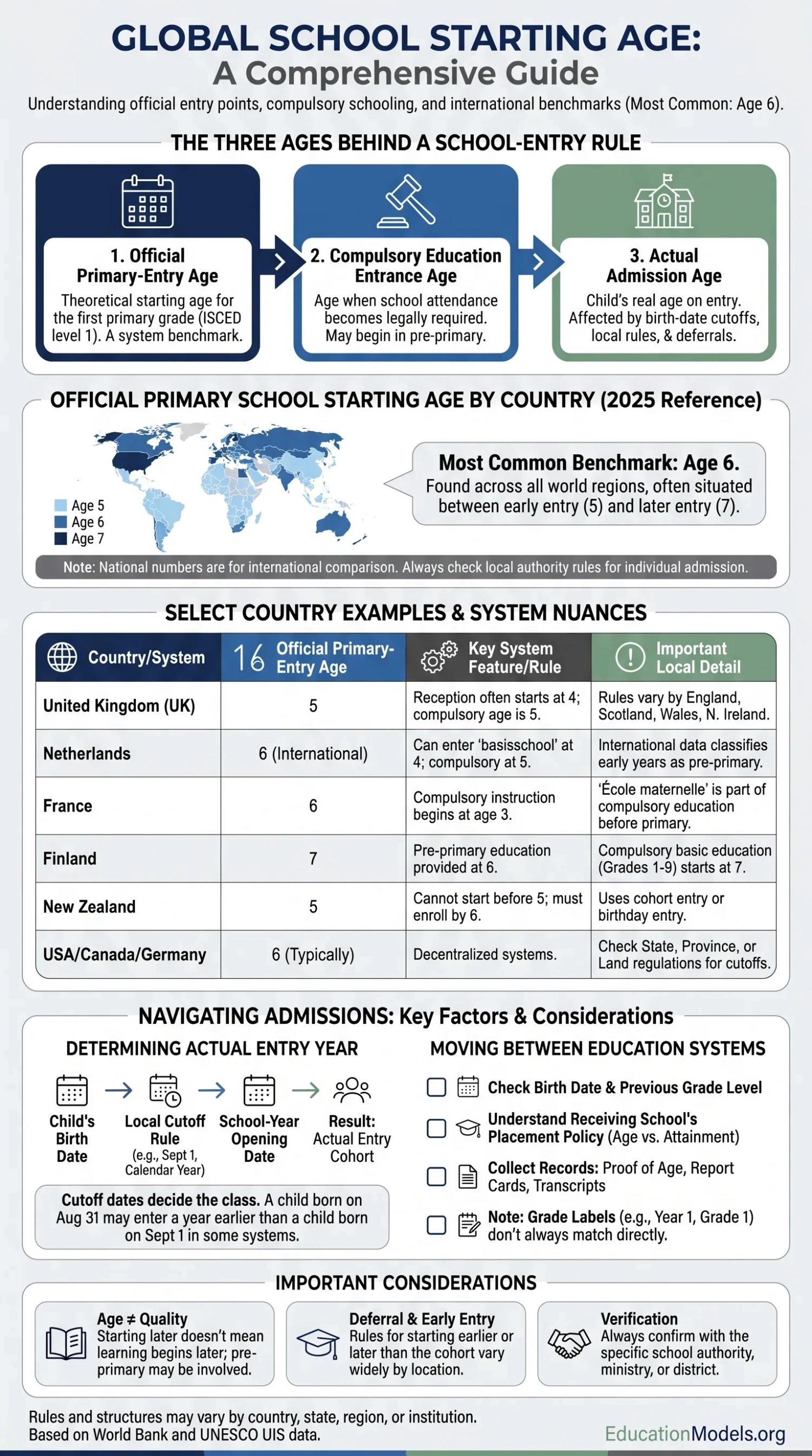
Children enter official primary education at age 5, 6, or 7 in most national systems, and age 6 is the most common international benchmark. That number is only the first layer of a school-entry rule. A country may require education before primary school, allow children into a school called “primary” before the internationally classified primary stage begins, or use a birth-date cutoff that places two children born weeks apart in different school years. The country table reports the official primary-entry benchmark used in the World Bank education indicator sourced from UNESCO UIS, then explains how compulsory attendance, school labels, and local admission rules change the result for an individual child.
The Three Ages Behind a School-Entry Rule
The phrase school starting age is used for several different measures. Treating them as interchangeable creates many of the apparent contradictions found in international tables. The World Bank metadata defines primary school starting age as the age at which a pupil would enter primary education after entering at the official age, studying full time, and progressing without repeating or skipping a grade. It is a theoretical system measure rather than a personal admission decision. The same distinction appears in the World Development Indicators metadata.
| Measure | What It Describes | Why the Child’s Age May Differ |
|---|---|---|
| Official primary-entry age | The theoretical age for entry into the first grade classified as primary education, usually ISCED level 1. | A school may enrol younger children in a reception, kindergarten, foundation, or pre-primary class within the same institution. |
| Compulsory education entrance age | The age at which participation in education becomes legally required. | Compulsory education may begin in pre-primary education, or the law may allow children to attend school before attendance becomes mandatory. |
| Actual admission age | The child’s age when the school year, term, or entry cohort begins. | Birth-date cutoffs, regional rules, early entry, deferred entry, and the month in which the school year opens can move the start by a year. |
What the Country Number Represents
The value is best used for international comparison of education structures. It does not promise that every child enters a school building, Grade 1, Year 1, or the compulsory phase on that birthday.
Official Primary School Starting Age by Country
The table uses the latest country-level values in the World Bank series for the 2025 reference year, published from UNESCO Institute for Statistics data in 2026. It records the official age attached to the first internationally classified primary grade. It does not replace a ministry, regional authority, municipality, school district, or school admission notice. Values are left out rather than estimated when a separate current country observation could not be confirmed in the selected series.
| Country or Education System | Official Primary-Entry Age |
|---|---|
| Afghanistan | 7 |
| Albania | 6 |
| Algeria | 6 |
| Andorra | 6 |
| Angola | 6 |
| Antigua and Barbuda | 5 |
| Argentina | 6 |
| Armenia | 6 |
| Australia | 5 |
| Austria | 6 |
| Azerbaijan | 6 |
| Bahamas | 5 |
| Bahrain | 6 |
| Bangladesh | 6 |
| Barbados | 5 |
| Belarus | 6 |
| Belgium | 6 |
| Belize | 5 |
| Benin | 6 |
| Bhutan | 6 |
| Bolivia | 6 |
| Bosnia and Herzegovina | 6 |
| Botswana | 6 |
| Brazil | 6 |
| Brunei Darussalam | 6 |
| Bulgaria | 7 |
| Burkina Faso | 6 |
| Burundi | 6 |
| Cabo Verde | 6 |
| Cambodia | 6 |
| Cameroon | 6 |
| Canada | 6 |
| Central African Republic | 6 |
| Chad | 6 |
| Chile | 6 |
| China | 6 |
| Colombia | 6 |
| Comoros | 6 |
| Costa Rica | 6 |
| Croatia | 7 |
| Cuba | 6 |
| Cyprus | 6 |
| Czechia | 6 |
| Côte d’Ivoire | 6 |
| Democratic Republic of the Congo | 6 |
| Denmark | 6 |
| Djibouti | 6 |
| Dominica | 5 |
| Dominican Republic | 6 |
| Ecuador | 6 |
| Egypt | 6 |
| El Salvador | 7 |
| Equatorial Guinea | 7 |
| Eritrea | 6 |
| Estonia | 7 |
| Eswatini | 6 |
| Ethiopia | 7 |
| Fiji | 6 |
| Finland | 7 |
| France | 6 |
| Gabon | 6 |
| Gambia | 7 |
| Georgia | 6 |
| Germany | 6 |
| Ghana | 6 |
| Greece | 6 |
| Grenada | 5 |
| Guatemala | 7 |
| Guinea | 7 |
| Guinea-Bissau | 6 |
| Guyana | 6 |
| Haiti | 6 |
| Honduras | 6 |
| Hungary | 7 |
| Iceland | 6 |
| India | 6 |
| Indonesia | 7 |
| Iran | 6 |
| Iraq | 6 |
| Ireland | 5 |
| Israel | 6 |
| Italy | 6 |
| Jamaica | 6 |
| Japan | 6 |
| Jordan | 6 |
| Kazakhstan | 6 |
| Kenya | 6 |
| Kiribati | 6 |
| Kuwait | 6 |
| Kyrgyzstan | 7 |
| Laos | 6 |
| Latvia | 7 |
| Lebanon | 6 |
| Lesotho | 6 |
| Liberia | 6 |
| Libya | 6 |
| Liechtenstein | 7 |
| Lithuania | 7 |
| Luxembourg | 6 |
| Madagascar | 6 |
| Malawi | 6 |
| Malaysia | 6 |
| Maldives | 6 |
| Mali | 7 |
| Malta | 5 |
| Marshall Islands | 6 |
| Mauritania | 6 |
| Mauritius | 5 |
| Mexico | 6 |
| Micronesia | 6 |
| Moldova | 7 |
| Monaco | 6 |
| Mongolia | 6 |
| Montenegro | 6 |
| Morocco | 6 |
| Mozambique | 6 |
| Myanmar | 5 |
| Namibia | 7 |
| Nepal | 5 |
| Netherlands | 6 |
| New Zealand | 5 |
| Nicaragua | 6 |
| Niger | 7 |
| Nigeria | 6 |
| North Korea | 7 |
| North Macedonia | 6 |
| Norway | 6 |
| Oman | 6 |
| Pakistan | 5 |
| Palau | 6 |
| Palestine | 6 |
| Panama | 6 |
| Papua New Guinea | 7 |
| Paraguay | 6 |
| Peru | 6 |
| Philippines | 6 |
| Poland | 7 |
| Portugal | 6 |
| Qatar | 6 |
| Republic of the Congo | 6 |
| Romania | 6 |
| Russia | 7 |
| Rwanda | 6 |
| Saint Lucia | 5 |
| Saint Vincent and the Grenadines | 5 |
| Samoa | 5 |
| San Marino | 6 |
| Saudi Arabia | 6 |
| Senegal | 6 |
| Serbia | 7 |
| Seychelles | 6 |
| Sierra Leone | 6 |
| Singapore | 6 |
| Slovakia | 6 |
| Slovenia | 6 |
| Solomon Islands | 6 |
| Somalia | 6 |
| South Africa | 7 |
| South Korea | 6 |
| South Sudan | 6 |
| Spain | 6 |
| Sri Lanka | 5 |
| Sudan | 6 |
| Suriname | 6 |
| Sweden | 7 |
| Switzerland | 6 |
| Syria | 6 |
| São Tomé and Príncipe | 6 |
| Tajikistan | 7 |
| Tanzania | 7 |
| Thailand | 6 |
| Timor-Leste | 6 |
| Togo | 6 |
| Tonga | 6 |
| Trinidad and Tobago | 5 |
| Tunisia | 6 |
| Turkmenistan | 6 |
| Tuvalu | 6 |
| Türkiye | 6 |
| Uganda | 6 |
| Ukraine | 6 |
| United Arab Emirates | 6 |
| United Kingdom | 5 |
| United States | 6 |
| Uruguay | 6 |
| Uzbekistan | 7 |
| Vanuatu | 6 |
| Venezuela | 6 |
| Vietnam | 6 |
| Yemen | 6 |
| Zambia | 7 |
| Zimbabwe | 6 |
A Country Value Is Not an Admission Guarantee
The United States, Canada, Australia, Switzerland, Germany, and the United Kingdom all require a more local check. A state, province, territory, canton, Land, constituent country, district, or municipality may set the operative cutoff and enrolment procedure.
Why Age 6 Is the Most Common Benchmark
Age 6 sits between two widely used arrangements. In one, children enter a reception, kindergarten, foundation, or first primary year at about age 5. In the other, children complete a separate pre-primary year before beginning the first primary grade at 7. The age-6 model places the first primary grade between these two patterns and appears across every world region.
Within the systems covered by the OECD’s 2025 education comparison, nearly three quarters start primary education at age 6. The same OECD table places Australia, England, New Zealand, and Scotland in the age-5 group, while Bulgaria, Croatia, Estonia, Finland, Latvia, Lithuania, Poland, and Sweden are shown at age 7. That is an OECD comparison set, not a list of every country worldwide.
Starting later in the primary classification does not mean learning begins later. A child may already attend compulsory pre-primary education, a preschool class, or an early-years group with planned learning before the first ISCED 1 grade.
When an Age-5 System Does Not Produce One Starting Age
Age-5 systems often contain the widest visible spread within a classroom. A child may start while still four, soon after turning five, or later through a permitted deferral. The local name of the first class also matters. Reception, Primary 1, Foundation, Prep, and Year 1 do not carry one universal age or curriculum meaning.
England: Reception Before Compulsory School Age
In England, most children start Reception full time in the September after their fourth birthday. The legal compulsory-school-age point is later and is tied to the term following the child’s fifth birthday. The UK government school admissions page also makes clear that Scotland and Northern Ireland use different rules. This is why “the United Kingdom starts school at five” is too broad for a family-level answer.
Scotland: Primary 1 and the Deferral Window
Scotland uses Primary 1 rather than Reception. Children are usually between about 4.5 and 5.5 when they start, and younger eligible children may defer entry. The Scottish Government’s deferred-entry explanation links the intake group to birth dates and the August school-year opening. The national UK value therefore hides a constituent-country rule that families must check separately.
New Zealand: Entry at Five, Attendance by Six
New Zealand children cannot start school before age 5 and must be enrolled by age 6. Many start on or near their fifth birthday, while schools using cohort entry bring groups of children in on set dates. The New Zealand Ministry of Education cohort-entry guidance shows how an official age can operate through either birthday entry or scheduled group entry.
Ireland: Primary Entry and Legal Compulsion Are Separate
Ireland appears as age 5 in the international primary-entry series, but the compulsory age to begin education is 6. The Irish Department of Education overview states that pre-primary education is optional and compulsory education begins at 6. The benchmark and the legal deadline answer different questions.
Why Age 7 Can Include Education Before Grade 1
A seven-year primary-entry value describes the first grade classified as primary education. It does not show whether the preceding year is voluntary, publicly funded, attached to a school, or compulsory. The clearest example is Finland.
In Finland, children normally participate in pre-primary education at age 6 and begin nine-year basic education at age 7. The Finnish National Agency for Education describes basic education as Grades 1–9, usually covering ages 7–16. Compulsory education begins before the first basic-education grade, so the age-7 row cannot be read as “no required education before seven.”
Other age-7 systems arrange the preceding year differently. Some use compulsory preschool or a preparatory class. Others permit early entry under defined conditions. The first-grade curriculum also cannot be matched automatically to Grade 1 elsewhere merely because the pupils are one year older.
Compulsory Education May Begin Before Primary School
The largest gap between the two age measures appears where a country makes pre-primary participation compulsory. France is a direct example: compulsory instruction begins at age 3, while entry to école élémentaire is tied to age 6. The years in école maternelle are therefore part of compulsory education even though the international primary-entry indicator remains 6. The rules are set out on the French public-service pages for compulsory instruction and elementary-school registration.
| System Example | Official Primary-Entry Benchmark | Earlier Education Rule |
|---|---|---|
| France | 6 | Compulsory instruction begins at 3; children ordinarily attend école maternelle before école élémentaire. |
| Finland | 7 | Pre-primary education is provided at 6 before Grade 1 of basic education. |
| Switzerland | 6 | Children generally begin kindergarten at 4, with the exact compulsory structure governed by the canton. |
| Netherlands | 6 in the international ISCED-based series | Children may attend basisschool from 4 and school attendance becomes compulsory at 5. |
| New Zealand | 5 | Children may start at 5 and must be enrolled by 6. |
| Ireland | 5 | The legal compulsory starting age is 6. |
The Netherlands Shows Why School Labels and ISCED Levels Differ
The Netherlands is one of the most useful cases for interpreting a global table. Dutch children may enter basisschool, commonly translated as primary school, from age 4. Attendance becomes compulsory at 5. Yet the international official primary-entry indicator is 6 because international datasets classify the earlier groups within pre-primary education rather than ISCED level 1. The Dutch government confirms both the age-4 access to primary school and the age-5 attendance requirement.
Classification Is Not a Translation Exercise
A local institution called “primary school” may contain classes that an international dataset classifies as pre-primary. Conversely, a foundation or preparatory year may already sit inside primary education. The local name alone cannot establish the comparable entry age.
Cutoff Dates Decide the Child’s Actual Entry Year
A rule stating “start at age 6” is incomplete until it identifies the date on which the child must be 6. Education systems use several methods, and the chosen method changes the composition of the class.
- School-opening cutoff: the child must reach the stated age before the academic year begins.
- Calendar-year rule: children who reach the stated age at any point in that calendar year enter together.
- Fixed birth-date rule: eligibility is divided by a date such as 31 August, 1 September, or another locally defined day.
- Term-after-birthday rule: compulsory attendance begins at the start of a specified term after the child reaches the legal age.
- Cohort entry: several scheduled entry dates replace individual birthday entry.
Consider an illustrative system with a 31 August cutoff. A child born on 30 August may enter one school year, while a child born on 2 September may wait until the next. Both can be described as starting “at six,” yet their ages on the first day may differ by almost a year. The example is not a universal rule; it shows why the cutoff must accompany the age.
Germany adds another layer because compulsory entry is governed through the Länder. The general pattern is entry around age 6, but qualifying dates and treatment of children near the cutoff can differ. Eurydice’s description of German primary education ties school entry to statutory qualifying dates rather than one worldwide-style birthday rule.
Countries Without One National Admission Answer
A global indicator needs one value per country or system. Families often need a lower level of geography. In decentralised systems, the national number describes the broad structure but may not identify the legal cutoff, first class, or permitted deferral.
| Country or System | Authority Level to Check | Why the National Number Is Insufficient |
|---|---|---|
| United States | State, then school district | Entry cutoffs, kindergarten requirements, compulsory attendance, and early-entry options are mainly determined below the federal level. |
| Canada | Province or territory, then school board where relevant | Each province and territory operates its own school system, and compulsory ages are not identical nationwide. |
| Australia | State or territory | The first school year and cutoff rules differ among jurisdictions even though the international benchmark is 5. |
| Switzerland | Canton and municipality | Compulsory kindergarten and primary entry are organised by cantons, with local implementation details. |
| Germany | Land and local school authority | Qualifying dates, flexible entry zones, and procedures near the cutoff vary among the Länder. |
| United Kingdom | England, Scotland, Wales, or Northern Ireland | School-stage names, eligibility dates, compulsory-age rules, and deferral arrangements are not one UK-wide admission system. |
The U.S. Department of Education explains that education is primarily a state and local responsibility. Canada’s Council of Ministers of Education overview likewise describes provincial and territorial control. The Australian Government Department of Education identifies state and territory governments as the authorities responsible for school education in their jurisdictions. In Switzerland, the federal public-information portal states that children generally start kindergarten at 4 and that compulsory schooling is organised through the cantons; the operative rule must be checked on the relevant cantonal school and kindergarten information.
Early Entry, Deferred Entry, and Delayed Attendance Are Different
Early entry allows a child below the normal cohort age to enter, often after an application or readiness review. Deferred entry permits an eligible child to begin later. Delayed compulsory attendance means the child may be admitted before the law requires attendance. These arrangements can coexist in one system.
The class assigned after a deferral also needs checking. A system may preserve the child’s right to the first primary grade, place the child by chronological age, or require a separate decision. Preschool funding may continue in one jurisdiction and end in another. A general country table cannot resolve these administrative details.
Deferral Does Not Always Mean Repeating the Intended Entry Year
Before delaying entry, confirm which class the child would join the following year, whether the decision requires approval, and whether early-years provision remains available during the deferred period.
Grade Names Cannot Be Matched by Translation Alone
Families moving between countries often try to convert a class name directly: Kindergarten to Kindergarten, Year 1 to Grade 1, or Primary 1 to first grade. The labels may occupy different places in the education sequence. Age, completed schooling, curriculum content, school-year timing, and the receiving authority’s placement policy all matter.
| Local Label | Possible Role | Why Direct Conversion Fails |
|---|---|---|
| Reception | An early school year before Year 1, notably in England. | It may begin before compulsory school age and does not equal Grade 1 everywhere. |
| Kindergarten | Pre-primary, a compulsory early year, or a first school year depending on the system. | The term can refer to different ages and different international education levels. |
| Foundation or Prep | An entry year used in some school systems. | Its position relative to Year 1 and the cutoff is jurisdiction-specific. |
| Primary 1 | The first numbered primary class in systems such as Scotland. | The typical age and preceding early-years provision are not the same in every country using the label. |
| Grade 1 | Usually the first numbered primary grade. | Entry may occur at 5, 6, or 7, so the label does not identify the child’s age by itself. |
| Year 1 | A numbered year in systems using a year-based sequence. | Some systems place a reception or foundation year before it; others number the first primary year differently. |
School-Year Timing Can Add or Remove Several Months
Countries do not open the school year in the same month. Some systems begin the academic year early in the calendar year, while others open in August or September. A child described as entering at 6 may therefore be only just 6, almost 7, or part of an intake that spans both ages.
The reference date matters more than the hemisphere. A February school opening paired with a calendar-year age rule creates a different cohort from a September opening paired with a 31 August cutoff. International age tables generally do not encode that level of detail.
Moving a Child Between Education Systems
A receiving school may consider the child’s date of birth, the last completed grade, subjects studied, school reports, language support needs, and the point reached in the local academic year. The result can differ from a simple age conversion, especially when one country’s school year is ending as another begins.
Records that often help a placement review include proof of age, recent report cards, a transcript or completed-grade statement, details of learning support, and an explanation of the previous school calendar. These are not a universal document list. The receiving authority decides what it requires.
A pupil who completed Grade 1 at age 6 may not fit automatically into a class with the same English label elsewhere. The receiving school may place by age, prior attainment, completed curriculum, or a combination of these. Language assessment should also be distinguished from academic placement: needing support in the language of instruction does not by itself show that the child should repeat a grade.
What the Country Age Does Not Measure
- The amount or quality of pre-primary provision before the first primary grade.
- The exact birthday range inside one classroom.
- Whether early entry or deferral is a right, an exception, or unavailable.
- How formal, play-based, or academically structured the first school year is.
- The length of primary education or the age at which secondary education begins.
- The quality of the education system or likely student outcomes.
- The grade a transferring child will receive after moving countries.
- The admission decision of a particular public, private, or international school.
A later entry age should not be treated as proof of a better or weaker model. Nor does an earlier entry age show that children receive more formal instruction. The indicator describes system structure. Curriculum, participation, teaching practice, access, and student support require separate evidence.
How an Actual Entry Year Is Determined
The reliable sequence begins with the country’s official primary-entry age, then narrows to the authority that controls admission. The decisive questions are the child’s birth date, the applicable cutoff, the school-year opening date, the first class used in that jurisdiction, and any early-entry or deferral provision. In a decentralised system, the state, province, territory, canton, Land, district, council, or municipality must be identified before a firm answer is possible.
Rules can change between school years, and reforms may be phased in by birth cohort. The Eurydice education-structure material describes its published ages as theoretical or notional and warns that early or late entry and grade repetition are not represented. That limitation applies broadly to international comparison data.
This site is an independent informational guide and is not affiliated with any ministry of education, school authority, exam board, university, government agency, or official ranking organisation. For enrolment, deferral, compulsory-attendance, or placement decisions, check the current notice issued by the responsible public authority and the receiving school.
Sources and Verification
- World Bank — Primary school starting age (years) — Supplies the country-level 2025 primary-entry indicator used in the main table, sourced from UNESCO UIS.
- World Bank DataBank — Indicator metadata for SE.PRM.AGES — Defines the measure as a theoretical official entry age based on uninterrupted progression.
- OECD — How much time do students spend in the classroom? — Supports the age distribution described for OECD and partner education systems.
- Eurydice — The structure of European education systems — Explains that published education-stage ages are notional and do not capture early or late entry.
- GOV.UK — School admissions: school starting age — Verifies England’s Reception timing, compulsory-school-age rule, and the need to distinguish UK constituent systems.
- Scottish Government — Deferred entry to primary school — Supports Scotland’s usual Primary 1 age range, August intake, and deferral rule.
- New Zealand Ministry of Education — Cohort or group entry — Verifies the age-5 minimum, age-6 enrolment deadline, and cohort-entry option.
- Department of Education, Ireland — Education — States that the compulsory age to begin education in Ireland is 6.
- Finnish National Agency for Education — Primary and lower secondary education — Verifies pre-primary education at 6 and basic education beginning at 7.
- Service-Public.fr — Instruction obligatoire — Verifies compulsory instruction from age 3 in France.
- Service-Public.fr — Inscrire son enfant à l’école primaire — Verifies entry to école élémentaire from age 6 and notes possible earlier admission under conditions.
- Government of the Netherlands — Primary education — Verifies that children may attend Dutch primary school from age 4.
- Government of the Netherlands — Registering a child with a primary school — Verifies that school attendance becomes compulsory at age 5.
- Eurydice — Organisation of primary education in Germany — Supports the role of statutory qualifying dates and Land-level rules.
- U.S. Department of Education — Federal role in education — Confirms that school governance and enrolment rules are primarily state and local responsibilities.
- Council of Ministers of Education, Canada — Education in Canada — Explains provincial and territorial responsibility and variation in compulsory schooling.
- Australian Government Department of Education — How schools are funded — Confirms the responsibility of state and territory governments for school education in their jurisdictions.
- Swiss Confederation information portal — School and kindergarten — Verifies kindergarten entry around age 4 and canton-based organisation.