Complete guide: Education Systems
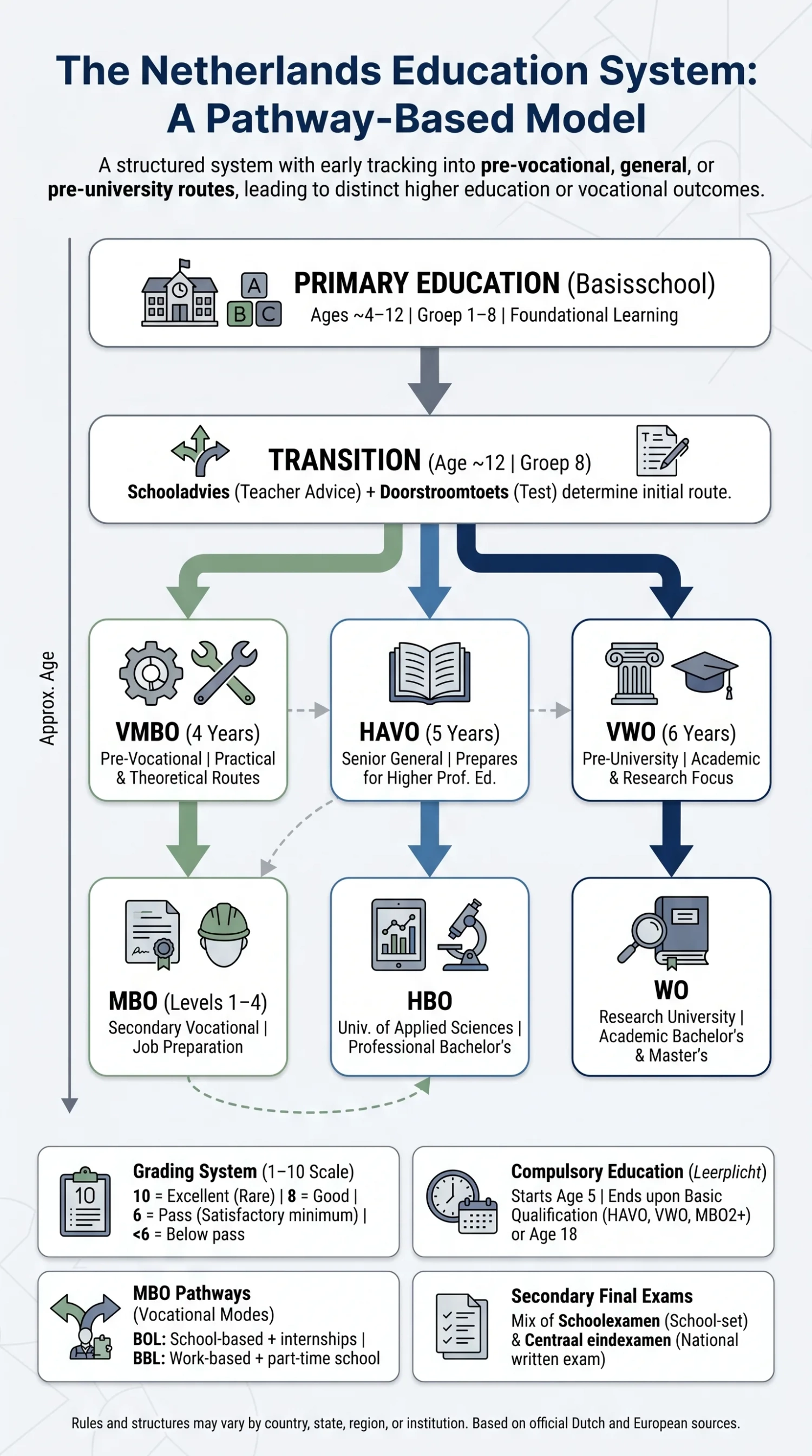
The Netherlands education system moves children through eight years of primary school before placing them on one of three main secondary routes: VMBO, HAVO or VWO. That choice is made near the end of Group 8 and influences the next destination, but it does not seal a student into one route for life. VMBO usually leads to MBO vocational qualifications, HAVO leads mainly to HBO higher professional education, and VWO prepares students for WO research-oriented university education. Transfer points allow students to move upward, sideways or into a more applied route when diploma and subject conditions are met.
The Dutch Route From Primary School to Higher Education
The clearest way to read the system is as a set of connected destinations rather than a single ladder. Primary education ends with a school recommendation for secondary education. VMBO, HAVO and VWO then differ in duration, balance between theory and practice, examination subjects and the type of further education they are designed to enter.
| Stage or Diploma | Usual Length | Main Educational Purpose | Common Next Route |
|---|---|---|---|
| Primary school, Groups 1–8 | 8 years | General primary learning and preparation for secondary placement | VMBO, HAVO or VWO |
| VMBO | 4 years | Pre-vocational secondary education with four theory-practice pathways | MBO; HAVO is possible from specified VMBO routes |
| HAVO | 5 years | General secondary preparation for higher professional education | HBO; progression to VWO is also possible |
| VWO | 6 years | Pre-university secondary education | WO or HBO |
| MBO level 1–4 | Varies by level and programme | Occupational qualifications taught through school and workplace learning | Employment, a higher MBO level or HBO after level 4 |
| HBO | Usually 4 years for a bachelor’s degree | Profession-oriented higher education | Employment, HBO master’s study or conditional academic progression |
| WO | Usually 3 years for a bachelor’s degree | Research-oriented higher education | WO master’s study or employment |
Dutch primary education is organised as Groups 1–8. The three secondary types end in their own national diplomas, and each diploma has a defined progression function. VMBO lasts four years, HAVO five and VWO six. VMBO-T and VMBO-GL graduates may continue toward HAVO when they meet the subject condition attached to that transition. [a]
A Track Is a Destination Route, Not a Permanent Label
VMBO, HAVO and VWO indicate the type and pace of secondary programme a student follows. Later diplomas can reopen routes that were not entered directly after primary school.
Basisschool: Eight Groups Before Secondary Tracking
Children may enter a Dutch basisschool from age four. Attendance becomes compulsory from age five. Families can register a child once the child is three, although municipal allocation rules, local catchment arrangements and waiting lists can affect placement at a preferred school. [b]
Groups 1 and 2 form the early primary years. Learning commonly uses play, structured activities, language development and early numeracy. Formal reading, writing and arithmetic become more prominent from the later groups. By Groups 7 and 8, schools are also preparing the student’s transition into secondary education.
The law defines attainment targets for compulsory primary subjects, while schools choose teaching methods and materials. The required areas include Dutch, English, arithmetic and mathematics, social and environmental studies, creative expression, and sport and movement. Frisian has a separate compulsory status in primary schools in Friesland, subject to the rules for exemptions. [c]
Preschool and compulsory school are not the same stage. A four-year-old may already attend primary school, but the legal attendance duty begins at five.
Group 8: School Advice Comes Before the Secondary Track
Near the end of primary school, the school issues a schooladvies, or school advice. It identifies the secondary level considered suitable for the pupil. Advice may name one track, such as HAVO, or a combined range, such as VMBO-T/HAVO. The decision draws on the student’s development and school performance over time rather than one isolated test result.
What the Doorstroomtoets Does
Group 8 pupils take the compulsory doorstroomtoets, a primary school leavers attainment test focused on Dutch language and arithmetic. Its role is to check whether the initial school advice may have underestimated the pupil’s academic level. It is not a conventional pass-or-fail gate into secondary school. [d]
When the test points to a higher route than the original advice, the primary school must normally raise the advice. The school may keep the original recommendation if it judges that an upward adjustment would not serve the pupil, but it must explain the decision to the pupil and parents or guardians. For ordinary admission, a secondary school may not add a separate level test to overrule the definitive primary school advice; special programmes may assess only the particular talent or skill they require. [e]
Advice and Admission Are Related but Separate
The secondary school board makes the admission decision and uses the definitive primary school advice as a central placement document. Capacity also matters. A school may be full, and municipalities or school boards may use allocation agreements or a draw. This means that receiving advice for a particular track does not always guarantee a place at the family’s first-choice school. [f]
A Planned Change to the Test System
The government announced in July 2026 that it intends pupils to use one national doorstroomtoets from the 2029/2030 school year. The plan still requires development and a transition process, and the announcement states that it could be reconsidered or delayed if later developments require it. The present system should therefore be checked before a future Group 8 application cycle. [g]
VMBO: Four Pathways With Different Theory-Practice Balances
VMBO means voorbereidend middelbaar beroepsonderwijs, or pre-vocational secondary education. The word “pre-vocational” matters. A VMBO diploma is a secondary qualification that prepares a student for further vocational education, mainly MBO; it is not the same as completing an occupational MBO qualification.
VMBO lasts four years. The first two years provide a general curriculum. In the upper years, students select a pathway and, depending on that pathway, an occupational sector or profile. The four routes differ mainly in how much time is devoted to general subjects and vocational learning. [h]
| VMBO Pathway | Dutch Name | Learning Balance | Typical Progression |
|---|---|---|---|
| VMBO-BB | Basisberoepsgerichte leerweg | Strong vocational component with general subjects | Usually an MBO programme matched to the diploma and entry rules |
| VMBO-KB | Kaderberoepsgerichte leerweg | Vocational learning with a broader theoretical level than BB | MBO, including access routes toward levels 3 and 4 where requirements are met |
| VMBO-GL | Gemengde leerweg | General subjects at the VMBO-T level with a vocational component | MBO or possible HAVO progression with the required extra examination subject |
| VMBO-T | Theoretische leerweg | Mostly general and theoretical subjects | MBO or possible HAVO progression with the required extra examination subject |
The pathways should not be read as four unrelated school systems. They sit inside VMBO and lead to diplomas that name the completed route. A school may offer several pathways, a combined first phase or selected vocational profiles rather than every possible option.
HAVO and VWO: Two Preparations for Higher Education
HAVO, hoger algemeen voortgezet onderwijs, is a five-year general secondary route designed mainly for entry into HBO. VWO, voorbereidend wetenschappelijk onderwijs, lasts six years and prepares students for WO research-oriented higher education. VWO graduates may also choose HBO.
The first three years of HAVO and VWO follow a broad curriculum. In the upper years, students choose one of four profiles: culture and society, economics and society, nature and health, or nature and technology. Each profile combines required specialised subjects with options. HAVO students take seven examination subjects and VWO students take eight, while other subjects can be completed through school assessment. [i]
HAVO and VWO Differ by Destination, Not Only Difficulty
HAVO is aligned with profession-oriented higher education. VWO gives direct access to research-oriented university education. Course pace, programme length, subject depth and final examination load all reflect those different destinations.
School Examinations and National Examinations Work Together
A VMBO, HAVO or VWO diploma is not based on a single national test. The secondary school leaving examination has two parts: a school examination and a national written examination. Schools schedule and design their school examinations within national subject requirements. The national examination uses the same questions for pupils taking the same subject at the same educational level.
School assessment may include written tests, oral work and practical tasks. The national component takes place at the end of the final year. A pupil may also sit a subject examination at a higher level than the main programme, such as a HAVO pupil taking English at VWO level. Adapted arrangements can apply for disability, dyslexia, chronic conditions or limited time in Dutch-language education. [j]
MBO: Occupational Qualifications at Four Levels
MBO, middelbaar beroepsonderwijs, is secondary vocational education. It follows VMBO for many students, although entry depends on the intended level and the applicant’s prior diploma. MBO programmes lead to recognised job qualifications rather than serving only as preparation for another school stage.
| MBO Level | Official Training Type | Usual Duration |
|---|---|---|
| Level 1 | Assistant training, or entreeopleiding | Usually 1 year |
| Level 2 | Basic vocational training, or basisberoepsopleiding | Usually 2 years |
| Level 3 | Professional training, or vakopleiding | Usually 3 years |
| Level 4 | Middle-management or specialist training | Usually 3–4 years for middle-management training; a specialist route may last 1 year after prior vocational training |
BOL and BBL Change Where Learning Happens
Each MBO course can use one of two learning pathways. In BOL, the school-based route, practical training accounts for between 20% and 60% of the course. In BBL, the block or day-release route, practical training exceeds 60%, so employment and workplace learning occupy a larger share of the programme. MBO level 4 diploma holders may continue into HBO. [k]
VMBO and MBO are different stages. VMBO is secondary preparation. MBO awards vocational qualifications at levels 1–4.
HBO and WO: Two Forms of Dutch Higher Education
Dutch higher education has two main directions. HBO, hoger beroepsonderwijs, is higher professional education delivered mainly by a hogeschool, commonly translated as a university of applied sciences. WO, wetenschappelijk onderwijs, is research-oriented higher education delivered by a universiteit.
| Feature | HBO | WO |
|---|---|---|
| Main orientation | Professional practice, applied assignments and preparation for a field of work | Academic theory, research methods and disciplinary study |
| Typical institution | University of applied sciences, or hogeschool | Research university, or universiteit |
| Common direct entry | HAVO or MBO level 4; VWO also permits entry | VWO; other routes may require a prior higher education certificate and programme-specific conditions |
| Bachelor’s duration | Usually 4 years and 240 ECTS | Usually 3 years and 180 ECTS |
| Common next step | Employment or HBO master’s study | WO master’s study or employment |
An HBO bachelor’s programme commonly includes a propaedeutic first year, professional specialisation, work placement and a final project. A WO bachelor’s programme is usually three years and centres more heavily on theory and academic research. Entry may also depend on the applicant’s subject profile, skills or requirements set by the programme. A completed HBO first-year certificate can provide a possible route into a WO bachelor’s programme, but institutions may impose extra conditions. [l]
HBO Does Not Mean High School
HBO is tertiary education. The English label “university of applied sciences” describes its profession-oriented role, while WO refers to research-oriented university study.
Where the Main Routes Reconnect
Early tracking shapes the next educational environment, yet later diplomas can change a student’s destination. The transition may require an extra examination subject, a specific profile, a related field of study or approval from the receiving institution.
| Completed Route | Possible Next Route | What to Check |
|---|---|---|
| VMBO-BB, KB, GL or T | An eligible MBO programme | The MBO level permitted by the completed VMBO pathway and programme rules |
| VMBO-GL or VMBO-T | HAVO | The extra general final examination subject and the receiving school’s transition requirements |
| HAVO | HBO or continuation toward VWO | Subject profile and school or programme admission conditions |
| VWO | WO or HBO | Programme-specific subject and selection requirements |
| MBO level 4 | HBO associate degree or bachelor’s programme | Any subject, skills or programme-match requirements |
| HBO first-year certificate or HBO bachelor’s degree | Possible WO entry or pre-master route | The receiving university’s academic preparation and admission rules |
A transition should never be assumed from the acronym alone. The receiving school or institution decides whether the diploma, profile and subject background satisfy its entry conditions. This is especially relevant for selective higher education programmes and for students entering with a qualification obtained outside the Netherlands.
Public-Authority and Privately Run Schools
The Dutch use of “private school” can mislead English-speaking readers. A privately run school may be founded around a religious, ideological or educational ethos and can still receive public funding when it satisfies statutory conditions. Public-authority schools are not based on a religion or belief and are generally established by local authorities. Both publicly and privately run schools may follow a distinct educational approach.
Equal public funding for the two categories is part of the Dutch freedom-of-education model. The distinction therefore concerns governance and identity, not simply whether parents pay commercial tuition. [m]
Support, Placement and the Duty of Care
Schools have a duty of care under passend onderwijs, usually translated as appropriate education. When a pupil needs extra educational support, the school must help arrange a place suited to those learning needs. Support may be provided at the current mainstream school, another mainstream school or a special education setting, depending on the pupil and available provision. [n]
School choice is still affected by practical limits. A preferred school may have a waiting list, local distribution rules or insufficient space. Parents should also ask whether the school offers the advised track through the final year, which VMBO profiles it teaches, whether a mixed bridge class is available and how transitions between levels are handled.
Parents do not pay a standard fee for a child’s secondary education, and schools provide most textbooks. Families may still need to buy items such as gym clothing, dictionaries, atlases or calculators. Schools can request voluntary contributions for camps, excursions and cultural activities. [o]
Curriculum Rules Are National, but Schools Retain Teaching Space
Dutch schools work within national attainment targets and examination programmes, but those targets do not prescribe every lesson, teaching method or textbook. Schools and teachers retain room to shape the programme around their pupils, educational ethos and local context.
Current Targets and the Transition to New Kerndoelen
SLO stated in July 2026 that the current legally applicable primary attainment targets date from 2006, while updated targets are being placed into law and regulation in phases. Transition rules allow schools to move by learning area, and SLO states that all schools must teach from the new targets by August 2031. The legal status of a particular learning area should be checked when exact curriculum requirements matter. [p]
Praktijkonderwijs: A Separate Secondary Route
Not every Group 8 recommendation points to VMBO, HAVO or VWO. Praktijkonderwijs, or practice education, is secondary education for pupils who are not expected to obtain a VMBO diploma through the usual route. Teaching follows an individual development plan and combines basic theory, practical skills, independence, work preparation and placements. It commonly lasts five years and may lead to employment, branch qualifications or progression into MBO for some pupils. [q]
Three Student Pathways in Practice
An Applied Vocational Route
Primary school → VMBO-KB → MBO level 3 or 4 → employment or HBO. This route moves from pre-vocational secondary study into an occupational qualification. Reaching MBO level 4 also creates access to higher professional education.
A Higher Professional Route
Primary school → HAVO → HBO bachelor’s degree → profession or further professional study. The secondary profile should support the intended HBO programme, especially when the programme requires particular subjects.
A Research-Oriented Route
Primary school → VWO → WO bachelor’s degree → WO master’s degree or employment. VWO prepares the student for academic study, but holding the diploma does not remove programme-specific subject or selection rules.
A fourth pattern shows why the Dutch system should not be drawn as three sealed columns: Primary school → VMBO-T → HAVO → HBO. Another student may progress through VMBO → MBO level 4 → HBO. These routes can take longer than direct entry, yet they provide recognised progression based on completed qualifications.
Independent Information Notice
This site is an independent informational guide and is not affiliated with any ministry of education, school authority, exam board, university, government agency or official ranking organisation. Rules for advice, admission, examinations, transfers and curriculum can change. Families and students should confirm decisions with the relevant school, institution or official education authority.
Sources and Verification
- [a] Primary and secondary education — Supports the Group 1–8 structure, VMBO, HAVO and VWO durations, diploma functions and specified progression routes. (Nuffic, the Dutch organisation for internationalisation in education.)
- [b] Registering a child with a primary school — Confirms primary school entry from age four, compulsory attendance from age five and registration and placement conditions. (Government of the Netherlands.)
- [c] Subjects and attainment targets in primary education — Lists compulsory primary subjects and explains the relationship between legal targets and school choice of teaching methods. (Government of the Netherlands.)
- [d] Compulsory primary school leavers attainment test — Verifies that Group 8 pupils take the test and that it measures Dutch and arithmetic attainment. (Government of the Netherlands.)
- [e] Schooladvies toelating voortgezet onderwijs — Explains single and combined school advice, upward adjustment after the doorstroomtoets and the limits on extra admission testing. (Dutch central government.)
- [f] Registering your child at a secondary school — Supports the role of school advice, school-board admission, capacity limits and local allocation arrangements. (Government of the Netherlands.)
- [g] Staatssecretaris wil van 6 naar 1 doorstroomtoets — Describes the announced intention to move to one test from the 2029/2030 school year and the conditions surrounding that plan. (Dutch central government.)
- [h] Pre-vocational secondary education (VMBO) — Confirms VMBO duration, its four pathways and the theory-practice differences in the upper years. (Government of the Netherlands.)
- [i] Senior general secondary education (HAVO) and pre-university education (VWO) — Supports programme lengths, educational destinations, common subjects, profiles and examination-subject counts. (Government of the Netherlands.)
- [j] Secondary school leaving examination — Explains the school examination, national written examination and available examination adaptations. (Government of the Netherlands.)
- [k] Secondary vocational education — Verifies MBO level names and durations, BOL and BBL practical-training shares and the vocational purpose of MBO. (Nuffic.)
- [l] Higher education — Supports HBO and WO orientation, programme duration, ECTS loads and the main entry routes. (Nuffic.)
- [m] Public-authority and private schools — Explains the governance distinction and equal-funding principle for publicly and privately run schools. (Government of the Netherlands.)
- [n] Appropriate education — Confirms the duty of care and the requirement to offer a school place suited to a pupil’s learning needs. (Government of the Netherlands.)
- [o] Secondary education: fees and other educational costs — Verifies the absence of standard secondary school fees, textbook provision and common family-paid items or voluntary contributions. (Government of the Netherlands.)
- [p] Kerndoelen — Clarifies which primary attainment targets were legally current in July 2026 and how the phased transition to updated targets is intended to work. (SLO, the Netherlands institute for curriculum development.)
- [q] Wat is praktijkonderwijs? — Describes practice education, its individual development plan, practical learning, usual duration and routes toward work or MBO. (Dutch central government.)
Related Topics
- → Japan Education System: Schools, Exams, and Student Life
- → Canada Education System: Provinces, Schools, and Higher Education
- → Germany Education System: Schools, Tracks, and Vocational Pathways
- → South Korea Education System: Schools, Exams, and Academic Pressure
- → United States Education System: Grades, Schools, and College Pathways
- → United Kingdom Education System: GCSEs, A-Levels, and School Stages