Complete guide: Education Models
The Waldorf education model, also called Steiner education, is a child-development-based school approach shaped by the educational ideas of Rudolf Steiner. Waldorf schools usually place strong emphasis on imagination, arts, movement, storytelling, practical work, nature, teacher-student relationships, and gradual academic development. Instead of treating learning mainly as test preparation, the model tries to connect intellectual learning with emotional, physical, artistic, and social growth. The first Waldorf school opened in Stuttgart, Germany, in 1919 for children connected with the Waldorf-Astoria Company, which is why the name “Waldorf” became attached to the movement.[a]
What the Waldorf Education Model Means
Waldorf education is not a single national school system. It is an educational model used by independent schools, public Waldorf-inspired schools, early childhood centers, teacher training institutes, and some homeschool communities in different countries. A Waldorf school may operate in Germany, the United States, Canada, the United Kingdom, Australia, South Africa, India, Japan, Brazil, or another country, but it still has to work within the legal school rules of its own location.
The model is associated with Rudolf Steiner, an Austrian thinker who founded anthroposophy. In education, Steiner’s ideas led to a view of childhood as a gradual process in which different kinds of learning become suitable at different stages. Britannica identifies Steiner as the founder of anthroposophy, and Waldorf education as a school model based on his educational philosophy.[b]
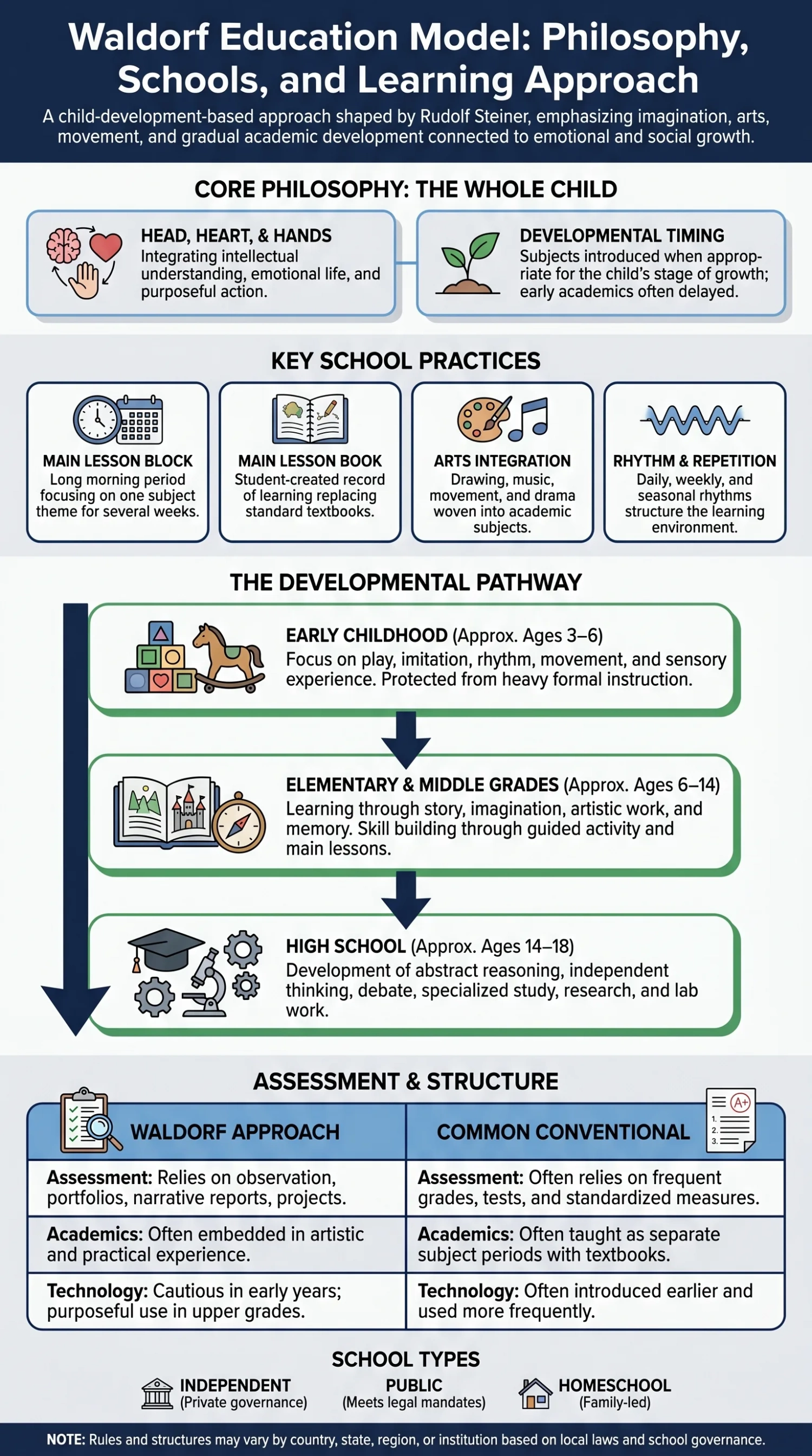
A simple way to understand Waldorf is this: early childhood is protected for play, imitation, rhythm, movement, and sensory experience; the elementary years use story, image, art, music, handwork, and active learning; the adolescent years add more abstract reasoning, debate, independent thinking, and specialized study. In practice, schools vary, but this broad developmental pattern is one of the model’s most recognizable features.
A Practical Way to Understand the System
Waldorf education is less about a fixed textbook sequence and more about when, how, and through what kind of experience a child meets knowledge. The same subject may be taught through movement, drawing, oral storytelling, observation, writing, music, and practical tasks before it becomes a formal abstract concept.
Philosophy Behind Waldorf Education
The philosophy behind Waldorf education rests on the idea that schooling should educate the whole child, not only the part of the child that can memorize facts or score well on a written test. Waldorf language often speaks about the development of thinking, feeling, and willing. In plainer terms, this means intellectual understanding, emotional life, and purposeful action.
AWSNA describes Waldorf pedagogy as developmentally appropriate and experiential, with the arts integrated into academic disciplines from preschool through twelfth grade.[c] This does not mean that academic subjects are absent. It means that subjects such as mathematics, science, literature, history, languages, and geography are often introduced through experience, image, story, pattern, observation, artistic work, and conversation.
In many Waldorf schools, the teacher’s task is not only to deliver content but to study the development of the child and shape lessons so that content meets the class at the right moment. The Association of Waldorf Schools of North America describes core elements such as the student-teacher relationship, the artistic approach, learning from experience to concept, the use of rhythm and repetition, and observation as a basis for assessment.[d]
Waldorf philosophy should not be confused with a no-academics approach. The model delays or softens some forms of early formal instruction, especially in early childhood, but it still expects serious academic work as children grow older. The timing and method are different from many conventional school models.
How Waldorf Schools Work in Practice
A Waldorf school day often has a recognizable rhythm. Many schools begin with a long academic block known as the main lesson. This period may focus on one subject area for several weeks, allowing students to stay with a theme long enough to draw, write, discuss, observe, practice, and create their own record of learning. Students often produce a main lesson book instead of relying only on a standard textbook.
The school day may also include foreign language, handwork, music, movement, painting, drawing, practical arts, gardening, drama, games, or outdoor activity. The balance changes by age. A kindergarten classroom will usually look very different from a Waldorf high school physics, literature, or history class.
The model gives strong weight to rhythm. This can mean daily rhythm, weekly rhythm, seasonal rhythm, and the repeated return to a subject at deeper levels. In the early years, rhythm may appear through songs, stories, outdoor play, cooking, cleaning, handwork, and seasonal activities. In the upper years, rhythm may appear through blocks of focused study, projects, rehearsals, laboratory observation, and written work.
| Feature | How It Usually Appears | Why It Matters |
|---|---|---|
| Main Lesson | A longer lesson block focused on one theme for several weeks. | It gives students time to meet a subject through story, practice, art, discussion, and written work. |
| Main Lesson Book | A student-created record of learning, often with writing, diagrams, drawings, and summaries. | It shifts part of the learning record from a textbook to the student’s own work. |
| Arts Integration | Drawing, painting, music, movement, drama, modeling, and handwork appear across subjects. | It connects academic learning with expression, memory, observation, and skill. |
| Teacher Continuity | In some schools, one class teacher may stay with a class for several years. | It supports long-term knowledge of students, though the exact practice varies by school. |
| Narrative Assessment | Teachers may use written reports, portfolios, conferences, and observation along with required tests. | It gives a fuller picture of progress than a single test score, but can be harder to compare across schools. |
Age Groups and School Settings
Waldorf education is used from early childhood through secondary education, although not every school offers every stage. Some schools offer only early childhood programs. Others run from kindergarten through Grade 8. Some include high school. AWSNA describes Waldorf education across preschool through twelfth grade, but the exact grade span depends on the individual school and the rules of the country or state where it operates.[e]
| Stage | Typical Age Range | Common School Setting | Learning Emphasis |
|---|---|---|---|
| Early Childhood | About 3–6 | Kindergarten, nursery, preschool, or early childhood center | Play, imitation, rhythm, movement, outdoor activity, practical tasks, oral language, and social habits. |
| Lower Grades | About 6–10 | Elementary or primary grades | Storytelling, drawing, music, movement, early literacy, numeracy, nature study, handwork, and class rhythm. |
| Middle Grades | About 10–14 | Upper elementary, middle school, or lower secondary | Growing academic structure, history, geography, sciences, mathematics, language work, practical arts, and projects. |
| High School | About 14–18 | Secondary or upper school | More abstract thinking, specialized subjects, laboratory work, literature, debate, research, arts, and preparation for graduation requirements. |
The well-known Waldorf idea of three broad developmental phases often appears in teacher education and school descriptions. These phases are usually described in approximate seven-year periods: early childhood, elementary years, and adolescence. Public Waldorf education materials also describe human development as proceeding in approximate seven-year phases, while noting that public schools must meet legal mandates in their location.[f]
Teaching Role and Student Role
The teacher role in Waldorf education is broad. The teacher is expected to know subject matter, understand child development, observe students closely, shape lessons artistically, and build a steady class culture. In the early and middle grades, the teacher may be a storyteller, artist, organizer, observer, mentor, and academic instructor. In the high school years, specialist teachers often become more prominent.
The student role also changes by age. Young children learn through imitation, play, movement, language, rhythm, and sensory experience. Elementary students are expected to engage through imagination, artistic work, memory, practice, and growing skill. Adolescents are asked to develop judgment, independent thinking, careful observation, discussion, written argument, and personal responsibility.
| Area | Teacher Role | Student Role |
|---|---|---|
| Early Childhood | Creates rhythm, models purposeful work, protects play, and supports social habits. | Learns through imitation, movement, play, language, sensory experience, and daily routine. |
| Elementary Years | Presents lessons through story, image, movement, music, drawing, practice, and observation. | Builds skills through imagination, repetition, artistic work, memory, and guided activity. |
| Middle Grades | Introduces stronger academic form while keeping practical and artistic learning active. | Develops accuracy, stamina, curiosity, collaboration, and more independent written work. |
| High School | Works more as subject specialist, seminar leader, mentor, and project guide. | Practices analysis, debate, research, laboratory work, performance, self-direction, and reflection. |
Classroom Structure and Learning Materials
A Waldorf classroom often looks different from a conventional classroom, especially in early childhood and elementary grades. Early childhood rooms may use natural materials, open-ended toys, seasonal tables, cloths, wooden objects, simple play structures, and spaces for domestic tasks. The room is meant to invite imaginative play rather than constant direct instruction.
In the grades, the classroom often includes student artwork, chalkboard drawings, handwork, musical instruments, maps, nature materials, and main lesson books. Textbooks may be used less heavily in some grades, while teacher-prepared lessons, oral presentation, experiments, primary texts, field observation, and student-created work may carry more weight.
Waldorf schools are often known for a cautious attitude toward screens in early childhood. This is not always the same as refusing all technology. Many Waldorf high schools use technology in age-appropriate ways, especially when students need research skills, media literacy, science tools, design work, or preparation for external graduation requirements. The point is usually timing and purpose, not a blanket claim that all technology is harmful.
Where Official Details May Vary
Technology policy, reading instruction timing, assessment records, graduation requirements, and teacher qualifications can differ by school and country. A private Waldorf school, a public Waldorf charter school, and a Steiner-inspired kindergarten may share ideas but still operate under different legal and curriculum rules.
Curriculum Approach
Waldorf curriculum is often described as developmental. This means subjects are introduced when teachers believe the content fits the child’s stage of growth. In early childhood, the curriculum may not look like “curriculum” in a conventional sense because much of the learning happens through play, rhythm, oral language, movement, imitation, and practical activity.
In the elementary and middle grades, subjects are often arranged in thematic blocks. A class might study local geography, farming, house-building, ancient stories, fractions, botany, geometry, physics, or history through a mix of teacher presentation, artistic work, hands-on tasks, and writing. A strong lesson is expected to reach the student through head, heart, and hands: thought, feeling, and action.
By the high school years, Waldorf education usually becomes more visibly academic. Students may study literature, modern history, chemistry, physics, biology, mathematics, languages, philosophy, arts, music, drama, and practical subjects. Where schools must prepare students for national exams, diplomas, or university entrance, the Waldorf curriculum has to interact with those requirements.
The Main Lesson Pattern
The main lesson is one of the clearest Waldorf practices. Rather than changing subjects every short period, students spend a longer morning block on one subject area for a period of weeks. This allows the class to enter a topic through many forms: speech, drawing, writing, experiment, movement, review, and discussion. The student’s main lesson book often becomes both a record and a personal expression of the learning.
Arts and Practical Work
Art in Waldorf education is not treated only as a separate subject. It is often used as a method for learning. Students may draw geometric forms, paint color studies, sing songs connected with language learning, act out historical scenes, model scientific forms, knit, sew, carve, garden, cook, or perform music. The aim is not simply decoration. The aim is to let students do something with knowledge.
Assessment and Progression
Waldorf assessment often relies on teacher observation, student work, portfolios, performances, projects, written comments, and narrative reports. In many settings, grades and standardized tests are not the main tool in early years. This does not mean students are never assessed. It means that assessment may be more descriptive and long-term than a system built mainly around frequent marks.
The AWSNA principles identify observation as the foundation for assessment within the Waldorf approach.[g] A teacher may look at a student’s written work, speech, artistic work, handwork, participation, memory, movement, social development, and ability to work independently. In upper grades and high school, schools may also use exams, transcripts, credit systems, or national qualifications when required.
| Assessment Type | Where It Commonly Appears | What It Can Show | Possible Limit |
|---|---|---|---|
| Teacher Observation | All stages, especially early childhood and grades | Growth over time, habits, social development, attention, effort, and readiness. | It depends heavily on teacher skill and clear communication. |
| Main Lesson Books | Elementary and middle grades | Understanding, written expression, care, sequencing, artistic work, and review. | Comparison across schools can be difficult without shared criteria. |
| Narrative Reports | Many Waldorf schools | Detailed description of progress, strengths, needs, and class participation. | Families used to grades may need help reading them well. |
| Projects and Performances | Middle grades and high school | Independence, planning, presentation, research, artistic skill, and persistence. | Quality expectations should be clear to students and parents. |
| External Exams or Credits | Where required by law, graduation, or university entrance | Standard comparison for diplomas, transfer, or admissions. | May not reflect the full range of Waldorf learning aims. |
Types of Waldorf Schools
Waldorf schools do not all have the same legal status. The school type matters because it affects tuition, admissions, accountability, curriculum requirements, teacher credentials, testing, and graduation records.
| School Type | Typical Funding or Governance | What Families Should Check |
|---|---|---|
| Independent Waldorf School | Usually privately governed, often tuition-based, and connected to Waldorf associations or accreditation processes. | Accreditation, teacher training, tuition, grade span, transfer records, high school preparation, and school governance. |
| Public Waldorf School | Publicly funded in some countries or regions; in the United States this often means charter or public school arrangements. | Legal mandates, standardized testing, access rules, curriculum adaptation, special education services, and public accountability. |
| Steiner-Inspired Early Childhood Center | May operate as preschool, kindergarten, nursery, or childcare depending on local law. | Licensing, staff qualifications, safety rules, daily rhythm, screen policy, and transition to primary school. |
| Waldorf-Inspired Homeschooling | Family-led education using Waldorf materials or methods, subject to homeschool laws. | Legal homeschool requirements, recordkeeping, assessment rules, and whether the approach fits the child and parent capacity. |
The International Forum for Steiner/Waldorf Education notes that Waldorf schools are diverse and may align their practice with cultural circumstances while still drawing from shared characteristics of Waldorf pedagogy.[h] This is why a Waldorf school in one country should not be assumed to operate exactly like a Waldorf school elsewhere.
Waldorf Education in Public Schools
Public Waldorf education is a separate area to understand. A public Waldorf school may use Waldorf-inspired pedagogy while also meeting public education laws. The Alliance for Public Waldorf Education states that public Waldorf education works with child development, relationship-based learning, access, diversity, legal mandates, and public accountability.[i]
This can create a different balance from an independent Waldorf school. For example, a public school may need to follow state standards, administer standardized tests, use public enrollment rules, provide legally required services, and document progress in ways that fit the public system. It may still use Waldorf methods such as arts integration, rhythm, main lessons, movement, and experiential learning.
Public Waldorf is not simply private Waldorf with no tuition. It is Waldorf-inspired education working inside public school law. Families should check the school’s charter, public accountability rules, special education services, and testing requirements.
Strengths of the Waldorf Education Model
The strengths often associated with Waldorf education come from its attention to development, relationships, creativity, and practical experience. Many families are drawn to the model because it offers a slower, more human-paced early childhood environment and a richer role for arts and hands-on learning than they see in some conventional systems.
- Arts are woven into academic learning. Students may draw, sing, move, model, paint, perform, and write as part of subject learning.
- Early childhood is protected from heavy formal instruction. Play, imitation, rhythm, movement, and practical life receive more attention.
- Teacher-student relationships may be long-term. In many schools, teachers know students over several years, which can support careful observation.
- Learning uses the body and senses. Movement, handwork, outdoor activity, and practical tasks are not treated as extras only.
- Narrative assessment can give richer feedback. A written report can explain growth, work habits, social development, and subject progress more fully than a number alone.
- The model values imagination and meaning. Story, myth, biography, drama, and image help children connect emotionally with content before later analysis.
These strengths can be valuable for students who respond well to artistic work, oral language, project-based learning, nature, handwork, movement, and close classroom community. They may also appeal to families who want less screen exposure in early childhood and a slower path into test pressure.
Limits and Criticisms
A balanced view also needs to name the limits. Waldorf education is not automatically the right fit for every child, family, teacher, or education system. The same features that some families value can raise concerns for others.
- Academic timing may differ from conventional expectations. Families who expect early formal reading, frequent worksheets, or regular grades may find the early years unfamiliar.
- School quality varies. Because Waldorf schools are not all governed by one national authority, the quality of teaching, leadership, support services, and communication can differ.
- Assessment may feel less transparent to some families. Narrative reports can be rich, but parents may still want clear information about grade-level skills, transfer readiness, and exam preparation.
- Anthroposophy can be misunderstood or disputed. It informs the historical roots of the model, yet schools differ in how openly they discuss it with families and how they separate teacher study from student curriculum.
- Research is still mixed and uneven by topic. A 2024 survey of empirical research notes that Waldorf research has grown, but English-language overviews and coverage across topics remain uneven.[j]
- Public accountability can create tension. Public Waldorf schools must meet legal standards, testing rules, and public service requirements, which may shape how the model is applied.
A Useful Way to Read the Evidence
Waldorf education should not be judged only by slogans, either positive or negative. Useful evaluation looks at student experience, teacher quality, school transparency, legal compliance, academic progression, assessment records, inclusion practices, and long-term fit. A good Waldorf school should be able to explain both its philosophy and its practical results.
How Waldorf Compares With Traditional Education
“Traditional education” is a broad phrase, so the comparison should be careful. A conventional public or private school may be excellent, weak, creative, rigid, test-heavy, project-based, or highly supportive depending on the country and school. Still, Waldorf education often differs in some clear ways.
| Area | Many Waldorf Schools | Many Conventional Schools |
|---|---|---|
| Early Childhood | More play, rhythm, imitation, movement, practical life, and delayed formal academics. | May introduce formal literacy, numeracy, worksheets, and digital tools earlier. |
| Lesson Method | Experience, story, image, art, movement, observation, and main lesson blocks. | Often subject periods, textbooks, worksheets, tests, and direct instruction, though this varies. |
| Assessment | Narrative reports, portfolios, observation, projects, and required external measures where applicable. | Often grades, tests, report cards, benchmarks, and standardized measures. |
| Arts | Arts are frequently part of academic teaching, not only separate classes. | Arts may be separate subjects or electives, depending on resources and policy. |
| Technology | Usually cautious in early years, with more purposeful use later. | May use digital tools earlier and more often. |
| Curriculum Control | Teachers may have more pedagogical freedom within shared Waldorf principles and school agreements. | Curriculum is often shaped by national, state, district, exam, or school standards. |
The comparison does not prove that one model is always better. Waldorf education may suit one student and frustrate another. A conventional school may be more appropriate for a child who needs explicit structure, frequent measurable feedback, advanced early academics, specialized services, or a clear exam path. A Waldorf school may be a strong fit for a child who thrives through story, art, rhythm, practical work, movement, and close community.
Who Waldorf Education May Suit
Waldorf education may suit families who value developmental pacing, arts-based learning, nature, handwork, oral language, community, and reduced early screen exposure. It may also appeal to students who learn well through doing, making, moving, listening, observing, and creating.
It may be less suitable when a family wants early formal academics, frequent numerical grades, heavy test preparation from the start, a strongly technology-based classroom, or a highly standardized curriculum with easy comparison across schools. It may also be a poor fit if a school cannot clearly explain how it supports students with learning differences, tracks academic progress, prepares for transfer, or meets national requirements.
The best question is not “Is Waldorf good?” in the abstract. A better question is: Does this specific Waldorf school, with these teachers, this governance, this assessment practice, this student support system, and this legal context, fit this child?
What Readers Often Confuse
Waldorf Education vs Montessori Education
Waldorf and Montessori are both alternative education models, but they are not the same. Montessori often emphasizes prepared environments, self-correcting materials, individual choice, and independent work. Waldorf emphasizes rhythm, imagination, story, art, teacher-led class culture, and developmental timing. Both may value the child, but their classroom methods and philosophy differ.
Waldorf Philosophy vs Religious Instruction
Waldorf education has historical roots in Steiner’s anthroposophy, but this does not automatically mean students receive religious instruction in anthroposophy. Schools differ in how they explain the philosophical background. Parents should ask directly how the school handles festivals, stories, spiritual language, teacher training, and classroom content.
Delayed Formal Academics vs Weak Academics
Delaying some formal instruction in early childhood is not the same as rejecting academics. Waldorf schools often expect strong work in later grades. The concern for families is whether the timing fits the child and whether the school documents progress clearly.
Arts Integration vs Art Class Only
In Waldorf education, art is not only a separate subject. Drawing, music, movement, drama, handwork, and modeling may be used to teach mathematics, science, language, history, and geography. This is why a Waldorf classroom can look more artistic than a conventional classroom without being less academic.
Independent Waldorf vs Public Waldorf
Independent Waldorf schools and public Waldorf schools may share methods, but they do not have the same legal conditions. Public Waldorf schools must meet public school requirements. Independent schools may have more freedom but also require close attention to accreditation, tuition, governance, and transfer records.
Common Terms Readers Should Know
| Term | Meaning | Why It Matters |
|---|---|---|
| Waldorf Education | An educational model based on Rudolf Steiner’s educational ideas and child-development view. | It is the main term used in North America and many international settings. |
| Steiner Education | Another name for Waldorf education, used more commonly in some countries. | Readers may see both terms used for the same school movement. |
| Rudolf Steiner | The Austrian thinker whose educational ideas shaped the first Waldorf school. | His philosophy is the historical source of the model. |
| Anthroposophy | Steiner’s wider spiritual-philosophical movement. | It informs the history and teacher study of Waldorf education, though schools vary in how they discuss it. |
| Main Lesson | A focused lesson block, often taught over several weeks. | It is one of the most recognizable Waldorf teaching structures. |
| Main Lesson Book | A student-created book of written and artistic work from a lesson block. | It often replaces or supplements textbook-centered learning. |
| Eurythmy | A movement art associated with Steiner education, used in some Waldorf schools. | It is a distinctive practice that may be unfamiliar to new families. |
| Narrative Report | A written description of student progress, often broader than a grade. | It reflects Waldorf’s preference for descriptive assessment, especially in earlier years. |
| Public Waldorf | Waldorf-inspired education within public school law. | It differs from independent Waldorf because public mandates still apply. |
What Can Change by Country or School
Waldorf education changes shape when it enters different legal systems. A school must work with local rules on compulsory education, teacher qualifications, safety, special education, testing, curriculum standards, graduation, inspection, and university entrance. This means a Waldorf high school in one country may have different exam duties from a Waldorf high school in another country.
The site is an independent informational guide and is not affiliated with any ministry of education, school authority, exam board, university, government agency, Waldorf association, or official ranking organization. For enrollment, transfer, graduation, accreditation, special education, or university entrance decisions, readers should check the specific school and the relevant official education authority.
Families comparing schools should ask practical questions: Is the school accredited or recognized? How does it document reading and mathematics progress? What happens when a student transfers? How does the school support students with learning needs? What external exams or graduation records are required? How does the school explain anthroposophy to parents? What teacher training do staff members have?
Sources and Verification
- [a] Waldorf school | Benefits, Curriculum & History | Britannica — Used for the founding of the first Waldorf school in Stuttgart in 1919 and the connection with the Waldorf-Astoria Company. (Reliable because Britannica is an established edited reference publisher.)
- [b] Rudolf Steiner | Anthroposophy, Education, Philosophy | Britannica — Used for Rudolf Steiner’s role as founder of anthroposophy and background context for the educational philosophy. (Reliable because Britannica is an established edited reference publisher.)
- [c] Discover Waldorf Education | Purposeful, Holistic, and Inspired Learning | AWSNA — Used for Waldorf pedagogy as developmental, experiential, and arts-integrated from preschool through twelfth grade. (Reliable because AWSNA is a major Waldorf school association in North America.)
- [d] AWSNA Principles for Waldorf Schools | AWSNA — Used for Waldorf principles including child development, student-teacher relationships, artistic approach, rhythm, repetition, and observation-based assessment. (Reliable because AWSNA publishes principles for member Waldorf schools.)
- [e] Discover Waldorf Education | Purposeful, Holistic, and Inspired Learning | AWSNA — Used for the preschool-through-grade-12 scope of Waldorf education. (Reliable because AWSNA is a major Waldorf school association in North America.)
- [f] Core Principles — Alliance for Public Waldorf Education — Used for Public Waldorf descriptions of child development, approximate seven-year phases, legal mandates, relationship-based learning, and public accountability. (Reliable because the Alliance represents public Waldorf education principles.)
- [g] AWSNA Principles for Waldorf Schools | AWSNA — Used for observation as a foundation for assessment in Waldorf schools. (Reliable because AWSNA publishes principles for member Waldorf schools.)
- [h] International Forum for Steiner/Waldorf Education (Hague Circle) – Guidelines — Used for the point that Waldorf schools share general characteristics while adapting to cultural circumstances and school diversity. (Reliable because the International Forum describes shared Steiner/Waldorf guidelines internationally.)
- [i] Core Principles — Alliance for Public Waldorf Education — Used for public Waldorf education principles, including child development, access, diversity, legal mandates, and school accountability. (Reliable because the Alliance publishes principles for public Waldorf schools.)
- [j] Waldorf education – a survey of empirical research | RoSE – Research on Steiner Education — Used for research context and the note that empirical Waldorf research has grown but remains uneven across topics and languages. (Reliable because it is a peer-reviewed article page hosted by RoSE, Research on Steiner Education.)
Related Topics
- → Montessori Education Model: How It Works and Who It Is For
- → IB Education Model: Curriculum, Exams, and Global Recognition
- → Project-Based Learning: How This Education Model Works
- → Private Education Model: Schools, Fees, Curriculum, and Access
- → Online Learning Model: Virtual Schools, Digital Classes, and Hybrid Education
- → Traditional Education Model: Structure, Strengths, and Limitations