Complete guide: Education Models
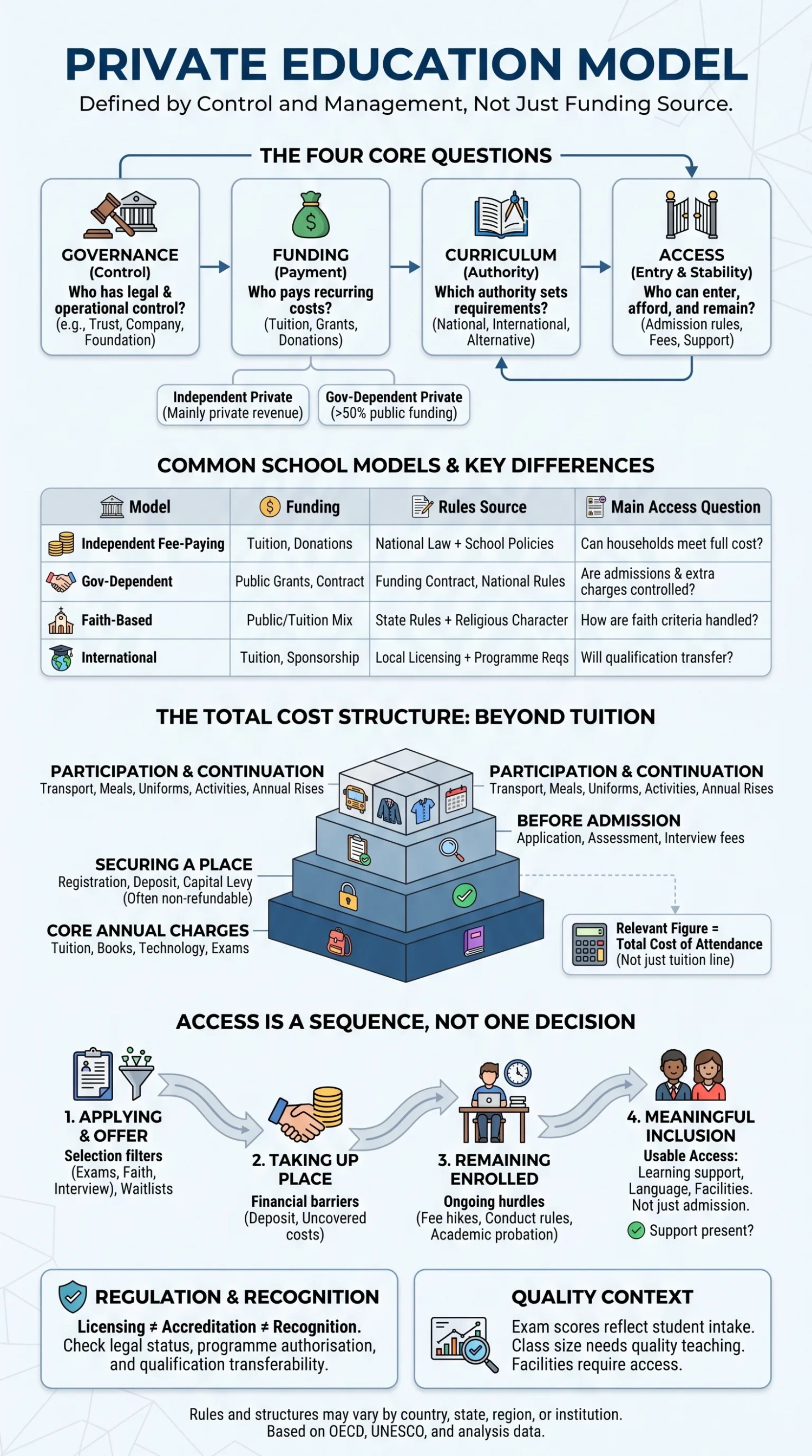
A private education model is defined first by who controls and manages a school, not simply by who pays its bills. Some private schools depend almost entirely on tuition and donations. Others are privately managed but receive most of their operating money from government. A private school may follow a national curriculum closely, offer an approved alternative, or combine local requirements with an international programme. Access is shaped by more than the advertised fee: admission rules, transport, language support, disability provision, recurring charges, and re-enrolment policies can all determine who enters and who remains. OECD data place about one in five students from pre-primary through secondary education in private schools, yet the legal and financial meaning of “private” differs widely between systems.[a]
“Private” Describes Control Before It Describes Funding
The label private school often creates an image of a fee-charging institution operating outside the public system. That description fits some schools, but it does not cover the full range of private provision. International statistics normally classify a school by the body that controls it. A company, trust, foundation, religious organisation, non-profit association, community group, or individual may manage the institution even when public money pays a large share of its costs.
The OECD separates private institutions into two broad financial categories. A government-dependent private institution receives more than half of its core funding from public sources, while an independent private institution relies mainly on tuition, donations, endowment income, or other private revenue. Both remain privately controlled. The distinction prevents a common error: treating every privately managed school as if it were financed in the same way.[b]
The Four Questions Behind Any Private School Model
Governance: Who has legal and operational control? Funding: Who pays the recurring cost? Curriculum: Which authority sets learning requirements and qualifications? Access: Who can enter, afford, and remain in the school?
These four questions can produce very different arrangements. A school may be privately governed, publicly financed, required to teach a national curriculum, and prohibited from selecting students by academic ability. Another may be privately governed and privately financed, use an international programme, and control its own admission process. Calling both institutions “private” is correct, but the label alone says little about the student experience.
| School Model | Typical Operator | Main Funding Pattern | Common Source of Rules | Main Access Question |
|---|---|---|---|---|
| Independent fee-paying school | Trust, company, foundation, or individual owner | Tuition, donations, endowment, and ancillary charges | National law plus school policies and any accreditor requirements | Can households meet the full cost over several years? |
| Government-dependent private school | Non-state organisation | Public grants or publicly paid staff, sometimes with limited fees | Funding contract, national rules, and inspection requirements | Are admissions and extra charges controlled? |
| Faith-based school | Religious organisation or affiliated trust | Public funding, tuition, community support, or a mixture | State curriculum rules plus the school’s religious character | How are faith criteria and student choice handled? |
| International school | Non-profit foundation, company, embassy-linked body, or school group | Usually tuition, employer support, or institutional sponsorship | Local licensing rules and the requirements of the offered programme | Will the curriculum and qualification transfer across systems? |
| Low-fee private school | Small proprietor, community organisation, or school chain | Household payments, sometimes supplemented by grants | Local registration and minimum school standards | Does the low headline fee conceal other costs or weak provision? |
| Contract-managed school | Private or non-profit operator under a public agreement | Government contract or per-student allocation | Contract terms, public standards, and performance monitoring | Who is responsible when the operator does not meet its duties? |
The Fee Structure Extends Beyond Tuition
The published tuition figure is rarely the complete cost of private schooling. Families may face an application charge before the school considers the student, an assessment charge before admission, a registration payment after an offer, and a deposit to reserve the place. Some schools also collect a capital, building, development, or technology levy. These charges may be non-refundable even when a family decides not to enrol.
Recurring costs can include books, digital licences, uniforms, meals, transport, examinations, laboratory materials, compulsory devices, sports, arts, field trips, and school clubs. Boarding schools add accommodation, residential supervision, health services, weekend activities, travel arrangements, and sometimes a guardian service. An activity described as optional may still affect participation if most students are expected to join it.
The Relevant Figure Is the Total Cost of Attendance
A useful first-year calculation is: tuition + admission and registration charges + compulsory recurring costs + realistic participation costs − confirmed aid. Later-year planning should also include likely fee changes and the cost of moving to another school if continuation becomes unaffordable.
UNESCO treats uniforms, books, transport, meals, digital access, and other school-related payments as costs that can restrict participation even where tuition is removed or reduced. Grants and scholarships can improve enrolment, but they need to address the expenses that households actually face rather than the tuition line alone.[c]
Fee Contracts Shape Continuity as Well as Entry
A family may be able to afford entry but not the full student pathway. Fee schedules can rise each year, while discounts may expire when a child moves to another campus or school stage. A bursary may be reassessed annually. Withdrawal clauses can require notice one term in advance, and failure to give notice may trigger another term’s tuition. Deposits may be applied to the final bill rather than returned immediately.
The most revealing documents are often the enrolment contract, fee regulations, refund policy, scholarship conditions, and re-enrolment rules. They show whether a student can be excluded from classes or examinations for unpaid balances, whether records are released during a fee dispute, and what happens when financial hardship develops during the year. These matters vary by jurisdiction and contract law; they should not be inferred from the school’s promotional material.
| Cost Layer | Examples | Question to Verify |
|---|---|---|
| Before admission | Application, assessment, interview, document review | Is any payment refundable if no place is offered? |
| Securing a place | Registration, deposit, enrolment, capital levy | When can the school retain the payment? |
| Core annual charges | Tuition, books, technology, examinations | Which items are mandatory and which can be sourced elsewhere? |
| Daily participation | Transport, meals, uniform, activities | Can the student participate fully without buying each service? |
| Continuation | Annual fee rise, re-enrolment deposit, renewed aid application | Is there any limit, notice period, or protection against abrupt change? |
| Leaving the school | Withdrawal charge, notice-period tuition, record transfer | What financial and academic documents are released, and when? |
Public Funding Changes the School’s Obligations
Public money can reach a privately managed school through an operating grant, a per-student allocation, publicly paid teachers, a voucher, a targeted scholarship, a tax arrangement, a building subsidy, or a management contract. The route matters because it determines which conditions can be attached to the money. A government may limit tuition, prohibit selective admission, set staff requirements, require audited accounts, or reserve places for defined student groups.
Public funding does not automatically create equal access. A school can receive a subsidy yet continue to charge top-up fees. It can apply admission criteria that favour families with more information or resources. Transport may remain the household’s responsibility. A voucher may cover only part of tuition, and a scholarship may not cover uniforms, meals, devices, or examinations.
OECD reviews of publicly funded private schooling identify selective admission, additional tuition charges, and for-profit ownership as areas that require close rules when public funds are involved. The effects of publicly supported private provision differ across systems because funding design and enforcement differ. Clear admission conditions, fee rules, accreditation, financial reporting, and monitoring can change who benefits from school choice.[d]
| Funding Route | Money Is Directed To | Possible Condition | Access Risk if Rules Are Weak |
|---|---|---|---|
| Operating grant | The school or operator | Approved budget, staffing, curriculum, and reporting | Public support may not reduce household charges |
| Per-student allocation | The school based on enrolment | Open admission or funding weighted for student need | Schools may favour students who cost less to educate |
| Voucher | The family’s chosen approved school | Fee limits and participation standards | Top-up charges can separate families by income |
| Targeted scholarship | An eligible student or receiving school | Income, disability, location, or another defined condition | Uncovered expenses can make the place unusable |
| Management contract | The contracted operator | Performance, access, staffing, and reporting duties | Responsibility can become unclear when results are poor |
| Teacher salary support | Approved teaching posts | Qualification, pay, workload, and appointment rules | Support may cover staff while other charges remain high |
Curriculum Freedom Has Several Boundaries
Private status does not give a school unlimited control over what students learn. Governments may require minimum teaching time, defined subjects, local language instruction, national history or civics, health and safety content, approved assessment, and recognised graduation conditions. The school may retain freedom over teaching methods, textbooks, timetable design, enrichment subjects, religious education, arts, technology, or the pace of study.
Curriculum authority therefore sits on a spectrum. At one end, a private school follows the national curriculum and national examinations in much the same way as a public school. In the middle, the school teaches the required national core while adding its own programme. At the other end, it offers an approved international or alternative curriculum while still meeting local legal requirements. The exact position can change by school stage: a school may use a proprietary primary programme and switch to an externally recognised qualification in secondary education.
Curriculum, Programme, and Qualification Are Different Claims
A school may use teaching materials associated with a named programme without being authorised to offer its qualification. It may be licensed to operate locally without its diploma being recognised elsewhere. Verification should cover the school, the campus, the programme, the examination entry route, and the final credential separately.
National Requirements Can Continue Inside an International School
International schools often combine more than one educational layer. Students may study an international programme while also taking required local language, history, religion, or citizenship courses. Local students and foreign students may face different compulsory subjects. Graduation from the school may not by itself establish eligibility for every university system; the recognised qualification, subject combination, grade profile, and language evidence can matter separately.
Faith-Based Education Operates Within Education Law
A faith-based school may include religious instruction, worship, an ethical code, or admission priorities linked to its character. Those features do not remove the school from national education requirements. UNESCO’s Convention against Discrimination in Education recognises parental choice and the establishment of private or religious institutions, while stating that the education provided should meet standards laid down or approved by competent authorities and should not be organised to exclude a group.[e]
Access Is a Sequence, Not a Single Admission Decision
Access begins before an application and continues until the student completes the programme. A school may appear open to all but be unreachable without private transport. It may advertise financial aid while requiring a deposit that a low-income family cannot pay. It may accept a student who needs language or learning support but charge separately for the service. It may admit the student for one year and reserve the right not to renew the place.
| Stage of Access | What Can Restrict Participation | Evidence That Clarifies the Rule |
|---|---|---|
| Finding the school | Distance, transport, language of information, application timing | Admissions calendar, transport map, translated information |
| Applying | Application charge, documents, interview, prior records | Published application rules and fee policy |
| Receiving an offer | Academic selection, faith priority, sibling priority, limited places | Admission criteria and waiting-list procedure |
| Taking up the place | Deposit, uniform, device, transport, uncovered support costs | Full first-year cost and aid coverage statement |
| Participating | Language access, disability support, activity charges, timetable | Support plan, inclusion policy, and itemised charges |
| Remaining enrolled | Fee increases, conduct rules, academic thresholds, aid renewal | Re-enrolment, discipline, scholarship, and withdrawal policies |
| Completing or transferring | Recognition of credits, records, examinations, school closure | Qualification status, transfer policy, and records procedure |
Selective Admission Can Operate Through Several Filters
Selection can be explicit, such as an entrance examination, grade threshold, language test, audition, faith criterion, or interview. It can also be indirect. High application charges, short deadlines, required recommendations, inconvenient testing locations, and complex financial-aid forms can shape the applicant pool before the school makes a formal decision.
A school may also influence its student profile after admission. Academic probation, behaviour contracts, limited learning support, and discretionary re-enrolment can affect which students remain until graduation. Published examination results should therefore be read alongside entry rules, student turnover, withdrawal patterns, and the number of students who complete the final assessment.
PISA 2022 found that private-school performance advantages in many systems were closely connected to the more advantaged social profile of their students. In the OECD analysis, greater reliance on parent-paid fees was also associated with a smaller share of disadvantaged students. These findings do not establish that every fee-charging school excludes low-income students, but they show why raw school averages cannot be separated from admissions and financing.[f]
Scholarships Can Lower Tuition Without Securing Full Access
Private schools use several forms of aid: income-assessed bursaries, merit awards, sports or arts scholarships, sibling reductions, staff discounts, community sponsorship, hardship funds, and publicly financed placements. The name of an award does not show how much support it provides. A full tuition award can still leave a family responsible for registration, transport, meals, uniform, examinations, trips, and digital equipment.
Aid conditions can also affect stability. A merit award may require a minimum grade. A sports award may depend on continued team participation. A need-based bursary may be reviewed each year and change when household income changes. Some awards apply only to tuition at one campus or school stage. Others are funded for a limited number of years.
A Scholarship Offer Needs an Itemised Reading
The award letter should state the amount, covered charges, duration, renewal process, academic or conduct conditions, treatment of annual fee rises, and consequences of withdrawal. “Full scholarship” should not be assumed to mean that every school-related expense is paid.
Disability, Language, and Learning Support Test the Model in Practice
Formal admission does not guarantee usable access. A student may need a step-free campus, adapted materials, examination adjustments, communication support, assistive technology, a learning-support teacher, counselling, or language instruction. A school may provide some services within tuition, charge separately, ask the family to employ an external specialist, or state that it cannot meet the student’s needs.
The legal duties of private schools differ by country and sometimes by the school’s funding status. Publicly funded private schools may have broader obligations than fully independent institutions. Even where anti-discrimination law applies, the process for obtaining an adjustment, challenging a refusal, or appealing a re-enrolment decision can vary.
Meaningful inclusion asks whether the student can learn, be assessed, join school life, and progress to the next stage—not only whether the school accepted the application.
The clearest evidence is a written support policy paired with specific information about staffing, facilities, charges, assessment arrangements, and review procedures. General promises of a supportive environment do not explain who delivers assistance, how often it is available, or whether the school can continue it throughout the student’s pathway.
Curriculum Quality and School Results Need Context
A private school may offer smaller classes, specialised subjects, longer instructional time, newer facilities, or more flexible teaching. None of those features alone demonstrates stronger learning. A science laboratory has educational value when students use it regularly with suitable teaching. A low student–teacher ratio can coexist with frequent staff turnover. A broad subject list may narrow if only a few courses run each year.
Examination averages also reflect the students who entered, the students who stayed, the subjects they were allowed to take, and any private tutoring used outside school. Comparisons become more useful when they include prior attainment, socio-economic profile, student mobility, completion rates, subject access, and the share of the cohort represented in published results.
| Published Indicator | What It Can Show | What It Does Not Show by Itself |
|---|---|---|
| Average examination score | Performance of the tested group | Entry selection, student withdrawals, or learning gained after admission |
| University placement rate | Destinations reported for a cohort | Which students were included or whether offers became enrolments |
| Class size | Number of students assigned to a class | Teacher experience, subject availability, or instructional quality |
| Student–teacher ratio | Staffing relative to enrolment | How teachers are distributed across classes and duties |
| Accreditation | Recognition by a named body for a stated scope and period | Guaranteed results, universal diploma recognition, or future renewal |
| Facilities list | Resources present on the campus | Frequency of student access or their effect on learning |
Licensing, Accreditation, and Recognition Answer Different Questions
Licensing normally concerns legal permission to operate. Registration places the institution on an official record. Inspection checks selected standards at a point or over a cycle. Accreditation is an external recognition process with a defined scope. Programme authorisation permits the school to offer a named curriculum or qualification. Qualification recognition concerns whether the resulting credential is accepted for transfer, employment, or further study.
One status cannot safely be substituted for another. A legally registered school may not be authorised to award the qualification named in its marketing. An accredited school may hold accreditation only for one campus, school stage, or programme. A candidate status may show that an application is under review rather than completed. Recognition can also depend on the receiving country, university, regulator, or qualification authority.
Verification should use the relevant official register or awarding body and should match the school’s legal name, campus address, programme, age range, and validity period. Families should also confirm how records and credits transfer if the student leaves before completing the final qualification.
Regulation Must Cover Operation, Equity, and Student Protection
Private-school regulation often starts with registration, premises, sanitation, fire safety, teacher credentials, and minimum instructional requirements. Those controls answer whether a school may operate. They do not necessarily answer whether admissions are fair, fees are transparent, students with support needs can participate, public money is traceable, or families have a workable complaint process.
UNESCO’s 2021/2 Global Education Monitoring Report found broad variation in the subjects covered by national rules for non-state schools. About 55% of countries in its review regulated admission procedures, 67% regulated fees in compulsory education, and roughly two thirds regulated curriculum. The report also warned that rules on paper may have limited effect when registration is costly, inspection capacity is weak, or unregistered schools remain outside ordinary oversight.[g]
| Regulatory Area | What a Clear Rule Should Establish | Student Risk When It Is Missing |
|---|---|---|
| Market entry | Legal operator, premises, financial capacity, permitted age range | Sudden closure or operation without recognised status |
| Admissions | Permitted criteria, waiting lists, non-discrimination, appeals | Hidden selection or inconsistent decisions |
| Fees | Disclosure, increases, deposits, refunds, extra charges | Costs that families discover after accepting a place |
| Curriculum and assessment | Minimum content, teaching time, examination and qualification status | Learning gaps or an unrecognised exit credential |
| Staffing | Qualifications, checks, contracts, safeguarding duties | Unverified staff or unstable teaching provision |
| Inclusion | Access duties, adjustments, support charges, complaint routes | Admission without workable participation |
| Public funding | Eligible spending, reporting, audit, access conditions | Public subsidy without public accountability |
| Closure | Notice, refunds, records, transfer support, final examinations | Interrupted education and lost documentation |
School Closure Is an Education Issue, Not Only a Business Failure
A private school can close because of insolvency, loss of a licence, termination of a public contract, falling enrolment, loss of premises, or a decision by its owner. Student protection requires more than notice. Academic records must remain available, examination entries must be secured, deposits and prepaid fees need a defined treatment, and students may need help moving without losing a year.
The operator, education authority, accreditor, awarding organisation, and records custodian may hold different responsibilities. A well-defined system identifies these roles before a closure occurs. Families can look for a closure policy, financial protection arrangement, record-retention procedure, and named authority for complaints.
A Workable Private Education Model Connects Choice With Accountability
Private provision can add school places, offer language or faith-based education, support specialised programmes, and give families alternatives within a national system. Its results depend on how governance, funding, curriculum, and access fit together. The same ownership label can produce an open publicly supported school, a highly selective fee-paying school, a community institution with narrow resources, or an international school designed for mobile families.
A model is easier to assess when it discloses the legal operator, full cost, funding sources, admission rules, curriculum authority, qualification status, staff requirements, support provision, student outcomes, complaint route, and closure protections. Publicly funded providers also need clear rules showing what the subsidy buys for students and which access conditions accompany it.
No single public–private comparison determines whether a school is suitable or whether a national model is fair. The useful comparison is between stated purpose and actual operation: who can enter, who can remain, what education is recognised, what households must pay, and who acts when the school does not meet its obligations.
This site is an independent informational guide and is not affiliated with any ministry of education, school authority, examination board, university, government agency, accreditor, or official ranking organisation. Private-school rules, fees, curriculum permissions, qualification recognition, and admission conditions can change. Decisions should be checked with the relevant education authority, official register, school, awarding organisation, or qualification body.
Sources and Verification
- [a] How do public and private schools differ in OECD countries? — Supports the OECD-wide enrolment context and the need to interpret public–private performance differences through student background. (OECD policy brief.)
- [b] How are primary and lower secondary education financed? — Defines private institutions by control and distinguishes government-dependent from independent private institutions. (OECD 2025 education indicators report.)
- [c] Remove fees and other hidden costs of education — Supports the treatment of tuition and non-tuition expenses as connected barriers to enrolment and continued schooling. (UNESCO SDG 4 Knowledge Hub.)
- [d] Regulating Publicly Funded Private Schools — Reviews admission selection, add-on tuition, for-profit ownership, and conditions attached to public funding. (OECD Education Working Paper.)
- [e] Convention against Discrimination in Education — Supports the discussion of parental choice, private and religious institutions, non-exclusion, and authority-approved education standards. (UNESCO legal instrument.)
- [f] Governing education systems: PISA 2022 Results (Volume II) — Supports the analysis of socio-economic composition, parent-paid fees, and public–private performance comparisons. (OECD PISA 2022 analysis.)
- [g] Non-state actors in education – 2021/2 GEM Report — Provides cross-system findings on regulation of admissions, fees, curriculum, staffing, registration, and unregistered schools. (UNESCO Global Education Monitoring Report.)