Complete guide: Education Models
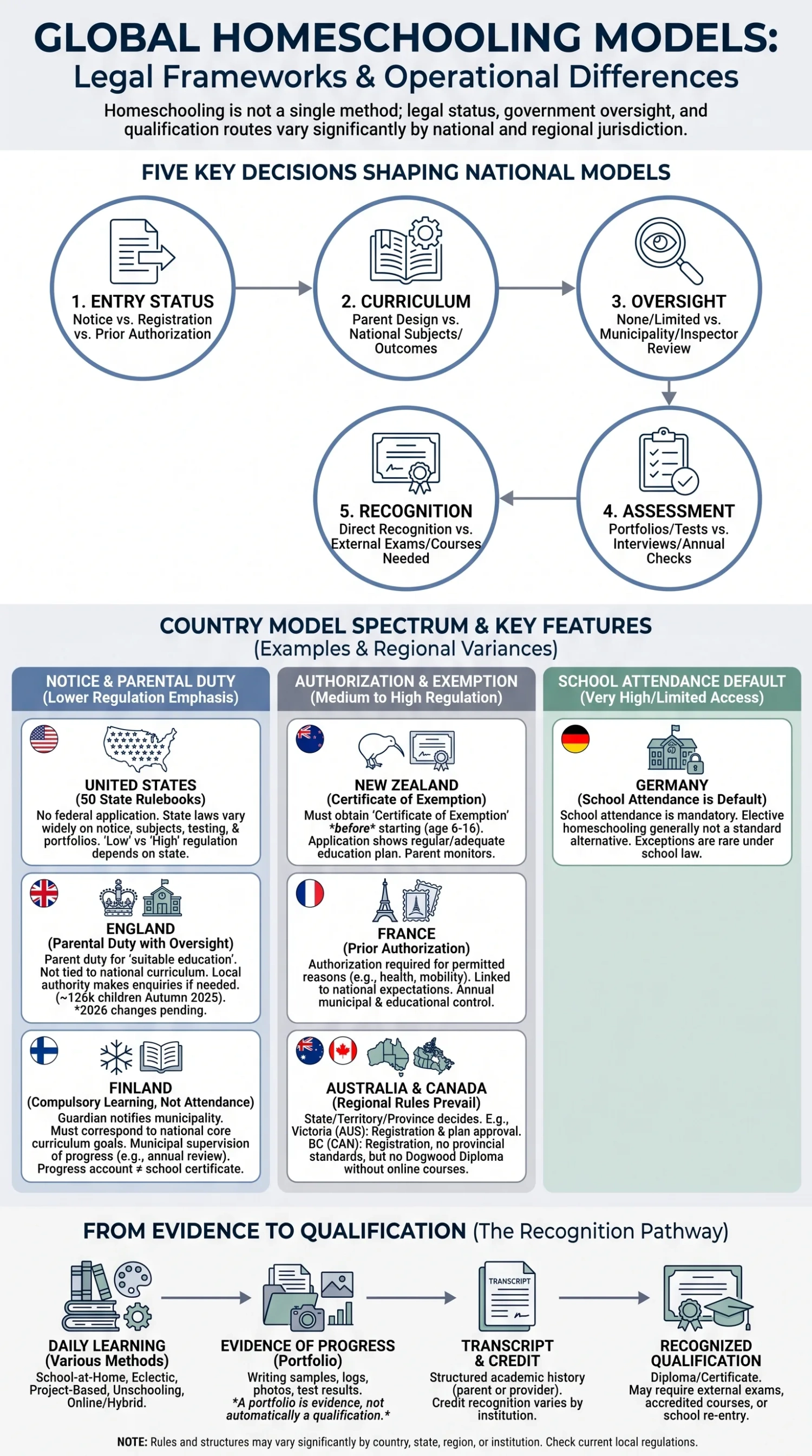
A homeschooling model is not a single teaching method used in the same way everywhere. In one country, a parent may begin after sending a notice. In another, the family must obtain permission, follow national learning goals, submit evidence, or accept inspections. Some systems treat home education as a lawful way to meet compulsory education duties, while others define those duties through attendance at a public or private school. The practical questions therefore begin with legal status: who authorizes the arrangement, what must be taught, how progress is checked, and how the learner later proves completion.
The term also covers arrangements that may look similar at home but have different legal meanings. Parent-directed home education, enrolment in an online school, school-provided distance education, temporary teaching during illness, and informal unschooling may all take place outside a classroom. They do not give the family the same rights, duties, services, or qualification route.
Home Education Begins With Legal Status
Countries first decide what compulsory education requires. Some require a child to receive education but do not require daily attendance at a school. Others allow education outside school only after approval. A third group treats school attendance as the normal way to satisfy the legal duty and permits exceptions only in narrow circumstances. The European Court of Human Rights has noted that European states do not share one position: some permit home education, while others require attendance at a state or private school.[a]
The Same Location Can Carry a Different Status
A child studying at a kitchen table may be a registered homeschooler, an enrolled online-school student, a pupil receiving distance education, or a learner temporarily taught at home because attendance is not possible. The location alone does not identify the legal model.
Elective home education usually means that a parent chooses to take primary responsibility for the child’s education outside full-time school. Online schooling normally keeps the learner enrolled in a recognized school whose teachers, curriculum, assessment, and reporting rules still apply. Home tuition may be arranged by a public authority or school for a learner who cannot attend. Unschooling describes a learner-led approach, but its legality depends on whether the local system accepts the resulting curriculum coverage and evidence of progress.
Five Decisions Shape Every National Model
The differences between countries become clearer when the same five questions are applied to each system.
- Entry: Is a notice enough, is registration required, or must the family receive prior authorization?
- Curriculum: May the parent design the programme, or must it follow national subjects, learning areas, or prescribed outcomes?
- Oversight: Does a municipality, school board, regional office, inspector, or state authority review the arrangement?
- Assessment: Is progress shown through portfolios, interviews, standardized tests, written work, annual checks, or no routine review?
- Recognition: Can home education alone lead to a recognized certificate, or must the learner take external examinations, enrol in credited courses, or enter another institution?
Curriculum freedom and legal freedom are not identical. A family may be free to choose materials while still being required to demonstrate national learning outcomes. Another system may ask only for registration but offer no direct route to a school-leaving certificate.
United States: Fifty State Rulebooks, Not One National Procedure
The United States has no federal homeschooling application that applies to every family. The U.S. Department of Education states that regulation of private and home schools is primarily a state and local responsibility and that the federal department does not have general jurisdiction over homeschools.[b] A family therefore needs the rules of the state where the child is being educated, not a country-level overview alone.
State laws can differ on notice, compulsory subjects, attendance records, parent qualifications, testing, portfolio review, and interaction with the local school district. The same variation affects high school records. A parent may prepare a transcript, but graduation requirements, access to public-school courses, participation in activities, and acceptance of particular records can depend on state law and the receiving institution.
This decentralized structure also changes the meaning of “low regulation” and “high regulation.” A state may ask for little paperwork at entry yet still set subject requirements. Another may require annual notice and assessment but leave daily teaching methods to the parent. Country-level descriptions that label the entire United States as one type of homeschooling system hide these differences.
England: Parental Duty With Local Authority Oversight
In England, elective home education rests on the parent’s duty to secure an efficient, full-time education suitable to the child’s age, ability, aptitude, and any special educational needs. Home education does not have to reproduce school hours or a classroom timetable, and the national curriculum is not automatically the required programme. Local authorities can make enquiries when they need to establish whether suitable education is being provided.[c]
The system distinguishes elective home education from education arranged by a local authority outside school and from children who are missing education. Official statistics reported 126,000 children in elective home education on the autumn 2025 census date, compared with 111,700 in the previous autumn. The Department for Education describes the series as official statistics in development and warns that data quality is still improving.[d]
England’s 2026 Registration Changes
The Children’s Wellbeing and Schools Act 2026 contains provisions on local authority registers for children not in school and on local authority involvement in specified withdrawals from school.[e] An enacted section and a live local procedure are not always the same thing on the same date. Families and schools need to check commencement rules, current guidance, and the relevant local authority process before acting.
England is therefore best understood as a parent-responsibility model with public oversight rather than a curriculum-approval model. The authority’s concern is whether the education is suitable, not whether the home follows an ordinary school day. Evidence may include plans, samples of work, reports from tutors, records of progress, or other material that gives a clear picture of the education being received.
Finland: Compulsory Learning Without a General School-Attendance Duty
Finland separates compulsory education from a general duty to attend school. A guardian can notify the municipality that the child will complete the relevant part of compulsory education through home education. The guardian then carries responsibility for organizing study, obtaining materials, and ensuring that the learner gains knowledge and skills corresponding to the goals and central content of the national core curriculum. The municipality must supervise progress, although local practice determines how this is arranged. The Finnish National Agency for Education describes discussions, portfolios, written and oral tasks, and demonstrations of practical skills as possible evidence; one or two review occasions a year are common practice rather than a fixed national frequency. A written account of progress is not the same as a school certificate.[f]
This model gives families room to organize the learning environment, schedule, and teaching materials, but it does not remove national educational expectations. The municipality compares progress with the required curriculum content. A family also needs to plan how the learner will obtain formal proof of completed basic education when later study or an institution asks for it.
New Zealand: A Certificate of Exemption Comes First
New Zealand uses an exemption model. A parent or legal guardian applies to the Ministry of Education and must receive a Certificate of Exemption before home education replaces enrolment at a registered school. The ministry’s current guidance states that applications cover children from age 6 to 16, that a child older than 6 must remain enrolled while the application is being considered, and that an approved certificate remains valid until the child turns 16 or enrols in a registered school, whichever occurs first.[g]
The application is not simply notice of intent. It needs to show how the learner will be taught as regularly and as well as in a registered school. Families describe the proposed programme, resources, methods, and ways of tracking progress. Once approval is granted, the parent remains responsible for delivery and monitoring.
A 2026 Proposal Was Paused
New Zealand considered tighter monitoring rules for home education in 2026. On 27 May 2026, the government announced that work on those regulation changes would be paused and that the relevant amendments would be removed from the bill then before Parliament.[h] The existing exemption route remains the starting point unless later legislation changes it.
France: Prior Authorization and Regular Control
France treats instruction dans la famille as a permitted exception within compulsory instruction rather than an open choice based only on parental preference. Children resident in France who are subject to compulsory instruction from ages 3 to 16 may receive education in the family only under stated conditions. The parent applies to the Dasen, the departmental education authority, and the permitted reasons include the child’s health or disability, intensive artistic or sporting activity, family mobility within France, distance from a public school, or a situation specific to the child that supports the proposed educational project. The normal application window runs from 1 March to 31 May before the school year, with exceptions for circumstances that arise later. Municipal enquiries and educational controls examine both the declared situation and the learner’s progress; the individual educational control takes place at least once a year.[i]
The French model affects teaching design from the beginning. A family needs an educational project that can be explained to the authority, and later control considers whether the child is progressing toward the expected common base of knowledge, skills, and culture. Parents may choose methods and materials, but the arrangement remains tied to authorization and public review.
Germany: School Attendance Is the Default Legal Route
Germany sits near the school-attendance end of the comparison. School law is made by the Länder, yet compulsory attendance is a general feature of the German system. In a 2021 order, the Federal Constitutional Court stated that school attendance is mandatory in Germany and that children are required to attend classroom lessons.[j] A family’s preference for parent-directed education does not normally create a general exemption from attendance.
This does not mean that learning can never occur at home. A school or authority may arrange exceptional provision when ordinary attendance is not possible. That type of provision remains different from elective homeschooling because the exception, supervision, and educational responsibility arise from school law rather than from a broad parental right to replace school.
Australia and Canada: The Region Often Gives the Real Answer
Australia
Australia has a national curriculum, but state, territory, and non-government education authorities decide how it is delivered.[k] Home education registration and review therefore need to be checked in the state or territory where the child lives. A national description cannot replace the jurisdiction’s application rules.
Victoria shows how a regional model can work. A parent teaching a child at home must register with the Victorian Registration and Qualifications Authority, submit a proposed learning plan, and receive approval. The plan addresses eight learning areas, and the authority may later check that education is being provided. Victorian rules also allow families to approach a government school about partial enrolment for selected subjects or activities.[l]
Canada
Canada follows provincial and territorial education law, so registration, curriculum expectations, school-board involvement, funding, and graduation routes vary. In Ontario, Policy/Program Memorandum 131 directs school boards and schools on home schooling and states that parents continuing home schooling should give written notice to the board each year.[m]
British Columbia uses a different distinction between registered homeschooling and enrolled online learning. A parent providing homeschooling is responsible for the entire programme, the child must be registered each year, and the home programme is not supervised by a British Columbia certified teacher or required to meet provincial curriculum standards. Homeschooling alone does not lead to the British Columbia Certificate of Graduation, commonly called the Dogwood Diploma, although eligible learners in Grades 10 to 12 may take online courses that earn graduation credit while remaining registered homeschoolers.[n]
How the Country Models Compare
The table brings together the legal and educational differences described in the country sections. It is a model comparison, not a substitute for current national, state, provincial, municipal, or local authority rules.
| Country or System | How Home Education Begins | Curriculum Position | Routine Oversight | Recognition Issue |
|---|---|---|---|---|
| United States | State procedure; notice, filing, or another route may apply | Requirements vary by state | Ranges from limited reporting to testing or portfolio review | Transcripts and graduation status depend on state law and receiving institutions |
| England | Parent assumes responsibility; school-removal rules and local procedures matter | Suitable education rather than automatic national-curriculum delivery | Local authority enquiries and developing registration duties | External examinations or provider routes may be needed |
| Finland | Guardian notification to the municipality | Learning must correspond to national core curriculum goals and content | Municipal supervision of progress | A progress account is not automatically a school certificate |
| New Zealand | Ministry Certificate of Exemption | Application must show regular and adequate education | Parent monitoring, with official review possible | Later qualification planning remains separate from exemption |
| France | Prior authorization for a permitted reason | Educational project linked to national expectations | Municipal enquiry and educational control | Progress toward the common base is examined |
| Germany | Elective homeschooling is generally not a standard alternative | School curriculum applies through attendance | School authorities under Land law | Qualifications normally follow recognized school or examination routes |
| Australia | State or territory registration and approval rules | Jurisdiction learning requirements apply | Review methods differ by jurisdiction | Senior certificates and course credit depend on the state or territory route |
| Canada | Provincial or territorial notice or registration | Ranges from parent-led programmes to provincial expectations | School-board or ministry involvement varies | High school diploma access depends on the province and enrolment status |
The site is an independent informational guide and is not affiliated with any ministry of education, school authority, exam board, university, government agency, or official ranking organization. Education law and administrative procedures can change, and federal countries may have no single national answer. Decisions about withdrawal, registration, examinations, special educational provision, or later admission should be checked with the authority or institution that controls the actual case.
What a Home-Education Programme Can Look Like
Legal rules define the outer boundary, but they do not produce one daily timetable. Families may use a school-like schedule, a mixed programme, projects, tutors, online courses, community classes, or learner-led work. The choice must still fit the legal model.
School-at-Home
A school-at-home programme divides the week into subjects, lessons, assignments, and tests. It may use a published curriculum or follow the sequence used by local schools. This can make record keeping and later transfer easier, but copying a school timetable is not always required and may not suit every learner.
Eclectic and Project-Based Education
An eclectic programme selects different resources for different subjects. Mathematics may follow a structured course, reading may use literature, science may combine a textbook with experiments, and history may be organized through projects. Project-based education links several subjects around one investigation. A local river study, for example, can include measurement, ecology, mapping, writing, and public data.
Unschooling and Learner-Led Study
Unschooling places the learner’s questions and activities ahead of a fixed subject sequence. Reading, calculation, research, design, and practical skills may develop through daily life and chosen projects. The legal difficulty arises when the authority expects planned subject coverage, a written educational project, or evidence against age-related outcomes. A learner-led method may need careful mapping to those requirements even when lessons do not resemble school.
Online and Hybrid Arrangements
An online course can be a resource within homeschooling, but enrolment in an online school can change the child’s legal status. The school may control the curriculum, employ the teacher, issue reports, award credits, and require assessments. A hybrid arrangement can combine parent-led study with selected school subjects, tutoring, vocational courses, sports, arts, or a home-education cooperative. Before assuming that hybrid attendance is allowed, the family needs to check whether part-time enrolment changes registration or funding status.
How Progress Is Shown Without a Classroom Teacher
Assessment in home education serves two different purposes. The first is instructional: identifying what the learner understands and what should come next. The second is evidential: showing an authority, school, examination provider, college, or university what has been studied and achieved.
A useful record can include dated writing samples, mathematics work, reading logs, project reports, photographs of practical activity, laboratory notes, recorded presentations, art portfolios, course reports, tutor statements, and external test results. Young learners may be assessed through observation and samples of developing skills. Older students need clearer subject records because later credit and admission decisions often rely on course content, level, duration, and evidence of assessment.
A Portfolio Is Evidence, Not Automatically a Qualification
A portfolio can demonstrate progress and satisfy an inspection or review. It does not by itself become a national diploma, school-leaving certificate, examination grade, or university entrance qualification. Recognition depends on the rules of the body receiving it.
Where an authority checks progress, the family should organize records around the standards that the authority actually uses. Finland connects supervision to national core curriculum goals. France examines progress toward national expectations. Some U.S. states use tests or portfolio review. Other jurisdictions rely mainly on notice or registration. Collecting large amounts of unsorted work is less useful than keeping a clear record of goals, study, feedback, and development over time.
Diplomas, Transcripts, and Routes Into Higher Education
Permission to educate at home does not settle how the learner will earn a recognized secondary qualification. This becomes more important as the student approaches the age when schools issue credits, certificates, examination results, or graduation records.
A transcript records subjects, study periods, results, credits, and sometimes the grading method. In systems that accept parent-issued records, it can describe a home programme in a form used by colleges or universities. In qualification-led systems, the learner may instead need external examinations, accredited online courses, adult education, a recognized school programme, or another official route.
The family should distinguish four documents:
- Progress record: evidence that learning has taken place.
- Transcript: a structured academic history prepared by a parent, school, or provider.
- Course credit: formal recognition awarded under a school or qualification system.
- Diploma or school-leaving certificate: an official credential issued under defined rules.
Universities set their own admission rules within the national system. One institution may accept a parent transcript with standardized examination results. Another may require named national qualifications, proof of accredited coursework, subject prerequisites, language evidence, or an entrance examination. A learner planning cross-border study should check both the home country’s proof of education and the destination institution’s recognition rules well before the final school years.
Returning to School or Moving to Another Country
A return to school may involve more than submitting an enrolment form. The school may use the learner’s age, previous records, interviews, placement tests, subject coverage, or available spaces to decide the year level and course programme. Credit recognition becomes harder in upper secondary education because subjects may have required sequences, contact hours, examinations, or provider approval.
Records should therefore be kept even in systems that demand little routine reporting. Useful documents include the legal notice or authorization, dates of home education, curriculum plans, subject outlines, reading lists, samples of assessed work, test results, tutor reports, online course records, and translations where needed.
International relocation changes the legal question immediately. The rule usually follows the child’s place of residence rather than the family’s preferred national curriculum. A programme accepted in one country may need registration, prior approval, or school enrolment after a move. Federal countries add another layer because moving between states or provinces can also change the governing rules.
Check the New Jurisdiction Before Withdrawal or Relocation
Confirm the compulsory-education authority, entry procedure, application deadline, curriculum duties, inspection rules, qualification route, and school-return process. A visa, diplomatic status, temporary stay, or foreign online-school enrolment does not automatically remove local education duties.
Special Educational Needs, Public Support, and Family Responsibility
Home education can allow a learner to work at a different pace, reduce sensory demands, schedule breaks, or use materials matched to a particular learning profile. Those benefits depend on the child and the quality of the programme. They do not guarantee continued access to the services that a school previously supplied.
Support rules vary sharply. A municipality may supervise learning without providing textbooks, meals, transport, student welfare, or special teaching. A school board may offer resources or assessment services while leaving the programme under parental control. Another system may keep services attached to enrolment rather than residence. Before withdrawal, a family needs a clear account of which therapies, accommodations, specialist assessments, examination adjustments, and public benefits will continue.
The learner’s own view also matters. A home programme should provide access to suitable education, contact with other people, and a route back into education or training. Social learning can come through clubs, sports, arts, volunteering, libraries, community projects, cooperatives, tutors, and mixed-age groups. It still requires planning; leaving school does not create a social network by itself.
What the Cross-Country Differences Reveal
Home education systems distribute responsibility in different ways. The United States places the main legal decisions at state level. England asks whether the parent provides suitable education and gives local authorities an oversight role. Finland allows compulsory education outside school but measures progress against national goals. New Zealand requires an exemption before the arrangement begins. France uses prior authorization tied to stated reasons and later control. Germany normally connects compulsory education with attendance. Australia and Canada require the state, territory, province, or school-board rules to be identified before a reliable answer is possible.
The teaching method is only one part of the model. A lawful and workable programme also needs a valid entry route, a curriculum that satisfies local duties, evidence of progress, records for future transitions, and a realistic plan for recognized qualifications. The phrase “homeschooling is legal” gives too little information on its own. The useful answer explains under which status, subject to which controls, and leading to which educational route.
Sources and Verification
- [a] Guide on Article 2 of Protocol No. 1 – Right to education — Supports the comparison between countries that permit home education and countries that require school attendance. (European Court of Human Rights legal guide.)
- [b] Frequently Asked Questions: Non-Public Education — Confirms that U.S. home-school regulation is primarily a state and local responsibility. (U.S. Department of Education.)
- [c] Elective home education — Provides the official English guidance for parents, schools, and local authorities. (UK Department for Education on GOV.UK.)
- [d] Elective home education – Autumn term 2025/26 — Supports the autumn 2025 England count and the warning about data quality. (Department for Education official statistics.)
- [e] Children’s Wellbeing and Schools Act 2026 – Children not in school — Sets out the 2026 statutory provisions on withdrawal, registration, and children not in school. (Official UK legislation database.)
- [f] Kotiopetus — Supports Finland’s notification, parental responsibility, municipal supervision, curriculum relationship, and certification distinctions. (Finnish National Agency for Education.)
- [g] Home education — Explains New Zealand’s application, age range, enrolment requirement during processing, and Certificate of Exemption. (New Zealand Ministry of Education.)
- [h] Government listens to feedback on homeschool regulations — Confirms that proposed New Zealand homeschool regulation changes were paused in May 2026. (Official New Zealand Government ministerial release.)
- [i] Instruction dans la famille — Supports France’s authorization grounds, application period, compulsory-instruction ages, municipal enquiry, and educational control. (French public-service information portal.)
- [j] Order of 19 November 2021 — Supports the statement that German law generally requires school attendance and classroom lessons. (Federal Constitutional Court of Germany.)
- [k] Australian Curriculum — Confirms the role of state, territory, and non-government authorities in curriculum delivery. (Australian Government Department of Education.)
- [l] Home school your child — Supports Victoria’s registration, learning-plan, approval, review, and partial-enrolment rules. (Victorian Government.)
- [m] Policy/Program Memorandum 131 — Supports Ontario’s school-board procedure and annual written notification approach. (Ontario Ministry of Education.)
- [n] Homeschooling Policy — Supports British Columbia’s registration, parent responsibility, curriculum distinction, and graduation-credit rules. (Government of British Columbia.)