Complete guide: Education Systems
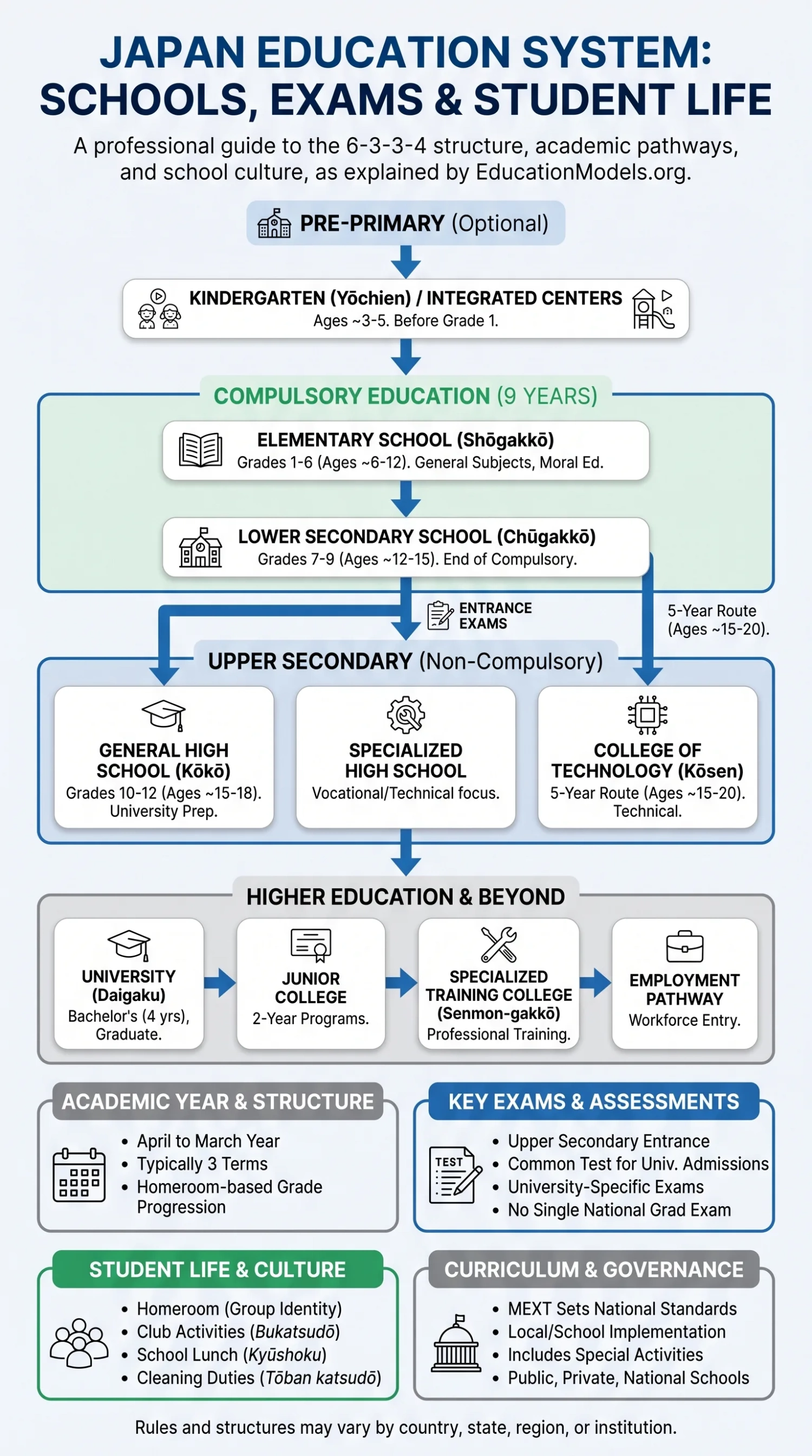
The Japan education system is usually understood through a 6-3-3-4 structure: six years of elementary school, three years of lower secondary school, three years of upper secondary school, and four years of university for many bachelor’s programs. Compulsory education covers elementary and lower secondary education, while upper secondary school is not legally compulsory but is a common next step for most students. Japan also has entrance exams for many upper secondary schools, national and university-level admissions routes for higher education, and a school culture shaped by homerooms, club activities, school lunch, and shared student duties.[a]
How the Japan Education System Works
Japan’s school system is easier to understand when it is seen as a sequence rather than as a set of separate institutions. Most children begin formal schooling in elementary school, move into lower secondary school, and then choose an upper secondary route. After that, students may continue to a university, junior college, college of technology, professional and vocational university, specialized training college, or employment pathway.
The Ministry of Education, Culture, Sports, Science and Technology, usually called MEXT, plays the national role in education policy, curriculum standards, school categories, and broad system rules. Local education authorities and individual schools also matter, especially in day-to-day school management, school placement, timetables, school culture, and local implementation. MEXT’s own overview describes the postwar school structure, the 6-3-3-4 model, compulsory education schools, upper secondary schools, secondary education schools, higher education institutions, colleges of technology, and specialized training colleges.[b]
A Practical Way to Understand the System
Think of Japan’s school route as basic education first, pathway choice later. Elementary and lower secondary education form the compulsory base. The larger choices usually appear after lower secondary school, when students move into general high school, specialized high school, college of technology, upper secondary specialized training, or another approved route.
The system is not only exam-based, even though exams receive much attention. Classroom learning, teacher assessment, school reports, club activities, special activities, moral education, homeroom life, and social routines all shape the student experience. A student’s path may include entrance exams, but daily schooling is also built around group membership, school duties, teacher guidance, and steady progression through age-based cohorts.
School Levels and Typical Ages
Japan’s school levels are often described with Japanese terms as well as English translations. The most common terms are Shōgakkō for elementary school, Chūgakkō for lower secondary or junior high school, and Kōtō-gakkō or Kōkō for upper secondary or senior high school. The table below uses typical ages. Individual placement can depend on birth date, school calendar rules, local procedures, and the type of school.
| School Level | Typical Age | Typical Grade/Year | What It Usually Covers |
|---|---|---|---|
| Kindergarten / Yōchien | About 3–5 | Pre-primary | Early childhood education before formal elementary schooling. Attendance patterns vary by family and local provision. |
| Integrated Center for Early Childhood Education and Care / Nintei Kodomoen | Pre-primary ages | Before Grade 1 | Combines early education and childcare functions for young children and families. |
| Elementary School / Shōgakkō | About 6–12 | Grades 1–6 | Primary general education, including Japanese, mathematics, science, social studies, arts, physical education, moral education, and school activities. |
| Lower Secondary School / Chūgakkō | About 12–15 | Grades 7–9 | General lower secondary education and the final stage of compulsory schooling in the standard route. |
| Compulsory Education School / Gimukyōiku-gakkō | About 6–15 | Grades 1–9 | A single institution covering the elementary and lower secondary stages together. |
| Upper Secondary School / Kōtō-gakkō or Kōkō | About 15–18 | Grades 10–12 | General, specialized, or integrated courses. Many students enter through an admissions process or entrance exam. |
| Secondary Education School / Chūtō-kyōiku-gakkō | About 12–18 | Six-year secondary program | Combines lower and upper secondary education in one six-year institution. |
| College of Technology / Kōsen | From about 15 | Five-year route after lower secondary school | Technical education route for students who want an early specialist pathway in engineering or applied fields. |
| University / Daigaku | Usually after upper secondary completion | Undergraduate and graduate study | Bachelor’s, master’s, doctoral, and professional programs, depending on institution and field. |
The table should not be read as a promise that every child follows one identical route. Japan has public schools, private schools, national schools, special needs education, specialized upper secondary courses, correspondence programs, part-time programs, colleges of technology, and professional training routes. The common structure is stable, but the lived path can differ.
Compulsory Education
Compulsory education in Japan covers the elementary and lower secondary stages. In the standard route, this means six years of elementary school followed by three years of lower secondary school. The compulsory period is often described as nine years of schooling, beginning when children enter elementary school and continuing through the end of lower secondary education.
Upper secondary school comes after compulsory education. It is not the same legal category as compulsory schooling, but it is a normal part of the educational route for many students. This distinction matters because readers sometimes assume that the 6-3-3-4 model means twelve years are compulsory. The better reading is: the first nine years are compulsory, and the next three years are a common upper secondary pathway.
Japan also has Gimukyōiku-gakkō, or compulsory education schools, which provide Grades 1 through 9 within one institution. These schools do not create a different compulsory age span; they organize the elementary and lower secondary stages in a continuous school setting.
Academic Year and Grade Structure
The Japanese school year normally begins in April and ends in March of the following year. Many schools use a three-term rhythm, with a summer break, winter break, and spring break. Public junior high and high schools commonly operate on a weekday schedule, while some schools may also hold classes or activities on Saturdays. Japan Educational Travel describes school life with six daily periods in many junior high and high school settings, typical fifty-minute periods, cleaning in shifts after classes, and club activities after the regular school day.[c]
Grade progression is usually age-based in elementary and lower secondary school. Students move with a homeroom group, and the class identity can be an important part of school life. The homeroom teacher often has a wider role than subject instruction alone, especially in elementary school and lower secondary school, where teachers may guide classroom routines, communication with families, school duties, and student support.
At the upper secondary level, students are still often organized into homerooms, but course choice and academic direction become more visible. General courses may prepare students for university, employment, or other postsecondary routes. Specialized courses can focus on areas such as industry, commerce, agriculture, nursing, home economics, science-mathematics, arts, music, sports, or foreign language, depending on the school.
Why the April School Year Matters
Japan’s April-to-March school year affects entrance ceremonies, graduation timing, exam schedules, club transitions, and university admissions. International readers should not assume that Japanese school years follow the September-to-June pattern used in some other countries.
Curriculum and School Governance
Japan has a national curriculum structure known in English as the Courses of Study. MEXT sets these as broad standards from kindergarten through upper secondary school so that schools organize teaching around a shared national direction. The Courses of Study are not the same as a single daily lesson plan. They set standards, subjects, aims, and areas of learning, while schools and teachers still plan lessons and classroom practice within the national structure.[d]
This makes Japan more nationally standardized than systems where each state, province, or district writes its own main curriculum. Yet it is not a system where every school day is identical across the country. Boards of education, school leaders, teachers, school culture, local resources, and student needs all influence how education is delivered.
The curriculum includes regular subjects, moral education, foreign language learning, integrated study, and special activities. Special activities are worth noticing because they connect academic learning with classroom meetings, school events, student roles, group routines, and social participation. This is one reason Japanese schooling can feel different from systems where school is described mainly through subject periods and exams.
Public schools are usually part of local education administration. Private schools have their own founding principles and management structures, but approved schools still operate inside Japan’s legal and policy environment. National schools, public schools, private schools, and international schools can therefore look similar in some areas and very different in others.
Main Exams, Qualifications, and Assessments
Japan is often described as exam-focused, but the exam system is not one single national test taken at every transition. The main pressure points are usually upper secondary school admissions and higher education admissions. Students may also face school-based tests, term exams, mock exams, recommendation processes, interviews, essays, subject tests, and institution-specific requirements.
For university admissions, the Common Test for University Admissions is administered through the National Center for University Entrance Examinations. The center explains that national, local public, and private universities may use Common Test scores according to their own criteria, often alongside other selection methods. The test is not the whole admissions process for every program; universities decide how it fits their own admissions rules.[e]
| Exam or Qualification | Typical Stage | Purpose | Notes |
|---|---|---|---|
| Upper secondary entrance exams | End of lower secondary school | Admission to many public and private high schools | Rules vary by prefecture, school type, and admissions category. School reports and interviews may also matter. |
| Upper secondary certificate | End of high school | Marks completion of upper secondary education | Needed for many higher education routes, though equivalent qualifications can also be relevant. |
| Common Test for University Admissions | University admissions | National test used by many universities as part of admissions | Universities decide how to use scores and may combine them with their own exams, interviews, essays, or school records. |
| University-specific entrance exams | University admissions | Selection by individual universities or faculties | Can include subject exams, essays, interviews, practical tests, or faculty-level requirements. |
| EJU | International student admissions | Assesses academic and Japanese-language readiness for some international applicants | Used by many institutions for international admissions, but requirements differ by university and program. |
| JLPT | Language proficiency | Shows Japanese-language ability | May be requested for programs taught in Japanese or for other language-related screening. |
| Kōsen associate title / advanced course routes | College of technology route | Technical qualification and pathway to further study or work | Students may continue to advanced courses or transfer into university upper divisions depending on rules. |
| Senmonshi | Professional training college route | Title for approved postsecondary specialized training programs | Commonly linked to practical, occupational, or technical fields. |
For international students, the exam picture can be different from the domestic Japanese route. The Study in Japan official site lists the EJU, the JLPT, the unified or common university entrance examination, proof of English proficiency, and proof of completion of secondary education among the tests and documents that may appear in admissions planning.[f]
Grading System
Japan does not have one simple national equivalent of the U.S. GPA that explains every school level. Assessment depends on school stage, school type, subject, report-card format, and admissions context. Elementary and lower secondary schools often use evaluation tied to curriculum goals, classroom work, tests, participation, and teacher judgment. Upper secondary schools use grades, credits, school records, internal exams, and sometimes class rank or recommendation-related documents.
For international comparison, the safest approach is to avoid converting Japanese grades too quickly into another country’s scale. A number, letter, or descriptive mark may not carry the same meaning across systems. University admissions offices, credential evaluators, and receiving schools usually interpret transcripts according to their own rules.
Useful distinction: school grades, entrance exam scores, school reports, recommendation documents, and university admissions results are connected, but they are not the same thing. A student can have strong school records and still face a competitive entrance exam process.
Public, Private, and International Schools
Japan has public, private, and national schools across different stages. Public elementary and lower secondary schools are usually tied to local residence and local education administration. Private schools may have their own admissions procedures, founding philosophy, school culture, tuition model, and curriculum emphasis. MEXT notes that private schools play a role at several stages, including upper secondary and higher education, and that national policy includes support measures such as subsidies and administrative guidance for private schools.[g]
International schools require careful reading. Some follow international curricula, some serve mobile families, some teach mainly in English or another language, and some may be connected to overseas accreditation systems. Their legal status in Japan can affect recognition, transfer options, and later admissions. Japanese Law Translation defines schools, specialized training colleges, miscellaneous schools, and private schools under relevant law, which is why the exact legal category of a school should be checked rather than guessed from the school’s English name alone.[h]
For families comparing options, the main questions are not only “public or private?” but also: What curriculum does the school use? What language is used for teaching? Does the school prepare students for Japanese high school or university admissions, overseas admissions, International Baccalaureate routes, or another qualification? Are credits and completion records recognized by the next institution the student may enter?
Student Life in Japanese Schools
Student life in Japan is often described through routines that are not always visible in system charts. These include homeroom, cleaning time, school lunch, class duties, school festivals, sports days, morning and afternoon meetings, and bukatsudō, or club activities. These routines can shape the student experience as much as formal lessons do.
Kyūshoku, or school lunch, is common in elementary and lower secondary schools. In many schools, students eat together in classrooms and may help serve meals in rotating groups. Tōban katsudō, or duty activities, can include lunch service, cleaning roles, classroom tasks, and leading short meetings. These practices support order, group responsibility, and shared participation rather than treating school as only a place for subject instruction.
Bukatsudō is especially visible in junior high and high school. Clubs may include baseball, soccer, volleyball, basketball, swimming, track and field, judo, kendo, brass band, choir, art, drama, literature, calligraphy, tea ceremony, flower arrangement, and other activities. Participation patterns vary by school and student, but club life can be a major part of friendships, identity, discipline, and daily schedule.
Uniforms are also common in many lower secondary and upper secondary schools, though not universal in the same way in every school. School bags, indoor shoes, classroom seating, class committees, entrance ceremonies, graduation ceremonies, and school events can make the school culture feel highly organized to outsiders.
Vocational and Technical Education
Japan’s vocational and technical routes deserve more attention than they often receive. The system is not only a line from high school to university. Students can enter specialized upper secondary courses, colleges of technology, specialized training colleges, professional and vocational universities, professional and vocational junior colleges, and other postsecondary routes.
Kōsen, or colleges of technology, are one of Japan’s best-known technical pathways. They usually accept students after lower secondary school and provide a long technical program. Many focus on engineering, maritime studies, technology, and applied fields. Kōsen students may move into employment, advanced courses, or transfer routes into university depending on the program and admissions rules.
Senmon-gakkō, often translated as professional training colleges or specialized training colleges, usually serve students after upper secondary school. They can be linked to fields such as design, childcare, business, information technology, hospitality, health-related support fields, animation, fashion, and other occupation-oriented areas. Program recognition, duration, title, and transfer options depend on official designation and school type.
| Pathway | Typical Route | Common Outcome |
|---|---|---|
| General upper secondary school | Lower secondary school → general high school | Preparation for university, junior college, work, or other postsecondary routes. |
| Specialized upper secondary school | Lower secondary school → high school with a specialized course | Subject or career-oriented study in areas such as industry, commerce, agriculture, arts, nursing, or science-mathematics. |
| Integrated upper secondary course | Lower secondary school → integrated course high school | Broader subject selection combining general and specialized areas. |
| College of Technology / Kōsen | Lower secondary school → five-year technical program | Technical employment, advanced course study, or university transfer route. |
| Specialized Training College / Senmon-gakkō | Upper secondary completion → professional training program | Occupational training, technical title, employment route, or possible further study depending on designation. |
| University / Daigaku | Upper secondary completion or equivalent → undergraduate admissions | Bachelor’s degree route, followed by possible graduate study. |
Higher Education and University Entrance
Higher education in Japan includes universities, junior colleges, colleges of technology, professional and vocational universities, professional and vocational junior colleges, and specialized training colleges with postsecondary courses. The Study in Japan official site explains that most higher education institutions set their academic year from April to March, many use a semester system, and many institutions admit students in April, with some offering autumn admission. It also lists institution types such as universities, junior colleges, colleges of technology, and specialized training colleges.[i]
University entrance can involve several routes. A student may apply through general selection, school recommendation-based selection, comprehensive selection, university-specific exams, interviews, essays, school records, the Common Test, or a combination. The exact route depends on the university, faculty, program, applicant category, and year.
For domestic applicants, the Common Test often receives attention because it is national and widely known. Yet the admissions decision may still depend on university-level criteria. For international applicants, the EJU, JLPT, English-proficiency tests, proof of secondary completion, interviews, essays, and program-specific screening may matter more than the domestic student route.
Medicine, dentistry, veterinary medicine, some pharmacy programs, arts programs, teacher education, engineering, and selective national university programs may all use different combinations of academic documents, tests, interviews, or practical assessment. A short phrase such as “Japan has university entrance exams” is true but incomplete. The better reading is that Japan has a multi-route admissions system with national testing, university exams, school records, recommendations, and applicant-category rules.
How This System Compares Internationally
Internationally, Japan is often seen as a system with a clear national curriculum direction, strong basic education, steady age-based progression, and visible exam transitions. Compared with more decentralized systems such as the United States or Canada, Japan has a more nationally aligned curriculum. Compared with some European tracking systems, Japan’s main early structure is more uniform through lower secondary school, with larger pathway differences appearing after compulsory education.
OECD Education GPS data for PISA 2022 reports Japanese 15-year-olds scoring above the OECD average in mathematics, reading, and science. These data points help describe measured performance in selected subjects, but they do not measure every part of schooling, such as student well-being, creativity, club life, family pressure, teacher workload, local variation, or the experience of students with different needs.[j]
A Useful Way to Read the Data
International test data can show how students perform on selected assessments. It cannot prove that one country’s everyday school life is better for every child. Japan’s results should be read alongside curriculum structure, admissions pressure, family expectations, vocational routes, student support, and local school culture.
Japan is also sometimes compared with South Korea and China because all three systems include demanding academic expectations and well-known exam routes. That comparison can be useful, but it should stay precise. Japan’s high school entrance process, university admissions, school clubs, homeroom culture, cram school market, and technical pathways have their own shape. The country should not be reduced to a single phrase such as “exam culture.”
What Readers Often Confuse
Compulsory Education and High School Attendance
Compulsory education ends after lower secondary school in the standard route. Upper secondary school is not legally the same as compulsory schooling, even though many students continue into high school. This difference matters when comparing Japan with countries where schooling is compulsory until a later age.
Junior High School and Senior High School
In English, junior high school usually refers to lower secondary school, or Chūgakkō. Senior high school usually refers to upper secondary school, or Kōtō-gakkō / Kōkō. These names can confuse readers from countries where middle school, junior high, and high school cover different ages.
Entrance Exams and Graduation Exams
Japan’s best-known exams are often entrance exams, not national graduation exams in the same sense used in some countries. Students may take exams to enter upper secondary school or university, while school completion depends on the school stage, credits, attendance, and school rules.
Common Test and University Decisions
The Common Test is national, but it does not automatically decide every university admission result. Universities may use it in different ways. Some combine it with their own subject exams; others use interviews, essays, school reports, recommendations, or faculty-specific screening.
Juku and Regular School
Juku, often translated as cram school or supplementary private tutoring school, is not a formal school level in the national system. It can play a role in exam preparation, but it should not be confused with Shōgakkō, Chūgakkō, Kōkō, Kōsen, Senmon-gakkō, or Daigaku.
International School Names and Legal Status
An English-language school name does not tell the whole story. Families should check whether a school is recognized under Japanese categories, follows an overseas curriculum, offers an international qualification, or has a status that affects transfer and university eligibility.
Common Terms Readers Should Know
Japanese education terms are useful because direct English translations can hide important differences. The table below gives plain meanings without treating each term as identical to a foreign school category.
| Term | Meaning | Why It Matters |
|---|---|---|
| MEXT | Ministry of Education, Culture, Sports, Science and Technology | The national ministry connected to education policy, curriculum standards, and school system rules. |
| Shōgakkō | Elementary school | The six-year primary stage and the start of formal compulsory schooling. |
| Chūgakkō | Lower secondary school / junior high school | The three-year stage after elementary school and the final part of compulsory education. |
| Kōtō-gakkō / Kōkō | Upper secondary school / senior high school | The three-year post-compulsory stage that often requires admissions screening. |
| Gimu Kyōiku | Compulsory education | Usually refers to the elementary and lower secondary stages. |
| Gimukyōiku-gakkō | Compulsory education school | A school covering Grades 1–9 in one institution. |
| Chūtō-kyōiku-gakkō | Secondary education school | A six-year school combining lower and upper secondary education. |
| Kōsen | College of technology | A technical route often entered after lower secondary school. |
| Senmon-gakkō | Professional or specialized training college | A practical postsecondary route linked to occupational fields. |
| Daigaku | University | The main bachelor’s degree route, with graduate options after undergraduate study. |
| Common Test | Common Test for University Admissions | A national test used by many universities as part of admissions. |
| EJU | Examination for Japanese University Admission for International Students | Used by many institutions when assessing international applicants. |
| JLPT | Japanese-Language Proficiency Test | May be used to show Japanese-language ability. |
| Bukatsudō | Club activities | A major part of student life in many junior high and high schools. |
| Kyūshoku | School lunch | Often part of daily school routine, especially in elementary and lower secondary schools. |
| Tōban katsudō | Rotating class duties | Student responsibilities such as lunch service, cleaning, or classroom tasks. |
| Juku | Cram school or supplementary tutoring school | Common in exam preparation but separate from the formal school system. |
What Can Change Over Time
Several parts of the Japan education system can change over time. These include curriculum revisions, university admissions rules, Common Test subject arrangements, international student requirements, prefectural high school admissions procedures, school calendar details, tuition support rules, and recognition of private or international school routes.
Families and students should be careful with any rule that affects enrollment, transfer, graduation, immigration status, university eligibility, exam registration, scholarship application, or professional qualification. A general guide can explain the system, but the final check should come from the relevant school, university, board of education, MEXT page, exam center, or admissions office.
Where Official Details May Vary
This site is an independent informational guide and is not affiliated with any ministry of education, school authority, exam board, university, government agency, or official ranking organization. For decisions that affect a real student, use the relevant official source before acting.
The most stable parts of the system are the broad 6-3-3-4 structure, the elementary and lower secondary compulsory base, and the presence of upper secondary and higher education pathways. The parts that deserve the closest checking are admissions rules, school-specific requirements, international school recognition, and current exam procedures.
Sources and Verification
- [a] 20.学校系統図 — Used for the 6-3-3-4 school structure, school levels, typical ages, and compulsory education stages. (Reliable because it is an official MEXT school system document.)
- [b] MEXT : Overview — Used for Japan’s school system overview, institution types, upper secondary routes, higher education categories, colleges of technology, and specialized training colleges. (Reliable because it is an official MEXT education overview page.)
- [c] JAPANESE EDUCATIONAL SYSTEM | JAPAN Educational Travel — Used for academic calendar, school timetable, cleaning, clubs, and school organization context. (Reliable because it is a Japan Educational Travel resource operated by JNTO.)
- [d] MEXT : Improvement of Academic Abilities (Courses of Study) — Used for the role of the Courses of Study as national curriculum standards. (Reliable because it is an official MEXT curriculum page.)
- [e] About the National Center for University Entrance Examinations(2024).pdf — Used for the Common Test for University Admissions and how universities use the test with their own criteria. (Reliable because it is published by the National Center for University Entrance Examinations.)
- [f] Examinations|Study in Japan Official Website — Used for EJU, JLPT, common university entrance examination, English proficiency tests, and international student admissions-related exams. (Reliable because Study in Japan is an official information site for studying in Japan.)
- [g] MEXT : Promotion of Private Schools — Used for private school context and MEXT’s description of private schools in Japan. (Reliable because it is an official MEXT policy page.)
- [h] Private Schools Act – English – Japanese Law Translation — Used for legal category context around schools, private schools, specialized training colleges, and miscellaneous schools. (Reliable because Japanese Law Translation provides official English translations of Japanese laws.)
- [i] Japanese Educational System|Study in Japan Official Website — Used for higher education institution types, academic year timing, semester use, and admission timing. (Reliable because Study in Japan is an official information site supported by Japanese education authorities.)
- [j] Education GPS – Japan – Student performance (PISA 2022) — Used for OECD PISA 2022 comparison context on mathematics, reading, and science performance. (Reliable because OECD Education GPS is an international education data source.)
Related Topics
- → South Korea Education System: Schools, Exams, and Academic Pressure
- → Netherlands Education System: Schools, Tracks, and Learning Pathways
- → Canada Education System: Provinces, Schools, and Higher Education
- → United States Education System: Grades, Schools, and College Pathways
- → Germany Education System: Schools, Tracks, and Vocational Pathways
- → Education Systems Around the World: How School Systems Differ by Country