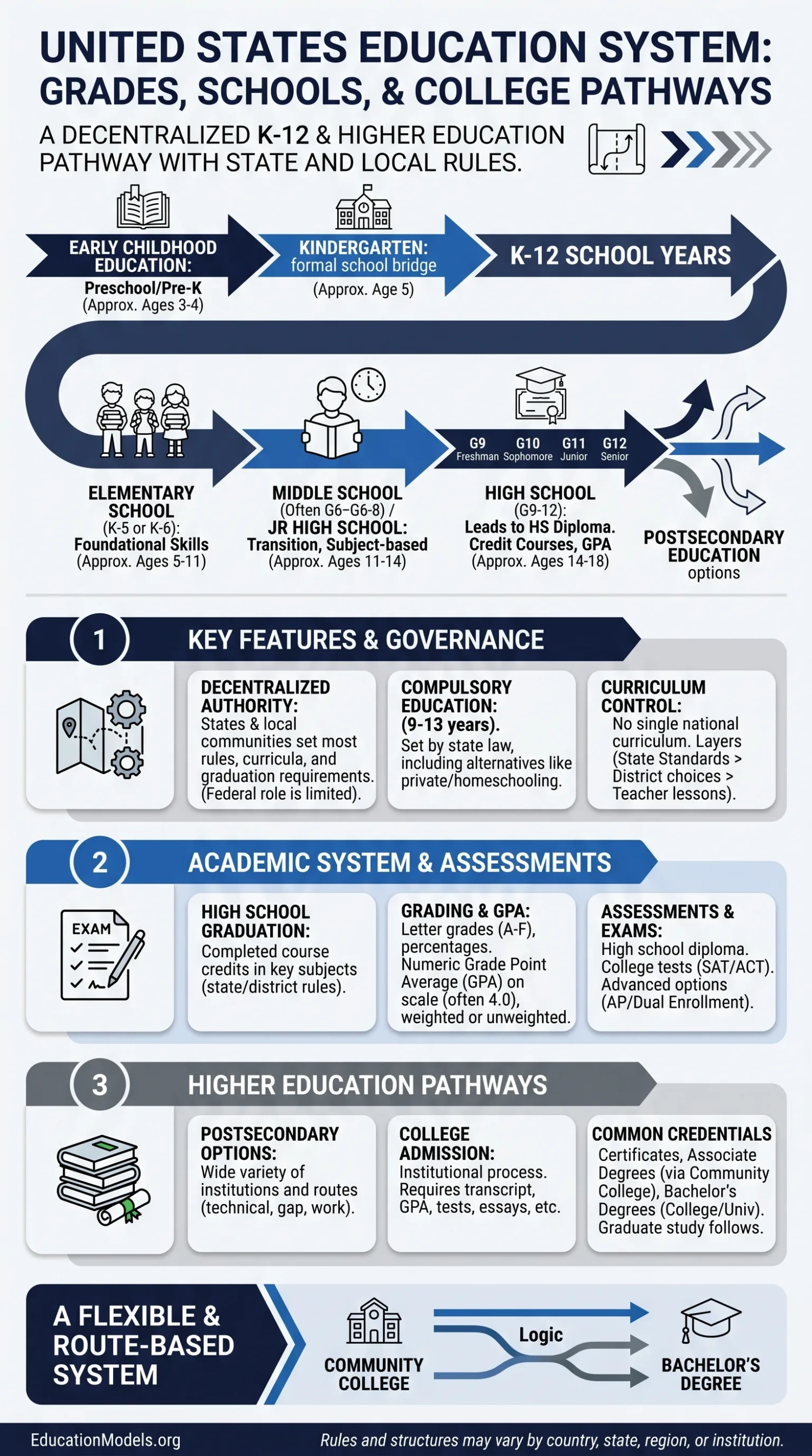
The United States education system is best understood as a decentralized K–12 and higher education pathway rather than one single national school model. Most students move from elementary school to middle school or junior high school, then to high school, and after Grade 12 they may enter community college, a four-year college, a university, technical training, military service, work, or another route. The basic pattern is familiar across the country, but school starting ages, graduation rules, academic calendars, curriculum choices, and college admission expectations can vary by state, district, school, and institution.
How the United States Education System Works
The American school system is usually described through the phrase K–12. The “K” means kindergarten, and “12” means Grade 12, the final year of high school in the common school sequence. Before kindergarten, many children attend preschool or prekindergarten, but early childhood access is not the same in every state or district.
NCES describes American education as having three broad levels: elementary, secondary, and postsecondary. Elementary and secondary education are the K–12 school years, while postsecondary education includes community colleges, colleges, universities, technical institutions, graduate schools, and professional programs. [a]
The United States does not have one national ministry that runs all schools in the way some centralized education systems do. The federal government has a role in funding, data, civil rights, research, and national programs, but states and local communities hold much of the authority over schools, curricula, enrollment rules, and graduation requirements. [b]
This creates a system that is easy to outline but harder to generalize. Two students in different states may both be in Grade 10, yet follow different course requirements, testing rules, school calendars, grading practices, and graduation pathways.
The Basic Flow
- Early childhood education may include preschool, prekindergarten, or childcare-based learning before formal school.
- Kindergarten often serves as the bridge into the K–12 system.
- Elementary school usually covers the early grades, often from kindergarten through Grade 5 or Grade 6.
- Middle school or junior high school usually covers the transition years before high school.
- High school usually covers Grades 9–12 and leads toward a high school diploma.
- Postsecondary education may include community college, a four-year college, a university, a certificate program, a technical route, or graduate study.
The system is route-based rather than ladder-only. A student may go directly from high school to a bachelor’s degree program, start at a community college and transfer later, enter career and technical education, take a gap period, work first, or return to education as an adult.
School Levels and Typical Ages
School levels in the United States are described by grade numbers. The table below shows the common pattern, not a rule that applies identically everywhere. Age cutoffs for kindergarten and first grade are set by states or districts, and school configuration can differ. One district may use K–5 elementary, Grades 6–8 middle school, and Grades 9–12 high school. Another may use K–6 elementary, Grades 7–8 junior high, and Grades 9–12 high school.
| School Level | Typical Age | Typical Grade or Year | What It Usually Covers |
|---|---|---|---|
| Preschool or Prekindergarten | About 3–4 | Before kindergarten | Early learning, social development, basic routines, early literacy, and early numeracy. Availability varies by state, district, and provider. |
| Kindergarten | About 5 | K | Transition into formal school, early reading, early math, classroom routines, play-based learning, and social development. |
| Elementary School | About 5–11 | K–5 or K–6 | Reading, writing, math, science, social studies, arts, physical education, and foundational classroom habits. |
| Middle School | About 11–14 | Grades 6–8 | Subject-based classes, early electives, stronger academic expectations, and preparation for high school. |
| Junior High School | About 12–14 | Grades 7–8 or 7–9 | A less common alternative to middle school, often with a more high-school-like subject structure. |
| High School | About 14–18 | Grades 9–12 | Credit-based courses, electives, GPA, graduation requirements, college preparation, career programs, and diploma completion. |
| Postsecondary Education | Usually after high school | College, university, technical, or career route | Certificates, associate degrees, bachelor’s degrees, graduate degrees, professional study, or occupational preparation. |
In everyday speech, Americans often say “fifth grade,” “eighth grade,” or “senior year” rather than referring to a national stage name. High school grades also have common student labels: Grade 9 is freshman year, Grade 10 is sophomore year, Grade 11 is junior year, and Grade 12 is senior year.
Compulsory Education
Compulsory education in the United States is set mainly by state law, so there is no single national compulsory schooling age. Education Commission of the States reports that state requirements differ in both the lower and upper age limits, with students required to attend school for as few as nine years and up to 13 years depending on the state. [c]
This is one of the most common points of confusion for international readers. A child may commonly start kindergarten around age 5, but compulsory attendance may begin later in some states. A student may commonly finish high school around age 17 or 18, but compulsory attendance may end before Grade 12 in some states under specific rules.
Compulsory education also does not always mean physical attendance at a traditional public school. State law may allow recognized alternatives, including private schooling, homeschooling, online schooling, or other approved programs. The exact rules are local and should be checked with the state education agency or school district.
Compulsory Age Is Not the Same as the Normal School Path
The normal pathway is still K–12 for most students. Compulsory attendance laws define the legal duty to receive education; they do not fully describe how families usually use the school system. Many students attend school before the compulsory age begins, and many continue through Grade 12 even if the compulsory age ends earlier.
For parent decisions, enrollment deadlines, homeschooling rules, and grade placement, the safest source is the student’s state education department or local school district. A general national article can explain the pattern, but it cannot replace the legal details that apply in one state.
Academic Year and Grade Structure
The U.S. school year usually runs from late summer or early fall through late spring or early summer, but K–12 calendars are set locally. Many schools begin in August or September and end in May or June. Higher education follows a similar broad rhythm, and EducationUSA notes that the university academic year usually runs from August through May, with institutions using semester, quarter, or trimester calendars. [d]
Grade progression is usually annual. Students complete one grade during a school year and move to the next grade the following year. A student in Grade 8 may enter Grade 9 the next school year if the school requirements are met. In high school, progression is often tied not only to age but also to credits earned in required subjects.
High school course credits are central. A student may need a certain number of credits in English, mathematics, science, social studies, physical education, arts, world language, electives, or career-related subjects. These rules are not national. Education Commission of the States notes that almost all states set minimum credit and course requirements for a standard high school diploma, while many states also allow substitutions, endorsements, multiple diploma options, or other pathways. [e]
How Grade Names Work in High School
| Grade | Common Name | Typical Age | Usual Focus |
|---|---|---|---|
| Grade 9 | Freshman year | About 14–15 | Starting high school credits, core courses, early electives, and adjustment to high school expectations. |
| Grade 10 | Sophomore year | About 15–16 | Continuing core subjects, exploring electives, and building the GPA record colleges may later review. |
| Grade 11 | Junior year | About 16–17 | More advanced coursework, SAT or ACT planning, college research, AP or dual enrollment where available. |
| Grade 12 | Senior year | About 17–18 | Finishing diploma requirements, college or career applications, financial aid steps, and transition planning. |
Students do not all follow the same course sequence. A high school may offer honors courses, Advanced Placement, International Baccalaureate, dual enrollment, career academies, arts programs, technical programs, or locally designed electives. Access depends on the school and district.
Curriculum and School Governance
The curriculum structure is one of the most decentralized parts of the U.S. education system. The federal government does not prescribe one national curriculum for every student. States set standards and graduation rules, districts choose programs and materials, and schools organize day-to-day instruction within those requirements.
This is why two U.S. students may study the same broad subjects but use different textbooks, take different state assessments, and follow different graduation rules. State education departments, local school boards, superintendents, principals, and teachers all shape what students experience.
Core academic subjects usually include English language arts, mathematics, science, social studies, and physical education. Many schools also offer arts, technology, career courses, world languages, health education, and electives. High schools often give students more choice than elementary schools, especially in later grades.
State Standards and Local Decisions
A state may define what students should know in mathematics or reading by a given grade. A district may then choose curriculum materials and pacing plans. A teacher may design daily lessons and assignments within that local plan. This layered structure helps explain why national comparisons of American education can be misleading if they treat the country as one uniform school system.
The phrase “school district” matters in the United States. A school district is a local education authority that may operate several schools, manage budgets, set attendance zones, hire staff, and carry out state requirements. District size varies widely, from very small rural districts to very large urban systems.
Main Exams, Qualifications, and Assessments
The United States does not have one national school-leaving exam like the baccalauréat, Abitur, Gaokao, or A-Levels. Instead, high school completion usually depends on state and local diploma requirements, course credits, school grades, and sometimes state assessments. College admission may involve GPA, coursework, recommendations, essays, extracurricular records, and standardized tests such as the SAT or ACT, depending on the institution.
| Exam or Qualification | Typical Stage | Purpose | Notes |
|---|---|---|---|
| High School Diploma | End of high school | Shows that a student completed state and local graduation requirements. | The exact credit, course, and assessment rules vary by state and district. |
| GPA | High school and college | Summarizes academic performance using grade points. | Often based on a 4.0 scale, but weighting and calculation rules differ by school. |
| SAT | Usually Grade 11 or Grade 12 | Used by some colleges as part of undergraduate admission or scholarship review. | The SAT is administered through College Board and is now connected to digital testing tools such as Bluebook. [f] |
| ACT | Usually Grade 11 or Grade 12 | Used by some colleges as part of undergraduate admission or scholarship review. | ACT describes the test as including English, math, reading, and optional science and writing sections. [g] |
| Advanced Placement | High school | Allows students to take college-level courses and exams while in high school. | AP scores may lead to college credit or placement, depending on the college’s own policy. [h] |
| Dual Enrollment | High school and college overlap | Lets high school students take courses for postsecondary credit. | NCES data describe dual enrollment as courses for postsecondary credit taken during high school, separate from AP and IB exams. [i] |
| Associate Degree | Postsecondary | Usually earned through community college or a two-year college route. | May lead to employment, technical progression, or transfer toward a bachelor’s degree. |
| Bachelor’s Degree | Undergraduate higher education | Common four-year college or university degree route. | Students usually complete general education, major requirements, electives, and credit totals. |
Standardized tests do not carry the same role at every institution. Some colleges require SAT or ACT scores, some are test-optional, and some are test-free for certain cycles or applicant groups. Because admission policy can change, students should verify requirements on each college’s admission page before applying.
Grading System
U.S. grading often uses letter grades, percentages, and GPA. A common college-style GPA scale uses 4.0 for an A, 3.0 for a B, 2.0 for a C, 1.0 for a D, and 0.0 for an F, but schools may calculate grades differently. EducationUSA describes GPA as a numeric indicator of academic performance, usually calculated on a 4.0 scale, with letter grades carrying numeric values. [j]
High schools may use unweighted GPA, weighted GPA, or both. An unweighted GPA treats courses on the same basic scale. A weighted GPA gives extra weight to more demanding courses such as honors, AP, IB, or dual enrollment, when the school uses such a system.
This can confuse readers from countries with national grading systems. In the United States, a 3.8 GPA at one high school may not mean exactly the same thing as a 3.8 GPA at another high school. Colleges often read GPA together with course rigor, school profile, transcript details, class context, and available coursework.
| Term | Meaning | Why It Matters |
|---|---|---|
| Letter Grade | A grade such as A, B, C, D, or F. | Used in many schools to show course performance. |
| Percentage Grade | A score such as 92% or 85%. | May be converted into a letter grade according to school policy. |
| GPA | Grade Point Average. | Used in high school records, college applications, scholarships, and college academic standing. |
| Weighted GPA | A GPA that gives added value to more demanding courses. | Can show that a student took advanced courses, but policies differ by school. |
| Transcript | The official record of courses, grades, credits, and sometimes GPA. | Central for college admission, transfer, and academic evaluation. |
| Credits | Units earned by completing courses. | High school graduation and college degrees usually require specific credits. |
Public, Private, Charter, and International Schools
American schooling includes several school types. The main categories are public schools, public charter schools, magnet schools, private schools, international schools, and homeschooling. These are not all governed in the same way.
Public schools are funded and regulated through state and local systems. Most children attend public schools assigned by residence or district rules, though some districts allow transfers, choice programs, magnet schools, or specialized schools. The U.S. Department of Education uses “education choice” to describe a range of learning options available to families, including public, private, charter, magnet, and other arrangements. [k]
How the Main School Types Differ
| School Type | How It Is Usually Funded | Admission Pattern | What Readers Should Know |
|---|---|---|---|
| Traditional Public School | Public funds through state and local systems | Often based on residence and district boundaries | Usually follows state standards and district rules. |
| Public Charter School | Public funds | Often application-based; lotteries may be used if demand is high | Publicly funded but operates under a charter with more autonomy than many district schools. |
| Magnet School | Usually public funds | May use application, lottery, attendance zone, or criteria depending on district policy | Often has a focus such as science, arts, language, or technology. |
| Private School | Tuition, donations, religious organizations, or private funding | School-based admission | May have its own curriculum, mission, admission criteria, and tuition model. |
| International School | Usually tuition-based | School-based admission | May offer international curricula, foreign-language programs, or globally recognized diplomas. |
| Homeschooling | Family-directed, with state rules | Chosen by family under state law | Requirements for registration, assessment, records, and subjects vary by state. |
Private schools and international schools should not be assumed to be “better” or “worse” than public schools. They may differ in tuition, mission, curriculum, class size, religious affiliation, language of instruction, extracurricular offerings, and admissions practices. Public schools may also differ widely because district funding, local programs, teacher staffing, student needs, and state policy vary.
Families comparing schools should look at accreditation or authorization, curriculum, student support, graduation outcomes, language support, transportation, special education services, transferability of credits, and the student’s longer-term pathway. For international families, it is especially useful to ask how the school transcript will be read by colleges in the United States and abroad.
Vocational and Technical Education
Career and technical education, often shortened to CTE, is a major part of the American education system, though short explanations of U.S. schooling often leave it out. CTE can appear in high schools, career centers, community colleges, technical colleges, and private trade schools. IES describes CTE as education that helps students gain skills, knowledge, and experience for the labor market or further occupational education, with federal support through the Carl D. Perkins Act. [l]
CTE is not one single track. It may include health sciences, information technology, agriculture, manufacturing, construction, business, culinary arts, transportation, early childhood education, media production, cybersecurity, or other career fields. Some programs lead to industry-recognized credentials. Others prepare students for college-level technical programs.
In high school, CTE may be offered as electives, career academies, regional technical centers, internships, work-based learning, or dual-credit courses with community colleges. After high school, many students continue through community colleges, technical colleges, apprenticeships, certificates, or associate degree programs.
Why CTE Matters in the U.S. Pathway
The American system is often described through the college admission lens, but not every student’s route is a direct move from high school to a four-year bachelor’s degree. A student may complete a high school diploma, earn a technical certificate, attend community college, transfer later, work while studying, or combine credentials over time.
| Pathway | Typical Route | Common Outcome | What to Check |
|---|---|---|---|
| Four-Year College or University | Apply during Grade 12 or after high school | Bachelor’s degree | Admission requirements, major options, cost, aid, accreditation, and graduation rates. |
| Community College | Start at a two-year institution | Associate degree, certificate, transfer credits, or workforce preparation | Transfer agreements, program accreditation, credit acceptance, and advising quality. |
| Technical or Trade Program | Enter an occupational program after high school | Certificate, license preparation, or job-specific training | Licensing rules, employer recognition, placement data, and total cost. |
| Apprenticeship or Work-Based Route | Combine paid work and training | Occupational skill development and possible credential | Program approval, wages, training hours, and long-term career progression. |
| Military Route | Enter military service after meeting eligibility rules | Training, service pathway, and possible education benefits later | Eligibility, service obligations, education benefits, and career fit. |
| Gap Period or Work First | Work, volunteer, train, or pause before postsecondary study | Later entry into college, training, or another route | Application timelines, credit transfer, savings, and skill development. |
Higher Education and College Pathways
After high school, students may enter a wide variety of postsecondary institutions. American higher education includes community colleges, public universities, private nonprofit colleges, private universities, liberal arts colleges, technical institutions, professional schools, graduate schools, and specialized institutions.
EducationUSA explains that community colleges offer two-year programs leading to Associate of Arts or Associate of Science degrees, and that students may earn academic credit that can later count toward a bachelor’s degree. [m]
The community college route is central to understanding U.S. college pathways. It can serve students who want a lower-cost starting point, local access, technical training, transfer preparation, adult education, or a gradual return to study. Many students begin at a community college and then transfer to a four-year institution, but transfer rules depend on the institutions, the state, the program, the grades earned, and the course equivalencies.
College, University, and Degree Terms
In the United States, the terms “college” and “university” are often used loosely. A college may focus mainly on undergraduate education, while a university often includes undergraduate and graduate programs. In everyday speech, “going to college” can mean attending a community college, a liberal arts college, a public university, or a private university.
Undergraduate education usually means study after high school that leads to an associate degree or bachelor’s degree. Graduate education usually follows a bachelor’s degree and may lead to a master’s degree, doctoral degree, or professional degree.
| Credential | Usual Level | Typical Route | Common Purpose |
|---|---|---|---|
| Certificate | Postsecondary or technical | Shorter program at a community college, technical institution, or career school | Occupational training, skill development, or career entry. |
| Associate Degree | Undergraduate | Usually community college or two-year college | Workforce entry, transfer preparation, or academic foundation. |
| Bachelor’s Degree | Undergraduate | Four-year college or university route, though time can vary | Main undergraduate degree for many professional and graduate pathways. |
| Master’s Degree | Graduate | After a bachelor’s degree | Advanced study, professional development, research preparation, or career specialization. |
| Doctoral Degree | Graduate | After bachelor’s or master’s study depending on program | Research, advanced professional practice, academic careers, or specialized fields. |
| Professional Degree | Graduate or professional | Program-specific route after undergraduate preparation | Fields such as law, medicine, dentistry, pharmacy, or other licensed professions. |
How College Admission Usually Works
College admission in the United States is usually institutional rather than one national placement system. Students apply to individual colleges or university systems. Each institution sets its own requirements, deadlines, review process, and program criteria.
Common application materials may include a high school transcript, GPA, course list, essays, recommendation letters, extracurricular activities, test scores if required or submitted, English proficiency evidence for many international students, and financial documents where needed. Common App describes its platform as a way to apply to college for the first time or as a transfer student, with more than 1,000 colleges available through its search tools. [n]
Admission can be selective, moderately selective, open-admission, program-specific, or transfer-based. Community colleges often have broader access policies, while selective universities may review applicants through a more detailed process. Some public university systems have state-specific admission pathways or transfer agreements.
Accreditation and Recognition
Accreditation is a major term in U.S. higher education. The U.S. Department of Education recognizes institutional accrediting agencies as reliable authorities concerning the quality of education or training offered by the institutions or programs they accredit. [o]
For students, accreditation can affect credit transfer, graduate admission, employer recognition, professional licensing, and eligibility for federal student aid. Before choosing a college, technical institution, online program, or career school, students should verify accreditation through official sources and the institution’s own disclosures.
How This System Compares Internationally
Internationally, the U.S. education system is more decentralized than many national systems. Countries with national curricula, national leaving exams, or centralized university entrance exams often look very different from the American model. In the United States, the high school transcript, GPA, course rigor, local graduation rules, college applications, and institutional admission decisions carry more weight than a single national school-leaving exam.
Compared with exam-focused systems, the American model often gives students more course choice in high school. Compared with highly centralized systems, it can produce more variation between regions. Compared with systems that separate academic and vocational tracks early, the U.S. model often allows students to combine academic courses, electives, AP, dual enrollment, CTE, and later transfer pathways.
This flexibility is useful, but it can also be hard to understand. A student’s path may depend on state rules, district offerings, counselor access, course availability, college admission policy, transfer agreements, family finances, and the student’s own goals.
Education by Country describes the U.S. system as a national network of state, local, public, private, and postsecondary systems rather than a single centrally directed model.
What Readers Often Confuse
Many misunderstandings about the United States education system come from assuming that the country has one national answer for every school question. It rarely does.
Compulsory Education vs. Normal School Attendance
Compulsory education is the legal attendance requirement. Normal school attendance is the common pattern families follow. A child may attend kindergarten even when attendance is not yet compulsory in that state. A teenager may stay through Grade 12 even where the compulsory attendance age ends earlier.
Grade Number vs. School Level
Grade 6 may be in elementary school in one district and middle school in another. Grade 9 may be in a junior high school in some local designs but is usually the first year of high school. The grade number is often more stable than the school building label.
Public School vs. Free School
A public school is government-funded and part of the public education system. It is generally tuition-free for residents, but families may still face costs for supplies, activities, meals, transportation in some cases, or optional programs. Private schools charge tuition unless scholarships or aid apply.
Charter School vs. Private School
A charter school is usually a public school with a charter agreement and more operating autonomy. A private school is outside the public school system and usually tuition-funded. The two should not be grouped together just because both may involve family choice.
SAT or ACT vs. High School Graduation
The SAT and ACT are college admission tests. They are not the standard U.S. high school graduation exam. High school graduation depends on state and local diploma rules, not on a single national SAT or ACT requirement.
Community College vs. Lower Quality College
Community college is not simply a weaker version of university. It is a distinct access point that can provide associate degrees, technical programs, transfer preparation, adult education, and local workforce training. The best route depends on the student’s goal, finances, location, academic record, and intended major.
GPA vs. National Ranking
GPA is a school-based academic measure. It is not a national rank. Colleges usually read GPA in context, including course difficulty, school profile, grade trends, and available opportunities.
Common Terms Readers Should Know
The table below explains terms that appear often in discussions of American education. Some terms are used across the country, but the details behind them may vary by state, district, or institution.
| Term | Meaning | Why It Matters |
|---|---|---|
| K–12 | Kindergarten through Grade 12. | The main school sequence before postsecondary education. |
| School District | A local authority that operates public schools. | Districts shape calendars, staffing, attendance zones, programs, and local implementation. |
| State Education Department | A state-level education authority. | States set many rules for standards, testing, graduation, and school accountability. |
| Elementary School | The early grade school years. | Builds basic literacy, numeracy, and foundational learning habits. |
| Middle School | The transition level between elementary and high school. | Introduces more subject-based learning and early adolescent support. |
| High School | The final K–12 stage, usually Grades 9–12. | Leads to a diploma and prepares students for college, careers, or other routes. |
| Credits | Units earned by completing courses. | Credits are used for high school graduation and college degrees. |
| GPA | Grade Point Average. | Used for academic records, college admission, scholarships, and academic standing. |
| Transcript | Official academic record. | Shows courses, grades, credits, GPA, and sometimes rank or test details. |
| SAT | A standardized college admission test administered through College Board. | May be required, optional, or considered by colleges depending on policy. |
| ACT | A standardized college admission test administered by ACT. | Used by some colleges in admission, placement, or scholarship review. |
| AP | Advanced Placement. | High school students may take college-level courses and exams. |
| Dual Enrollment | College-credit coursework taken during high school. | Can help students begin college credit before graduating from high school. |
| Community College | A two-year postsecondary institution. | Offers associate degrees, certificates, transfer routes, and workforce programs. |
| Associate Degree | An undergraduate degree often linked to two-year study. | Can lead to work, technical fields, or transfer toward a bachelor’s degree. |
| Bachelor’s Degree | A main undergraduate college degree. | Required for many careers and graduate programs. |
| Accreditation | Quality review and recognition of institutions or programs. | Affects legitimacy, transfer, aid eligibility, licensing, and further study. |
What Can Change Over Time
Several parts of the U.S. education system can change. State compulsory attendance ages, kindergarten cutoffs, graduation requirements, testing rules, high school diploma pathways, charter school rules, homeschooling requirements, college admission policies, SAT or ACT requirements, AP credit rules, transfer agreements, accreditation status, and financial aid processes may be updated over time.
This site is an independent informational guide and is not affiliated with any ministry of education, school authority, exam board, university, government agency, or official ranking organization. The goal is to explain the system clearly, not to replace official advice or institution-specific decisions.
For decisions that affect a student’s enrollment, graduation, college admission, transfer credit, visa status, financial aid, professional licensing, or program recognition, readers should verify the details with the relevant state education agency, school district, school, college, university, accrediting body, exam provider, or official government source.
Sources and Verification
- [a] Mini-Digest of Education Statistics, 2009-The Structure of American Education — Used for the basic structure of U.S. education, including elementary, secondary, postsecondary levels, and typical grade progression. (Reliable because NCES is the federal statistical agency for education data.)
- [b] Federal Role in Education | U.S. Department of Education — Used for the explanation that education in the United States is primarily a state and local responsibility. (Reliable because it is an official U.S. Department of Education source.)
- [c] 50-State Comparison: Free and Compulsory School Age Requirements – Education Commission of the States — Used for state variation in compulsory school attendance ages and free education age requirements. (Reliable because Education Commission of the States tracks state education policy using statutes and state policy sources.)
- [d] Frequently Asked Questions (FAQs) — Used for the U.S. higher education academic calendar, college/university terminology, degree levels, credit system, GPA, and grading explanations. (Reliable because EducationUSA is a U.S. Department of State-supported advising network.)
- [e] 50-State Comparison: High School Graduation Requirements – Education Commission of the States — Used for state-level high school graduation requirements, course credits, diploma pathways, and assessment variation. (Reliable because it is a national state-policy comparison based on statutes, regulations, and state guidance.)
- [f] The SAT – SAT Suite | College Board — Used for SAT-related details and digital testing references. (Reliable because College Board administers the SAT.)
- [g] The ACT Test for Students | ACT — Used for ACT test structure and section information. (Reliable because ACT is the test provider.)
- [h] Advanced Placement® (AP) – College Board — Used for AP course, exam, college-level work, and credit/placement context. (Reliable because College Board operates the AP Program.)
- [i] Dual Enrollment: Participation and Characteristics — Used for the definition and context of dual enrollment as postsecondary-credit coursework taken during high school. (Reliable because it is an NCES publication using national education survey data.)
- [j] Frequently Asked Questions (FAQs) — Used for GPA and grading system explanations. (Reliable because EducationUSA is a U.S. Department of State-supported advising network.)
- [k] Education Choice | U.S. Department of Education — Used for the discussion of education choice and school options in K–12 education. (Reliable because it is an official U.S. Department of Education source.)
- [l] Career and Technical Education (CTE) | IES — Used for the definition and delivery settings of career and technical education. (Reliable because IES is part of the U.S. Department of Education.)
- [m] Community College | EducationUSA — Used for community college routes, associate degrees, and transfer-credit context. (Reliable because EducationUSA provides official U.S. higher education advising information.)
- [n] Apply to college with Common App | Your future starts here — Used for the role of Common App in first-year and transfer college applications. (Reliable because it is the official Common App website.)
- [o] Institutional Accrediting Agencies | U.S. Department of Education — Used for the role of recognized accrediting agencies in U.S. higher education. (Reliable because it is an official U.S. Department of Education accreditation source.)