Complete guide: Education Models
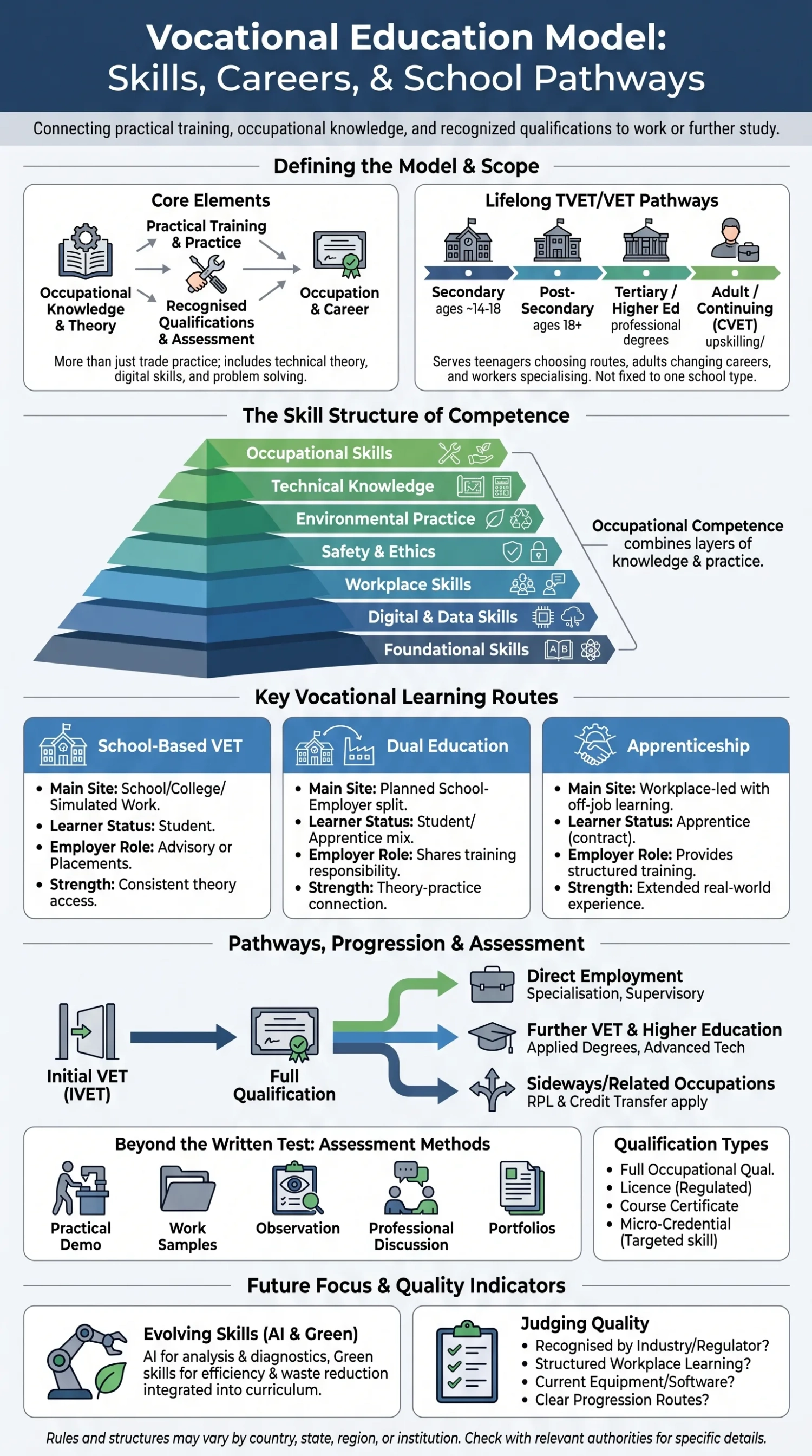
A vocational education model connects occupational knowledge, practical training, assessment, recognised qualifications, and routes into work or further study. It may be delivered mainly in a school, divided between a school and an employer, or organised as an apprenticeship in which the workplace carries much of the training. The model is wider than learning a trade through practice alone. Strong programmes also teach technical theory, mathematics, communication, digital tools, safety, problem solving, and the ability to adapt when equipment or job roles change. The exact school stage, qualification name, learner status, and access to higher education differ by country, so vocational education is best understood as a family of pathways rather than one fixed school type.
What Makes Education Vocational?
Vocational education is organised around preparation for an occupation, a trade, or a related group of occupations. UNESCO-UNEVOC uses the broader term technical and vocational education and training, usually shortened to TVET, and places it across secondary, post-secondary, tertiary, work-based, and continuing education settings. This definition matters because vocational learning does not belong to one age group or one type of institution. It can serve a teenager choosing an upper-secondary route, an adult changing careers, or an experienced worker adding a specialist qualification. UNESCO-UNEVOC’s TVET terminology describes this breadth directly.
Names vary across education systems. VET is common in Europe and many international reports. Career and technical education is widely used in the United States. Australia uses VET and also has the institution-based term TAFE. Some systems use technical schools, vocational colleges, professional institutes, trade schools, polytechnics, or sector academies. These labels are not exact equivalents. A programme should be judged by its learning outcomes, practical content, qualification status, and progression routes rather than by the word used in its title.
A short job course is not automatically a full vocational programme. A full route normally combines a defined occupational purpose, planned teaching, supervised practice, assessment, and a qualification that has value beyond simple attendance.
The Skill Structure Behind Occupational Competence
Occupational competence is often described too narrowly. A learner may be able to perform a task under supervision yet still lack the knowledge needed to diagnose faults, read technical instructions, manage risk, explain work to a customer, or respond when conditions change. Vocational curricula therefore combine several skill layers.
| Skill Layer | What It Covers | Typical Evidence of Learning |
|---|---|---|
| Occupational Skills | Tasks, tools, procedures, materials, and methods used in a trade or profession. | A completed product, service, repair, installation, procedure, or technical project. |
| Technical Knowledge | The principles that explain why a process works, why it fails, and how it can be improved. | Fault diagnosis, calculations, technical explanations, drawings, or process decisions. |
| Foundational Skills | Literacy, mathematics, measurement, science, and the reading of technical documents. | Accurate records, measurements, estimates, reports, and interpretation of instructions. |
| Digital and Data Skills | Sector software, digital work orders, automated equipment, data entry, and responsible use of AI tools. | A digital workflow, data record, software task, machine setup, or checked AI-assisted output. |
| Workplace Skills | Communication, teamwork, planning, customer contact, reliability, and problem solving. | Observed performance during group tasks, placements, simulations, or workplace projects. |
| Safety and Ethics | Risk control, professional conduct, privacy, quality procedures, and sector rules. | Safe practice, correct documentation, incident response, and adherence to required procedures. |
| Environmental Practice | Energy use, waste reduction, material efficiency, maintenance, and lower-emission processes. | A work plan or practical task that reduces waste, energy use, or avoidable replacement. |
The balance changes by occupation. A nursing support programme places more weight on care, communication, ethics, and infection control. Industrial maintenance requires measurement, mechanical or electrical knowledge, fault finding, and safe isolation procedures. Hospitality includes production skills, hygiene, timing, customer service, and cost control. Software testing may be vocational even though much of the work happens on a computer rather than in a physical workshop.
Where Vocational Pathways Sit in an Education System
Countries place vocational education at different points. Some introduce occupational exploration during lower secondary school without requiring a final specialisation. Others separate general and vocational routes at upper-secondary level. Post-secondary colleges may offer advanced technician programmes, while professional higher education institutions deliver applied degrees. Adult education providers may offer retraining, licence preparation, or continuing vocational education and training, often called CVET.
The first vocational qualification pursued before substantial occupational experience is often described as initial vocational education and training, or IVET. It may begin in school, after compulsory education, or after a general upper-secondary certificate. The category says little about quality by itself. An IVET programme can be broad and transferable, or so narrow that it prepares learners for only one production process.
Early Exposure Is Different from Early Lock-In
Career exploration can help students understand occupations before choosing a route. Permanent selection at a young age carries a different risk: a student may enter a narrow pathway before developing enough academic knowledge, work awareness, or confidence to make an informed choice. Systems can reduce that risk through bridge courses, shared general subjects, credit transfer, and routes back into other programmes.
Age alone does not define a vocational pathway. A 16-year-old in an upper-secondary technical school, a 22-year-old in a higher vocational institute, and a mid-career adult completing a maintenance qualification may all be participating in vocational education. What connects them is the organised relationship between learning outcomes and occupational practice.
School-Based, Dual, and Apprenticeship Routes
The location of training changes how a programme works. Three broad arrangements appear across many countries, though national definitions and legal rules differ.
| Feature | School-Based VET | Dual Education | Apprenticeship |
|---|---|---|---|
| Main Learning Site | School, college, training centre, laboratory, or simulated workplace. | Planned division between an education provider and an employer. | The workplace carries a large share of training, supported by off-the-job learning. |
| Learner Status | Usually a student. | Student, apprentice, employee, or a mixed status defined by national rules. | Usually an apprentice under a formal training agreement or contract. |
| Employer Role | May advise, supply placements, or contribute equipment and projects. | Shares planned training responsibility with the school or college. | Provides structured occupational training and supervised work. |
| Main Strength | Consistent teaching conditions and easier access to broad theory. | Regular movement between theory and real production or service settings. | Extended experience with real tasks, routines, equipment, and workplace expectations. |
| Main Risk | Workshops, software, or teaching methods may fall behind current practice. | Weak coordination can leave gaps or duplicate the same content. | Productive work can displace learning if the employer lacks a training plan. |
An internship or work placement should not be treated as another name for apprenticeship. Internships are often shorter and may complement a school programme without leading to an occupational qualification. On-the-job training can occur after hiring and may focus on one employer’s equipment or procedures. UNESCO-UNEVOC describes work-based learning as learning in a real work environment and includes apprenticeships, internships, traineeships, and on-the-job training as different forms within that wider category. Its work-based learning definition helps separate the broad category from any single programme type.
Workplace exposure is common but far from universal. OECD data report that 45% of upper-secondary VET learners across OECD countries are enrolled in programmes with a substantial work-based component. The same source stresses that the benefit depends on the length and quality of the placement, not only on its presence. OECD’s vocational education and training data also show wide differences among national systems.
How Occupational Work Becomes a Curriculum
A vocational curriculum begins with the work itself. Designers identify the tasks carried out in an occupation, the decisions workers make, the tools and knowledge they use, the risks they manage, and the standards their work must meet. These findings are then translated into learning outcomes that can be taught and assessed.
Occupational Analysis and Standards
Occupational analysis should look beyond a list of current vacancies. It needs evidence from employers, workers, professional bodies, regulators, educators, technology specialists, and labour-market data. A curriculum designed around today’s entry-level tasks alone may age quickly. Broader occupational standards can include the knowledge needed for diagnosis, adaptation, safe judgement, and movement into related roles.
Sequencing Learning
Learning normally moves from basic concepts and controlled practice toward combined tasks with less supervision. A student may first learn to read a circuit diagram, then assemble a simple circuit, measure it, diagnose a fault, document the repair, and finally complete a wider installation under workplace conditions. Theory and practice should meet repeatedly rather than being separated into long blocks that students are expected to connect on their own.
Choosing the Right Learning Site
Not every skill should be taught in the same setting. Safety procedures may begin through explanation and simulation. Repetitive manual techniques can be practised in a workshop. Customer communication may use role-play before a placement. Real production constraints, teamwork, scheduling, and unexpected faults are usually learned more fully in a workplace. High-risk procedures may require simulation even when the final occupation is highly practical.
Reviewing the Curriculum
Curriculum review should use graduate outcomes, employer feedback, assessment results, equipment changes, licensing rules, and evidence about new tasks. Updating only the tool list is not enough. A new technology may alter workflow, data handling, safety, customer communication, and the level of mathematics expected from a worker.
When the Workplace Functions as a Learning Site
A learner does not gain an education merely by being present at work. The placement needs clear outcomes, an appropriate range of tasks, supervision, feedback, protected learning time, and coordination with the education provider. Mentors need enough occupational knowledge and teaching support to explain decisions rather than simply demonstrate routines.
- A written agreement should define the programme, duration, parties, responsibilities, and conditions.
- Tasks should progress from observation and supported practice to independent performance where safe.
- The learner should receive feedback and have a way to report training, safety, or treatment concerns.
- School and workplace assessments should refer to the same occupational outcomes.
- Productive work should not replace the education promised by the programme.
- Pay, social protection, leave, insurance, and health-and-safety duties should follow the applicable national rules.
Work Experience Can Be Too Narrow
A placement may offer real work yet still provide weak training. Repeating one low-skill task, covering for staff shortages, or using equipment without explanation does not produce broad occupational competence. Evidence should show what the learner is expected to learn, who teaches it, and how progress is recorded.
The International Labour Organization’s Quality Apprenticeships Recommendation, 2023 (No. 208) links apprenticeships with defined learning outcomes, fair conditions, safe work, social protection, and recognised qualifications. The recommendation also treats regulation and cooperation among governments, employers, and workers’ organisations as part of apprenticeship quality. The ILO recommendation text provides the formal international reference.
Assessing Competence Beyond a Written Test
Written examinations can test technical knowledge, calculations, regulations, and diagnostic reasoning. They cannot, on their own, show whether a learner can complete a practical task safely and to the required standard. Vocational assessment therefore draws on several forms of evidence.
Practical demonstrations show performance under controlled or real conditions. Work samples may include a manufactured part, care record, technical drawing, menu, software output, maintenance report, or customer-service record. Observation allows an assessor to judge process, safety, communication, and independence. Portfolios show development over time. Professional discussions can test why a learner selected one method over another.
Assessment design also affects trust in the qualification. If the training provider alone teaches, assesses, and awards the credential without outside checks, standards may vary. External assessment, moderated marking, common practical tasks, licensed assessors, or national occupational standards can improve consistency. The best method depends on the occupation: a chef, laboratory technician, network installer, and childcare worker cannot be assessed through an identical task.
Qualifications, Licences, Certificates, and Micro-Credentials
Vocational documents can look similar while carrying different meanings. A full occupational qualification normally confirms a broad set of outcomes for a trade or occupation. A licence is legal permission to perform regulated work and may require a qualification, supervised experience, an examination, registration, or renewal. A course certificate may prove completion without confirming occupational competence. An industry certification may show ability with a particular product, technology, process, or sector standard.
Micro-credentials record a smaller unit of learning. They can help workers add a targeted skill, such as operating new equipment, installing a particular energy system, or using a sector-specific digital tool. They should not be assumed to equal a full occupational qualification. Their value depends on assessment, issuer, learning volume, recognition, and whether they can be combined with other learning. UNESCO’s paper on short courses, micro-credentials, and flexible learning pathways examines the need for clearer definitions and transparent use.
Recognition of prior learning, often shortened to RPL, allows skills gained through employment, informal learning, military service, volunteering, or previous study to be assessed against a qualification. Proper RPL does not award credit merely for time spent at work. The learner must provide evidence that the required outcomes have been achieved.
From Qualification to Employment and Further Study
The first destination may be direct occupational entry, but a vocational route can also lead to specialisation, supervisory work, self-employment, higher vocational education, or an applied degree. Progression is strongest when qualifications are connected rather than isolated. Credits, bridge programmes, advanced standing, common entry requirements, and RPL can prevent learners from repeating knowledge they have already demonstrated.
Access to higher education varies sharply. Some upper-secondary vocational qualifications open all tertiary routes, some lead mainly to short-cycle or professional programmes, and others require bridge courses or added academic preparation. Admission rules can still limit entry even where formal eligibility exists. OECD’s Pathways to Professions compares these entry arrangements and explains how higher vocational and professional programmes can connect occupational learning with tertiary education.
Formal Access and Practical Access Are Not the Same
A qualification may make a learner eligible to apply for higher education while subject requirements, entrance examinations, institutional selection, limited credit recognition, or timetable barriers still reduce the route in practice. A pathway should be judged by both legal eligibility and the conditions learners must actually meet.
One Qualification Can Support Several Career Directions
Consider an electrical and energy systems programme. Early learning may cover electrical principles, mathematics, technical drawings, measurement, safe isolation, wiring, and fault diagnosis. Workplace learning then places these skills within real schedules, team responsibilities, client requirements, and inspection procedures. A practical assessment confirms that the learner can plan, complete, test, and document work rather than reproduce separate workshop exercises.
After qualification, one graduate may enter building maintenance. Another may move into industrial systems. Further learning can support solar installation, battery storage, electric-vehicle charging, control systems, inspection, estimating, or site supervision. With the required admission preparation, the same learner may enter higher technical education or an applied engineering degree. The route is not a single ladder. It is a network of vertical and sideways moves shaped by licensing rules, prior learning, employer demand, and the design of the qualification.
How to Judge the Strength of a Vocational Programme
Programme quality cannot be read from the school name or occupational title alone. The following questions reveal how the route operates:
- Recognition: Which authority, awarding body, regulator, or industry body recognises the qualification?
- Occupational range: Does the programme teach a transferable occupation or only one employer’s procedure?
- Workplace learning: Are placements structured, supervised, assessed, and connected to the curriculum?
- Equipment and software: Do learners practise with tools and systems used in current workplaces?
- Teaching staff: Do instructors have occupational knowledge as well as the ability to teach and assess?
- Assessment: Must learners demonstrate full tasks, safety, judgement, and technical knowledge?
- Progression: Can the qualification lead to advanced study, specialist credentials, licensing, or related occupations?
- Outcomes: Are completion, employment, job match, retention, and further-study results reported separately?
- Learner conditions: Are fees, equipment costs, pay, insurance, working hours, and support arrangements clear?
A high employment rate can be useful evidence, but it needs context. Employment may be temporary, unrelated to training, low paid, unsafe, or too short to show a stable transition. Completion rates also need interpretation. Very low completion may point to poor support or programme design, while unusually high completion means little if assessment is weak.
Where Vocational Education Loses Value
Vocational education becomes less useful when curricula age faster than they are reviewed, placements provide labour without learning, or qualifications lead to a dead end. Narrow training may help with one immediate vacancy but leave graduates exposed when a plant closes, a process becomes automated, or licensing rules change.
Weak foundational learning creates another problem. A learner may pass a practical task yet struggle with new manuals, digital systems, calculations, written records, or further study. Broad technical literacy protects career mobility. It also helps workers question unsafe instructions and understand why a procedure has changed.
Access can be uneven. Rural areas may have fewer specialist teachers, employers, workshops, or transport options. Some occupations remain strongly divided by gender. Students with disabilities may encounter equipment, placement, or assessment barriers that could be reduced through accessible design and suitable support. Social status also affects enrolment when vocational routes are presented as a lesser destination rather than a different form of learning.
Shortages cannot always be solved by enrolling more students. Cedefop’s 2026 analysis of VET occupations in shortage in the European Union links shortages with demographic ageing, weak job attractiveness, gender imbalance, teacher shortages, working conditions, and mismatches between training supply and occupational demand. Cedefop’s shortage analysis shows why education capacity and job quality must be considered together.
AI, Green Skills, and Faster Curriculum Renewal
Artificial intelligence is changing both occupational tasks and the process used to design vocational programmes. OECD work published in June 2026 describes early uses of AI to analyse labour-market information, compare occupational standards, identify skill changes, and support curriculum or qualification development. It also warns that poor data, limited transparency, bias, security risks, and weak human oversight can produce misleading results. Developing Vocational Education and Training with Artificial Intelligence presents the cross-country evidence.
AI literacy within a vocational programme should be occupation-specific. A healthcare learner needs to understand privacy, verification, and the limits of automated suggestions. A maintenance technician may use sensor data or an AI-assisted diagnostic tool but still needs to test the result. A designer may generate options but must judge materials, tolerances, safety, copyright, and client requirements. Tool use without checking is not competence.
Environmental change also alters established occupations. OECD labour-market research published in 2025 found that nearly one in four upper-secondary VET graduates in the countries studied worked in jobs directly affected by the green transition, mainly existing occupations in which tasks or demand were changing. The study also found VET graduates overrepresented in greenhouse-gas-intensive work, which adds a need for retraining as production changes. The OECD study on VET and the green transition supports curriculum updates that combine occupational and environmental skills.
Green skills should not be restricted to programmes with “green” in the title. Electricians, construction workers, vehicle technicians, machine operators, farmers, logistics staff, and hospitality workers all make decisions about energy, materials, maintenance, waste, and process efficiency. The curriculum challenge is to connect these decisions to the real occupation rather than add a detached sustainability lesson.
What a Strong Vocational Route Should Preserve
A strong vocational route preserves a direct link with real work while giving learners enough theory and foundational knowledge to move beyond the first job. It protects the training purpose of workplace learning, uses assessment that reflects whole occupational tasks, and awards credentials whose meaning is clear. It also keeps more than one next step open: employment, specialisation, movement into a related occupation, higher vocational study, or higher education where entry conditions permit.
The model should be judged by what learners can do, how safely and independently they can do it, and whether their learning remains useful as work changes. School facilities, employer participation, qualification design, guidance, teacher knowledge, learner rights, and progression rules all shape that result.
This site is an independent informational guide and is not affiliated with any ministry of education, school authority, exam board, university, government agency, or official ranking organisation. Qualification names, apprenticeship conditions, licensing rules, programme recognition, and higher-education entry routes can change and often differ by country, region, occupation, and provider. Decisions should be checked with the relevant education authority, regulator, awarding body, institution, or official qualification register.
Sources and Verification
- UNESCO-UNEVOC: Technical and vocational education and training — Defines TVET as lifelong learning across secondary, post-secondary, tertiary, work-based, and continuing education settings.
- UNESCO-UNEVOC: Work-based learning — Distinguishes apprenticeships, internships, traineeships, and on-the-job training within work-based learning.
- OECD: Vocational education and training — Provides cross-country information on vocational enrolment, workplace learning, and early employment outcomes.
- ILO: Quality Apprenticeships Recommendation, 2023 (No. 208) — Sets an international reference for learning outcomes, agreements, rights, safety, social protection, and recognised qualifications.
- UNESCO: Short Courses, Micro-Credentials, and Flexible Learning Pathways — Examines definitions, transparency, quality, and the use of smaller credentials.
- OECD: Pathways into Professional Tertiary Programmes — Compares entry from vocational upper-secondary education, bridge routes, prior learning, and progression into higher vocational and professional study.
- Cedefop: Vocational Education and Training Occupations in Shortage — Reviews demographic, labour-market, job-quality, enrolment, and training-capacity pressures in the European Union.
- OECD: Developing Vocational Education and Training with Artificial Intelligence — Reviews current uses, possible benefits, limits, and safeguards for AI-supported curriculum and qualification development.
- OECD: Vocational Education and Training and the Green Transition — Analyses how environmental change affects occupations, skill demand, retraining, and post-secondary vocational learning.