Complete guide: Education Systems
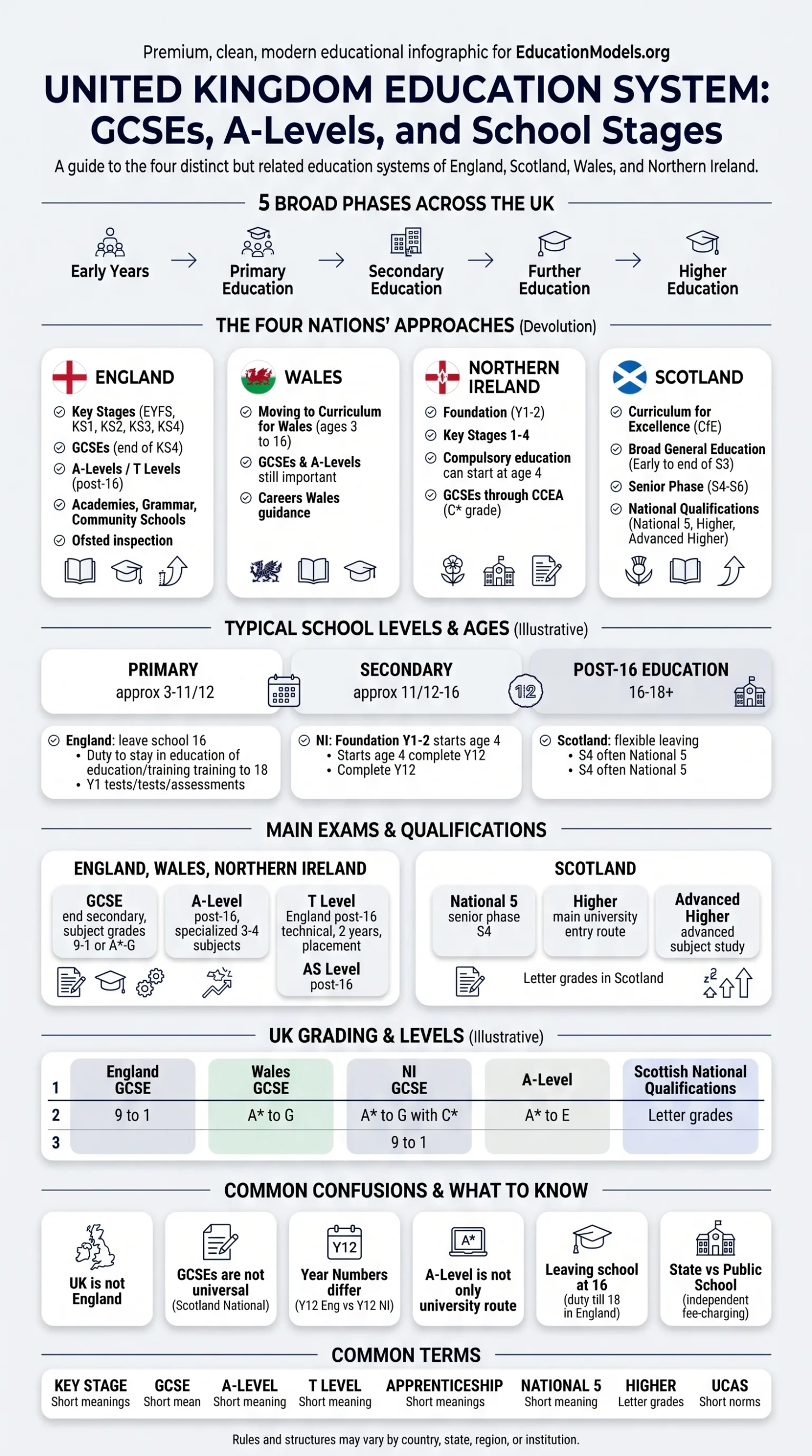
The United Kingdom education system is not one national sequence. England, Wales, Scotland and Northern Ireland set their own school structures, curricula and qualification rules. England and Wales generally use Reception followed by Years 1 to 13. Northern Ireland begins compulsory schooling earlier and uses Years 8 to 14 for post-primary education. Scotland uses Primary 1 to Primary 7 and Secondary 1 to Secondary 6. GCSEs are the main subject qualifications taken around age 16 in England, Wales and Northern Ireland, while Scotland normally uses National Qualifications, including National 5, Higher and Advanced Higher. A-Levels follow GCSE study in many schools and colleges outside Scotland, but the role of the AS Level differs by nation.
One Kingdom, Four Education Systems
The phrase “British education system” can hide differences that affect a pupil’s year group, examination route and school-leaving options. Education is devolved, so the government and education bodies in each UK nation make many of their own decisions. The systems share familiar terms, yet those terms do not always describe the same stage.
| Nation | Main School-Year Labels | Main Qualification Around 16 | Common Academic Route After 16 |
|---|---|---|---|
| England | Reception, Years 1–13 | GCSEs | AS Level or A-Level, usually in sixth form or college |
| Wales | Reception, Years 1–13 | GCSEs, including new Made-for-Wales qualifications | AS and A-Levels, with approved Welsh qualifications often delivered by WJEC |
| Scotland | P1–P7, S1–S6 | National 4 or National 5, depending on the learner and subject | Highers and, where offered, Advanced Highers |
| Northern Ireland | P1–P7, Years 8–14 | GCSEs | AS and A-Levels in school or further education college |
The Scotland Distinction
Calling National 5 “the Scottish GCSE” can be useful as a rough age-stage comparison, but the qualifications are not identical. They have different course designs, assessment rules, grade scales and progression patterns.
England’s National Curriculum groups learning into Key Stages. Reception normally covers ages four to five, Years 1 and 2 form Key Stage 1, Years 3 to 6 form Key Stage 2, Years 7 to 9 form Key Stage 3, and Years 10 and 11 form Key Stage 4. Most pupils take GCSEs or other national qualifications by the end of Year 11.[a]
Wales uses Reception followed by Years 1 to 13 in its school-year records.[b] In broad age terms, the sequence resembles England’s, but Welsh curriculum and qualification policy is set separately.
Scotland’s naming system is different. Children usually start school between four years six months and five years six months. Primary education runs from P1 to P7, and secondary education can run from S1 to S6.[c]
Northern Ireland has 12 compulsory school years. Foundation Stage covers P1 and P2, Key Stage 1 covers P3 and P4, Key Stage 2 covers P5 to P7, Key Stage 3 covers Years 8 to 10, and Key Stage 4 covers Years 11 and 12.[d] This is why a Northern Irish Year 8 pupil is at the beginning of post-primary education, while an English Year 8 pupil is already in the second year of secondary school.
How School Stages Line Up
Age is the safest starting point when comparing school systems, but even age needs care. School-entry cut-off dates, deferred entry, repeating a year and individual placement decisions can shift a pupil from the pattern shown below. The table gives the usual route rather than a guaranteed placement.
| Nation | Early and Primary Stage | Lower Secondary Stage | Qualification Stage Around 14–16 | Optional Study Around 16–18 |
|---|---|---|---|---|
| England | Reception and Years 1–6 | Years 7–9 | Years 10–11, mainly GCSE study | Years 12–13 in sixth form or college |
| Wales | Reception and Years 1–6 | Years 7–9 | Years 10–11, GCSEs and other approved qualifications | Years 12–13 in sixth form or college |
| Scotland | P1–P7 | S1–S3 Broad General Education | S4 and sometimes later years within the Senior Phase | S5–S6, college, training or employment routes |
| Northern Ireland | P1–P7 | Years 8–10 | Years 11–12, mainly GCSE study | Years 13–14 in sixth form or further education |
Primary to Secondary Transfer
In England and Wales, pupils normally transfer from primary school to secondary school after Year 6, at about age 11. Northern Ireland also transfers pupils at about 11, but the first post-primary class is Year 8 because its primary sequence begins with P1 at about age four. Scotland usually keeps pupils in primary school through P7 and moves them to S1 at about age 12.
These labels matter during an international move. A family transferring a 12-year-old should not match classes only by the number in the year name. The child may be in English Year 8, Northern Irish Year 9 or Scottish S1 depending on birth date and local placement practice.
School Leaving Does Not Mean the Same Thing Everywhere
School-leaving dates depend on the nation and the pupil’s birthday. England also separates leaving school from leaving education: after the permitted school-leaving date, a young person must remain in education or training until 18 through full-time study, an apprenticeship, or work or volunteering combined with part-time education or training. Wales, Scotland and Northern Ireland use their own leaving-date rules.[e]
Check the Nation, Not Only the Age
A statement such as “UK pupils must stay in school until 18” is inaccurate. The rule in England is participation in education or training, not compulsory attendance at the same school. The other UK nations have different legal arrangements.
GCSEs Are Subject Qualifications, Not One School Diploma
GCSE means General Certificate of Secondary Education. A pupil does not receive one combined “GCSE diploma.” Each completed subject produces a separate qualification and grade. A results statement may therefore include English Language, Mathematics, Biology, History, Art and several other subjects, each with its own outcome.
GCSE courses are usually studied during the final two compulsory secondary years: Years 10 and 11 in England and Wales, and Years 11 and 12 in Northern Ireland. Some schools begin selected course content earlier. Entry timing can also vary by subject and pupil.
Core Learning and Subject Options
English, mathematics and science form the centre of most GCSE programmes. Schools then build an option system around subjects such as history, geography, modern languages, computer science, art and design, music, drama, business, religious studies, design and technology, and vocational or applied courses. The number of entries is not fixed across the UK. It can change with the school timetable, local requirements, the pupil’s programme and whether a qualification is a single or double award.
GCSE subject choice can affect later study, but a 14-year-old is not always choosing a final career. A balanced set of subjects can preserve several sixth-form, college and apprenticeship routes.
Examinations, Coursework and Practical Assessment
Assessment depends on the subject and the nation. Written examinations carry most of the weight in many courses, but practical work remains necessary where an exam alone cannot test the required skill. Art may use a portfolio and practical work. Languages can include speaking assessment. Drama, music, design subjects and sciences may contain performance, project or practical elements.
The exam board also matters. Schools enter pupils for specifications offered by approved awarding organisations. That does not mean every pupil in the same nation sits an identical paper. Two schools may teach the same subject through different exam boards, provided the qualification is approved for use in that jurisdiction.
GCSE Grades Across England, Wales and Northern Ireland
GCSE grading is one of the easiest areas to misread. The same qualification name appears across three nations, yet the displayed grade can be numeric or alphabetic.
| Jurisdiction or Award | Grade Scale | Highest Grade | Reading the Result |
|---|---|---|---|
| England GCSE | 9–1, plus U | 9 | Grade 4 aligns with the lower boundary of the former grade C; the scales are not exact one-for-one conversions |
| Made-for-Wales single-award GCSE | A*–G, plus U | A* | Wales has retained letter grading for its own GCSEs |
| CCEA GCSE in Northern Ireland | A*–G with C*, plus U | A* | C* sits between B and C within the CCEA scale |
| Other approved GCSEs taken in Northern Ireland | May use 9–1 | 9 | A results statement can contain both number and letter grades when qualifications come from different awarding bodies |
In England, GCSEs have used the 9-to-1 scale since 2017. Grade 9 is the highest, grade 1 is the lowest graded result and U means ungraded. The official comparison places the lower boundary of grade 7 near the lower boundary of the former A, and the lower boundary of grade 4 near the former C. The two scales are not direct equivalents.[f]
Wales retained A*–G grading for Made-for-Wales single-award GCSEs. The scale runs from A* as the highest grade to G as the lowest graded result, with U used when a result is ungraded.[g]
Northern Ireland can produce a mixed-looking results sheet. CCEA GCSEs use letter grades and include C*, while GCSEs from some other examining bodies use 9–1. The official Northern Ireland guidance warns that pupils can therefore receive both letters and numbers in the same results cycle.[h]
Grade Comparisons Have Limits
A grade comparison table shows broad reference points, not a mathematical conversion. Course content, assessment design and grade boundaries differ. Schools, colleges, universities and employers may also set their own entry rules.
What Happens After GCSEs
GCSE results lead into several routes. The next step is not automatically A-Levels, and the alternatives are not all lower-level options. Students can choose an academic programme, technical education, vocational study, an apprenticeship or a mixed programme, subject to local availability and entry conditions.
Sixth Form and Sixth-Form College
Sixth form describes education after age 16, traditionally the lower and upper sixth. A school sixth form remains part of a secondary school, while a sixth-form college is a separate institution focused mainly on 16-to-19 education. Both can offer A-Levels, and some also provide applied or vocational qualifications.
Further Education College
A further education college may offer A-Levels alongside technical, occupational and vocational programmes. Colleges also teach GCSE resit courses, foundation programmes and qualifications for adult learners. “College” in the UK therefore does not always mean a university-level institution.
Apprenticeships and Technical Routes
An apprenticeship combines paid employment with structured training. Entry requirements depend on the occupation, programme level and employer. Technical courses can also lead to skilled work, higher apprenticeships or higher education.
In England, T Levels are two-year post-GCSE programmes that are broadly equal in size to three A-Levels. They combine technical study with an industry placement and can support entry to skilled employment, an apprenticeship or related further or higher study.[i] T Levels are an England-specific route and should not be presented as a uniform UK qualification.
| Post-16 Route | Typical Learning Style | Possible Next Steps |
|---|---|---|
| A-Levels | Subject-based academic study, usually across a small number of subjects | University, higher education, employment or higher-level training |
| Technical qualification | Classroom study linked to a sector, often with practical learning | Skilled work, apprenticeship or related higher study |
| Vocational course | Applied learning linked to an occupational area | Employment, further study or apprenticeship |
| Apprenticeship | Paid work combined with off-the-job training | Employment, a higher apprenticeship or later study |
| Mixed programme | A combination of academic and applied qualifications where permitted | Route depends on subjects, grades and institution requirements |
A-Levels and AS Levels: The Same Names, Different Structures
A-Levels are advanced subject qualifications usually studied after GCSEs in England, Wales and Northern Ireland. A full-time programme commonly lasts two academic years. Students usually specialise in fewer subjects than they studied at GCSE, which allows more depth and independent work.
Three A-Level subjects form a common programme, but this is not a universal legal rule. Some students begin with four subjects, combine academic and applied study, or take a different number because of timetable design, prior attainment or the demands of a particular subject combination.
England: AS Is Separate From the Full A-Level
In England, the reformed AS Level and A-Level are separate linear qualifications. An AS result does not contribute to the final A-Level grade. A student may take an AS qualification in its own right, but completing an AS exam is not a required first half of the full A-Level.[j]
Wales: AS Units Can Contribute to the A-Level
Approved A-Levels in Wales are divided into AS and A2 units. Both parts contribute to the full A-Level grade, and the AS achievement can also appear separately on the learner’s certificate. AS Levels use grades A–E and full A-Levels use A*–E. Qualifications Wales states that AS units contribute 40% of the final grade for approved Welsh A-Levels.[k]
Northern Ireland: AS Plus A2 Forms the Full A-Level
Northern Ireland retains a unit-based structure in which the AS Level is a qualification in its own right and combines with A2 to form the complete A-Level. Courses normally take two years of full-time study in a school or further education college, although subject design and assessment balance can vary.[l]
| Feature | England | Wales | Northern Ireland |
|---|---|---|---|
| Standalone AS available | Yes | Yes | Yes |
| AS contributes to full A-Level | No | Yes for approved Welsh A-Levels | Yes in the standard AS plus A2 route |
| Full A-Level grades | A*–E, plus U | A*–E, plus U | A*–E, plus U |
| Usual setting | School sixth form, sixth-form college or further education college | School sixth form or college | School sixth form or further education college |
The phrase “first year of A-Levels” does not prove that a student is taking an AS qualification. The answer depends on the nation, the awarding body and the course entered by the school or college.
Scotland’s National 5, Higher and Advanced Higher Route
Scotland does not normally organise secondary education around Key Stage 4, GCSEs and A-Levels. Under Curriculum for Excellence, pupils receive a Broad General Education through the end of S3. The Senior Phase runs through S4 to S6 and can include school, college, work-based learning and National Qualifications.[m]
National 4 and National 5
National 4 and National 5 courses are commonly taken during the Senior Phase. A learner may study subjects at different levels in the same year, so the programme can be tailored by subject rather than assigning one level to the whole pupil. National 5 is often used for broad comparison with GCSE because it occupies a similar stage in secondary education, but the match is not exact.
Highers and Advanced Highers
Highers are central to many Scottish university applications. Pupils often take a group of Highers in S5, then add further Highers or move to Advanced Highers in S6. The exact pattern depends on the school, subject availability, previous attainment and the entry requirements of the intended course or institution.
National 5, Higher and Advanced Higher courses are graded A–D. Other Scottish courses and awards may use pass or fail rather than the same letter scale.[n]
| Scottish Stage or Qualification | Usual Place in the Student Route | Broad Comparison Point |
|---|---|---|
| S1–S3 Broad General Education | Lower secondary learning before most national course specialisation | Overlaps in age with lower secondary years elsewhere in the UK |
| National 4 | Senior Phase subject course | Different assessment and grading model from GCSE |
| National 5 | Senior Phase subject course often used for progression to Higher | Roughly compared by stage with GCSE, not treated as the same award |
| Higher | Common university-entry qualification, often taken in S5 or S6 | Cannot be converted into an A-Level grade by a simple table |
| Advanced Higher | More advanced subject study, often in S6 | May support preparation for degree-level study in the subject |
University Entry Is Institution-Led
A-Levels and Scottish Highers are widely used for university entry, but they do not create one automatic national admission rule. Universities and colleges set requirements for each course, often through a combination of qualifications, named subjects and grades. Some courses also use UCAS Tariff points or require an admissions test, interview, portfolio, audition or relevant experience. GCSEs can remain part of the entry criteria, especially English and mathematics or their accepted equivalents.[o]
Scottish applicants often apply with Highers, while pupils elsewhere commonly apply with A-Levels or another Level 3 route. Universities assess the qualification actually taken; families should not attempt to translate every Scottish grade into an English grade without checking the institution’s published entry terms.
Moving Into a UK School From Another Country
International transfers are usually considered through age, birth date, prior schooling, language needs, available places and the receiving school’s programme. A foreign grade label is not always matched to the UK year with the same number. The receiving authority or school may request transcripts, reports, subject lists and evidence of completed courses.
Transfer During GCSE Study
A move during Year 10 or Year 11 can be difficult because GCSE specifications differ by exam board and school. The new school may not offer the same subjects, may teach topics in another order, or may use a different assessment plan. Coursework already completed may not transfer automatically.
Late Secondary Transfers Need Course-Level Checks
Before accepting a place, ask which awarding body and specification the school uses for each subject, whether prior assessed work can be carried over, and whether the pupil can complete the course within the remaining time.
English as an Additional Language
Language support and academic placement should be considered separately. A pupil may understand mathematics, science or history at an advanced level while still developing academic English. Schools can assess what the pupil knows, what language support is needed and whether examination access arrangements or a longer preparation period are appropriate.
Qualification Changes Now in Progress
The names GCSE, A-Level, National 5 and Higher remain in use, but parts of the curriculum and qualification offer are changing. Planned reforms should be separated from rules already in force.
England
England plans full first teaching of a revised National Curriculum from September 2028, with the final version intended for publication before implementation.[p] The current Key Stage and GCSE arrangements remain the basis for pupils studying before that change takes effect.
Post-16 vocational provision is also being reorganised. New V Levels are planned as broad vocational qualifications that can sit alongside A-Levels and T Levels. They are to be introduced in phases rather than replacing every existing course at once.[q]
Wales
Made-for-Wales GCSEs began entering classrooms from September 2025, with further subjects introduced from September 2026. The first cohort taking the earliest new courses is due to receive awards from 2027. The new suite is tied to the Curriculum for Wales and includes changes to subject combinations, assessment and the use of Welsh and English.[r]
Scotland
Qualifications Scotland replaced the Scottish Qualifications Authority on 1 February 2026.[s] Existing certificates, course materials and qualification services continue to be used during the organisation’s digital transition.
Assessment revisions are being developed in stages. Qualifications Scotland confirmed several course-level changes for the 2026–27 session while longer-term work on National Courses continues.[t] A proposal under review should not be described as a completed nationwide replacement.
Northern Ireland
Northern Ireland is consulting on a new curriculum intended for 2028. The consultation runs through September 2026, so the published material is a proposed future model rather than the current statutory curriculum.[u] Pupils and families should continue to use current school and CCEA information for present course decisions.
How to Read a UK Qualification Record
A useful reading order is nation, awarding body, qualification title, subject, level and grade. “GCSE Mathematics grade 7” points to the England-style numeric scale. “GCSE Mathematics grade A” points to a letter-graded award. “Higher Mathematics grade B” belongs to the Scottish route. The grade alone is not enough.
- Confirm which UK nation’s rules apply.
- Read the exact qualification title rather than assuming every age-16 award is a GCSE.
- Check whether the result is a single award, double award, short course or another qualification size.
- Identify the awarding body when assessment or resit rules matter.
- Use the receiving school, college, employer or university’s own entry conditions for decisions.
This site is an independent informational guide and is not affiliated with any ministry of education, school authority, exam board, university, government agency or official ranking organisation. Qualification specifications, school-leaving rules and admission conditions can change. Decisions about enrolment, examinations or university entry should be checked with the relevant school, awarding body, regulator, university or public authority.
Sources and Verification
- [a] The national curriculum: Overview — Confirms England’s Key Stages, typical ages and Year 11 GCSE stage. (UK government guidance.)
- [b] Regulations about reporting school and pupil information — Confirms the Reception and Year 1–13 labels used in Welsh school reporting. (Welsh Government guidance.)
- [c] Definitions and glossary — Confirms usual Scottish starting ages and the P1–P7 and S1–S6 stage names. (Scottish Government publication.)
- [d] School curriculum — Sets out Northern Ireland’s age, year group and Key Stage sequence from Year 1 to Year 12. (Northern Ireland public information service.)
- [e] School leaving age — Provides the nation-specific school-leaving rules and England’s participation requirement to age 18. (UK government guidance.)
- [f] GCSE 9 to 1 grade scale explained — Explains England’s numeric GCSE scale and broad reference points to the former letters. (Ofqual and UK government publication.)
- [g] Statement on the Approach to standards for Made-for-Wales GCSEs designed to support Curriculum for Wales — Confirms the A*–G scale for Made-for-Wales GCSEs. (Qualifications Wales.)
- [h] GCSEs — Explains GCSE study, assessment and mixed letter or number grading in Northern Ireland. (Northern Ireland public information service.)
- [i] Introduction of T Levels — Confirms the duration, size and intended progression routes of T Levels in England. (Department for Education.)
- [j] AS and A level decoupling — Confirms that AS and A-Level qualifications in England are separate and AS does not count toward the A-Level grade. (Ofqual.)
- [k] AS & A levels — Explains the Welsh AS and A2 structure, grade scales and contribution to the final A-Level. (Qualifications Wales.)
- [l] AS and A levels — Describes the Northern Irish AS plus A2 route and the usual two-year study pattern. (Northern Ireland public information service.)
- [m] Curriculum stages — Confirms Broad General Education through S3 and the Senior Phase from S4 to S6. (Education Scotland.)
- [n] Answering your questions about Results Day — Confirms A–D grading for National 5, Higher and Advanced Higher. (Qualifications Scotland.)
- [o] Entry requirements — Explains that universities and colleges set course-specific requirements using qualifications, subjects, grades and, for some courses, other selection methods. (UCAS.)
- [p] New curriculum to give young people the skills for life and work — Gives the planned September 2028 first-teaching date for England’s revised National Curriculum. (Department for Education.)
- [q] Qualification reform hub — Describes planned V Levels and their place beside A-Levels and T Levels. (Department for Education.)
- [r] GCSEs — Lists the 2025 and 2026 introduction waves for reformed GCSEs in Wales. (Qualifications Wales.)
- [s] Launching our new digital service — Confirms that Qualifications Scotland replaced SQA on 1 February 2026 and explains the transition of existing services. (Qualifications Scotland.)
- [t] Qualifications Scotland sets out latest progress on qualifications reform — Records course-assessment changes confirmed for the 2026–27 session. (Qualifications Scotland.)
- [u] Curriculum Reform — Confirms the 2026 consultation on the proposed Northern Ireland Curriculum 2028. (Department of Education, Northern Ireland.)
Related Topics
- → Netherlands Education System: Schools, Tracks, and Learning Pathways
- → Education Systems Around the World: How School Systems Differ by Country
- → Canada Education System: Provinces, Schools, and Higher Education
- → Germany Education System: Schools, Tracks, and Vocational Pathways
- → Japan Education System: Schools, Exams, and Student Life
- → United States Education System: Grades, Schools, and College Pathways