Complete guide: Education Systems
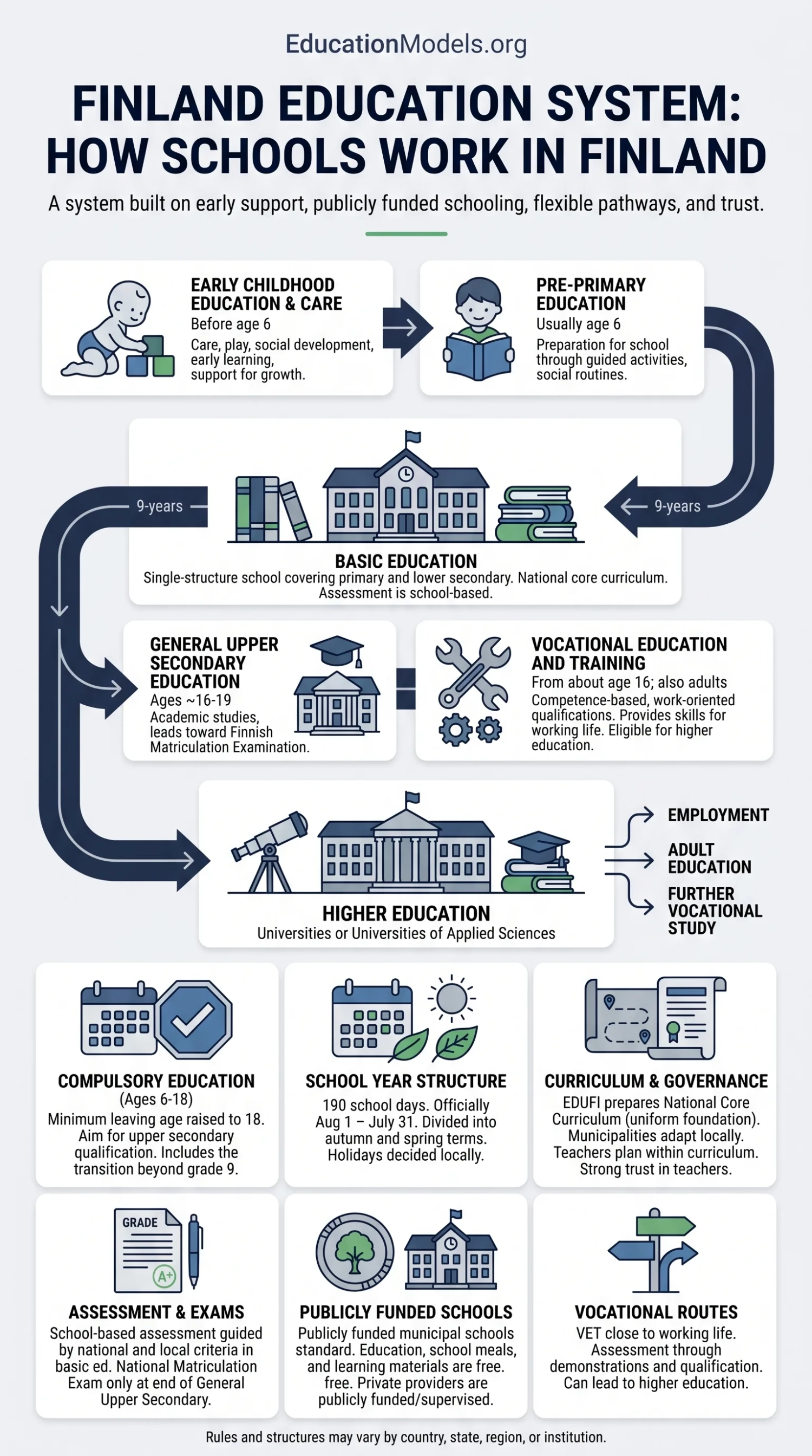
The Finland education system moves children from compulsory pre-primary education at age six into a nine-year basic education route that normally begins in the year they turn seven. After grade 9, students continue in either general upper secondary education or vocational education and training. Compulsory education normally continues until age 18, or ends earlier when a student completes an upper secondary qualification. Schools follow national curriculum requirements, yet municipalities, schools, and teachers make many decisions about local delivery. Assessment in grades 1–9 is mainly carried out by teachers rather than through a national leaving examination.[a]
Finland’s school model is often described through short claims about late school entry, limited testing, free meals, and teacher trust. Those claims point to real features, but they can hide how the parts connect. The system depends on a shared school route through grade 9, national learning goals, local curriculum work, trained teachers, school-based assessment, and support services that operate alongside classroom teaching.
The Student Path From Age Six to Upper Secondary Education
The clearest way to understand Finnish schooling is to follow the student’s route. Early childhood education and care may begin before compulsory schooling. Pre-primary education follows at age six. Grades 1–9 then form one continuous school structure, after which students choose an upper secondary path.
| Stage | Typical Age or Point | How It Works | Usual Next Step |
|---|---|---|---|
| Early childhood education and care | Before age 6 | Education, care, play, and development are combined in early-years services. | Pre-primary education |
| Pre-primary education | Age 6 | A compulsory year that prepares children for school through guided learning, interaction, and play. | Grade 1 |
| Basic education | Grades 1–9, usually ages 7–16 | Primary and lower secondary years are delivered within one shared route. | General or vocational upper secondary education |
| General upper secondary education | Usually begins after grade 9 | Academic studies lead toward the national Matriculation Examination. | University, university of applied sciences, vocational study, or other further study |
| Vocational education and training | Usually begins after grade 9 | Students develop occupational competence through studies and demonstrations in work tasks. | Employment, higher education, or further vocational study |
Age and Grade Placement
The ages in the table describe the usual route. A student’s placement can differ because of an earlier or delayed start, migration, interrupted schooling, support needs, or an individual study decision.
Why Formal School Usually Starts at Seven
Starting grade 1 at seven does not mean learning is postponed until seven. Finland treats early childhood education and care, commonly shortened to ECEC, as part of the education system. Its “educare” approach combines care, teaching, and education, with play used as a planned setting for language, movement, cooperation, imagination, and early problem-solving.[b]
At age six, children enter pre-primary education for one school year. The aim is school readiness in a broad sense: following shared routines, communicating with others, developing curiosity, managing everyday tasks, and gaining early literacy and numeracy experience. Pre-primary education is not intended to copy the timetable and subject structure of an older primary class.
Later formal entry and later learning are different ideas. Finnish children learn before grade 1, but the early-years setting gives greater space to play, interaction, physical activity, and gradual preparation for school.
Grades 1–9 Keep Students in One Shared School Route
Basic education contains grades 1–9 in a single structure. Students are not routinely separated into academic and vocational school types during the primary years. Municipalities arrange education, and pupils are normally allocated a place in a nearby school. Families may apply to another school, though admission can be limited by local rules, available places, or the focus of a particular programme.
Because the shared route continues through grade 9, the main formal choice between general and vocational upper secondary education comes after basic education rather than during the early school years.[c]
How National Goals Become Local Teaching
Finland does have a national curriculum. The national core curriculum sets shared objectives, subject content, assessment principles, and wider competences. Municipalities and schools then prepare local curricula that translate those requirements into teaching plans suited to their setting. Teachers choose methods, materials, tasks, and lesson sequences within those national and local duties.
| Decision Level | Main Responsibilities | What Can Vary |
|---|---|---|
| National | Learning objectives, required subjects, curriculum principles, assessment criteria, and minimum lesson allocations | National revisions can change goals, criteria, or required content over time. |
| Municipality or education provider | Local curriculum, school network, resource allocation, support arrangements, and local options | Course availability, specialist provision, schedules, and service organisation |
| School | School-level plans, learning modules, timetables, cooperation practices, and daily organisation | Projects, themes, optional studies, routines, and use of facilities |
| Teacher | Teaching methods, learning tasks, materials, feedback, and classroom assessment | Lesson design, pacing, grouping, and responses to pupil needs |
The curriculum also requires every school to organise at least one multidisciplinary learning module during each school year. A module may connect several subjects around a theme, project, or problem. The subjects themselves remain in the timetable, and learning within the module is assessed through the objectives of those subjects. Finland did not replace mathematics, science, history, or languages with project-only learning.
Basic education covers mother tongue and literature, mathematics, languages, environmental studies, biology, geography, physics, chemistry, health education, religion or ethics, history, social studies, music, visual arts, crafts, physical education, home economics, and guidance. The number and distribution of subjects change by grade. Schools may also offer optional subjects or local areas of emphasis.[d]
What the School Day Provides
A Finnish school day is not fixed by one national sample timetable. Younger pupils usually have fewer lessons than older pupils, while start and finish times depend on the local schedule. Lessons, breaks, outdoor time, practical work, group activities, and independent tasks can all appear during the day. Homework exists, but the amount and type depend on age, subject, teacher, and school.
Pre-primary and basic education are free of tuition. Pupils receive learning materials, a daily school meal, health and welfare services, and school transport when the journey meets the applicable conditions. School nurses, dentists, psychologists, and social workers are connected to school welfare provision.[e]
What “Free Schooling” Covers
The free offer in basic education extends beyond classroom tuition. It includes core materials, a meal, and student welfare services that reduce costs connected with ordinary school participation.
Assessment Is Led by Teachers
There is no national leaving test for pupils at the end of grade 9. In grades 1–6, a class teacher commonly teaches most subjects, while subject teachers take a larger role in grades 7–9. Teachers assess learning through exams, classwork, projects, assignments, participation, demonstrations, and other evidence suited to the subject. Assessment includes ongoing feedback during the year and final judgments against curriculum objectives.
Pupils receive a report at least once after each school year. Written and descriptive assessment can be used in the lower grades. Numerical grading begins no later than grade 4, using a scale from 4 to 10. A grade of 4 is failing; 5 is adequate; 8 is good; and 10 is excellent. National criteria support more consistent judgments in later grades, but teachers still award the grades.[f]
| Grade | Description | Meaning |
|---|---|---|
| 10 | Excellent | Performance reaches the highest level described by the assessment criteria. |
| 9 | Very good | Performance is clearly above the level described as good. |
| 8 | Good | A commonly used reference level in national assessment criteria. |
| 7 | Satisfactory | The pupil meets many objectives but shows gaps or uneven performance. |
| 6 | Moderate | The pupil has partial command of the required knowledge and skills. |
| 5 | Adequate | The minimum passing level is met. |
| 4 | Fail | The required passing level has not been reached. |
The absence of a national grade-9 examination does not mean the absence of tests. It means that no single nationwide test determines every pupil’s completion of basic education or assigns them one national score.
Learning Support and Student Welfare Operate Inside the School System
Support may begin with changes to ordinary teaching: clearer instructions, flexible grouping, additional practice, co-teaching, language support, or help from a special education teacher. Some pupils need student-specific measures, adapted arrangements, or changes to parts of the syllabus. Support is intended to respond to need rather than wait for a pupil to fail repeatedly.
A revised law on support for learning and school attendance took effect on 1 August 2025. The change placed stronger emphasis on support arranged within teaching groups and on student-specific measures when group support is not enough. The Finnish National Agency for Education updated the curriculum provisions to match the law.[g]
Student welfare is related but not identical to learning support. School health care, psychological services, social work, guidance, and cooperation with families address barriers that may affect attendance, wellbeing, or learning. The exact organisation can differ because municipalities and regional service providers arrange services in different ways.
Teacher Preparation Supports Classroom Autonomy
Teacher autonomy in Finland operates within curriculum duties and qualification rules. A qualified class teacher is normally required to hold a Master of Arts in Education, studies covering the subjects and themes taught in basic education, and pedagogical studies. A qualified subject teacher normally needs a master’s degree, studies in the teaching subject, and pedagogical studies.[h]
This preparation helps explain why teachers can make many day-to-day choices. They are expected to interpret curriculum objectives, assess pupils, adjust teaching, cooperate with support staff, and communicate with families. Autonomy does not remove accountability. It moves much of the professional judgment into the school and classroom rather than prescribing one teaching script for every lesson.
The Choice After Grade 9 Is Between Two Valid Upper Secondary Routes
After grade 9, students usually move into general upper secondary education or vocational education and training. The choice affects the form of study, but it does not create a permanent barrier between academic study, occupational training, employment, and higher education.
| Route | Study Design | Main Qualification or Examination | Later Options |
|---|---|---|---|
| General upper secondary | Subject-based academic studies, usually completed in about three years; the syllabus contains 150 credits. | General upper secondary syllabus and the Matriculation Examination | University, university of applied sciences, vocational study, or other further education |
| Vocational education and training | Competence-based studies that can combine institutional learning with tasks in real workplaces. | Vocational qualification demonstrated through competence in practical work | Employment, university of applied sciences, university study where admission conditions are met, or further vocational qualifications |
| Preparatory education | Additional preparation for students who need stronger study skills, language ability, guidance, or time before choosing a qualification route. | Preparatory studies rather than an upper secondary qualification | General or vocational upper secondary education |
General Upper Secondary Education and the Matriculation Examination
General upper secondary education is organised through credits and study units rather than a rigid national grade-by-grade programme. Students complete 150 credits, commonly over three years, though the pace can vary. The studies prepare students for further education and for the Matriculation Examination.[i]
The Matriculation Examination is a national examination taken near the end of general upper secondary school. It is organised in spring and autumn and is administered digitally. Passing it provides higher education eligibility, while institutions and programmes make separate admission decisions under their own published criteria.[j]
Vocational Education, Work Tasks, and Higher Education Eligibility
Finnish vocational qualifications are competence-based. Students demonstrate what they can do in real work tasks, and their studies may recognise skills acquired earlier. Initial vocational qualifications, further vocational qualifications, and specialist vocational qualifications serve learners at different stages. Work-based learning can take place through training agreements or apprenticeship arrangements, and the balance between institutional and workplace learning varies by field and learner. A vocational qualification provides eligibility to apply for higher education, so the route is not limited to immediate employment.[k]
Language of Instruction and Support for Multilingual Pupils
The main languages of instruction are Finnish and Swedish. A pupil who is developing the school language may study Finnish or Swedish as a second language and literature, often called S2 in Finnish-language settings. Pupils may also receive support in their own language for learning other subjects when local provision is available.[l]
Instruction preparing a newly arrived pupil for basic education may focus on the language of schooling, study routines, and subject learning before or alongside transition into a regular class. Provision differs by municipality, so families should check the local education authority rather than assume that every town offers the same language programme or international-school option.
English-Language General Upper Secondary Education
Authorised providers may begin Finland’s national general upper secondary programme in English from 1 August 2026. English-language Matriculation Examination tests are scheduled from autumn 2028. Eligibility is defined narrowly, and the route is not a general recruitment programme for students moving to Finland from outside the EU or EEA solely for study.[m]
Finland’s Reputation Does Not Remove Present-Day Pressures
Finland’s international reputation grew partly from strong results in earlier rounds of the OECD Programme for International Student Assessment, or PISA. PISA measures the skills of 15-year-olds in selected areas; it does not measure every part of a school system, every subject, or the full daily experience of pupils.
In PISA 2022, Finnish students remained above the OECD average in mathematics, reading, and science, but average results were lower than in 2018 and lower than Finland’s earlier PISA performance. The gap between higher- and lower-performing students also widened in all three tested areas during the latest comparison period reported by the OECD.[n]
These results help explain the current attention given to basic skills, learning support, classroom concentration, literacy, and differences between pupils. They do not erase the structural features associated with Finland, but they show that those features do not guarantee fixed outcomes. A school system can retain shared principles while revising laws, curriculum provisions, and local practice.
Reading the Finnish Model Without Turning It Into a Myth
Several popular descriptions need qualification. Finnish pupils do take tests, although basic education is not organised around one national grade-9 examination. Homework is used, though practices differ. Schools teach separate subjects, while interdisciplinary modules connect them for part of the year. Teachers have room to choose methods, yet they work under national and local curricula. Vocational education can lead to employment or higher education.
The model is better understood as a set of connected arrangements: a shared route through grade 9, later pathway choice, nationally defined goals, local delivery, qualified teachers, school-based assessment, free core services, and support linked to ordinary schooling. Removing one part from that relationship can produce a misleading comparison with another country.
This website is an independent informational guide and is not affiliated with any ministry of education, school authority, exam board, university, government agency, or official ranking organisation. Education laws, curriculum rules, language provision, qualification conditions, and admission practices can change. Decisions affecting a particular pupil should be checked with the relevant municipality, school, education provider, examination authority, or higher education institution.
Sources and Verification
- [a] Finnish education system — Confirms the national education stages, compulsory education for ages 6–18, and the general and vocational routes after basic education. (Finnish National Agency for Education.)
- [b] Early childhood education and care — Describes ECEC as part of the education system and explains the educare and play-based approach. (Finnish National Agency for Education.)
- [c] Primary and lower secondary education — Supports the grades 1–9 structure, municipal responsibility, nearby-school placement, and local curriculum role. (Finnish National Agency for Education.)
- [d] National core curriculum for primary and lower secondary education — Explains the relationship between national and local curricula and the annual multidisciplinary learning module. (Finnish National Agency for Education.)
- [e] Funding in pre-primary and basic education supports equity and equality — Verifies free materials, meals, welfare services, and transport duties in pre-primary and basic education. (Finnish National Agency for Education.)
- [f] Basic information about primary and lower secondary education — Confirms teacher-led assessment, the absence of national tests in grades 1–9, annual reports, and the 4–10 grading scale. (Finnish National Agency for Education.)
- [g] Support for learning and school attendance — Confirms that the amended support law entered into force on 1 August 2025 and led to curriculum updates. (Ministry of Education and Culture, Finland.)
- [h] Working as a teacher in Finland with a foreign qualification — States the degree, subject-study, and pedagogical-study requirements used for class and subject teacher eligibility. (Finnish National Agency for Education.)
- [i] General upper secondary education — Confirms the usual duration, 150-credit syllabus, and connection to the Matriculation Examination. (Finnish National Agency for Education.)
- [j] Matriculation Examination — Explains the national examination’s purpose, administration, digital delivery, and higher education eligibility. (The Matriculation Examination Board.)
- [k] Vocational qualifications in Finland — Verifies competence-based vocational qualifications, workplace demonstrations, qualification types, and higher education eligibility. (Finnish National Agency for Education.)
- [l] Education and support for pupils with migrant and multilingual background — Supports Finnish or Swedish as a second language provision and subject support through a pupil’s own language. (Finnish National Agency for Education.)
- [m] Finnish general upper secondary school can be completed in English as of autumn 2026 — Confirms the earliest start date, the planned English examination date, provider authorisation, and limits on the intended student group. (Finnish National Agency for Education.)
- [n] PISA 2022 Results: Country Notes — Finland — Provides Finland’s latest released PISA results in mathematics, reading, and science, including trends and performance gaps. (OECD.)
Related Topics
- → Canada Education System: Provinces, Schools, and Higher Education
- → Netherlands Education System: Schools, Tracks, and Learning Pathways
- → United States Education System: Grades, Schools, and College Pathways
- → South Korea Education System: Schools, Exams, and Academic Pressure
- → Education Systems Around the World: How School Systems Differ by Country
- → France Education System: Schools, Exams, and Higher Education