Complete guide: Education Models
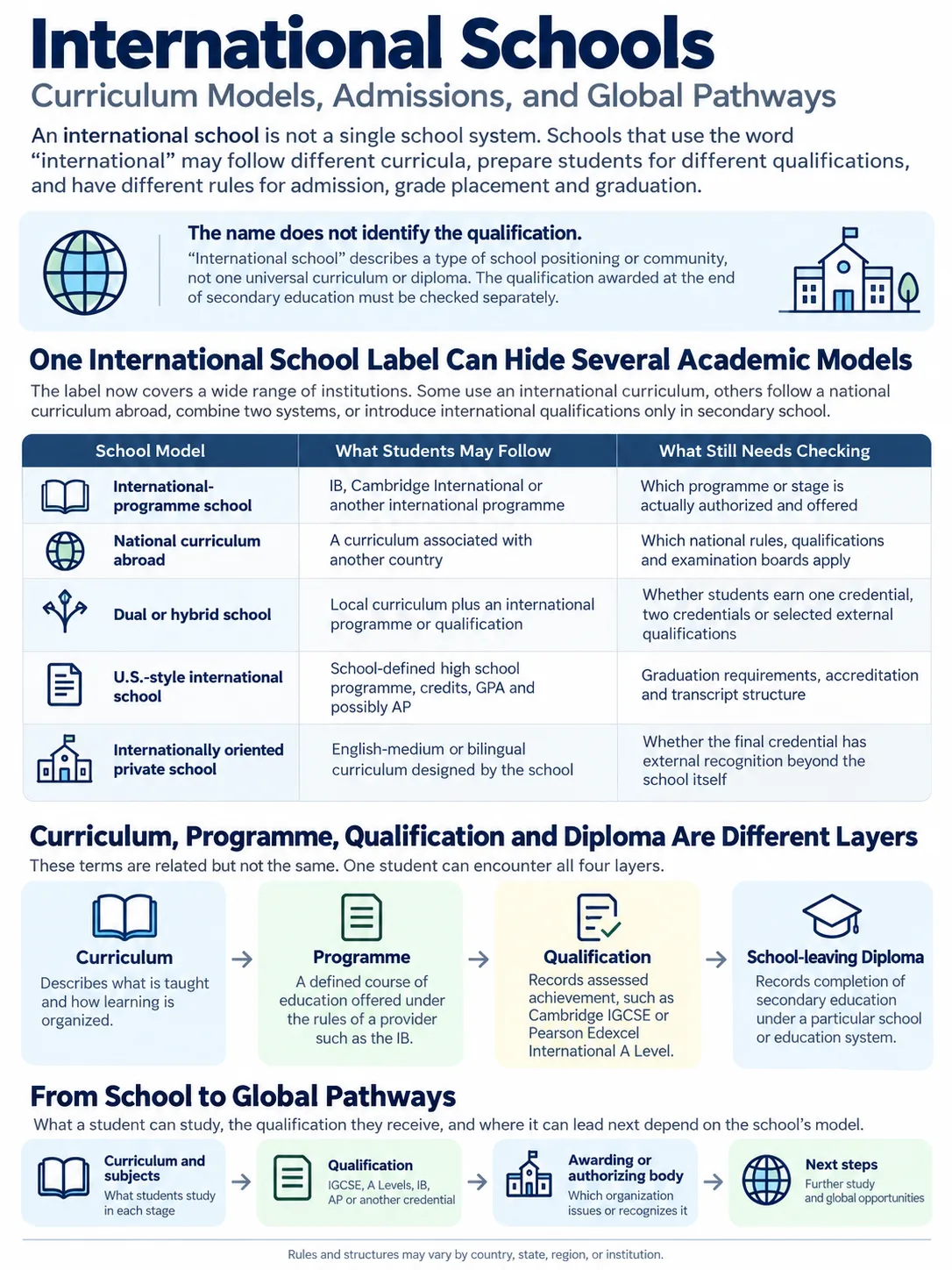
An international school is not a single school system. Two schools in the same city may both use the word “international” while teaching different curricula, preparing students for different qualifications and following different rules for admission, grade placement and graduation. One may offer the International Baccalaureate, another may use Cambridge IGCSE followed by A Levels, another may award a U.S.-style high school diploma with AP courses, and another may combine a national curriculum with an international qualification. The useful question is therefore not simply whether a school is international, but what students study, what credential they receive, who authorizes or awards it, and where that credential can lead next.
The Name Does Not Identify the Qualification
International school describes a type of school positioning or community, not one universal curriculum or diploma. The qualification awarded at the end of secondary education must be checked separately.
One International School Label Can Hide Several Academic Models
International schools developed around cross-border education, internationally mobile families, foreign-language instruction and access to qualifications that can be understood outside one national system. The label now covers a much wider range of institutions. Some use an international curriculum from the early years to graduation. Others follow a national curriculum abroad, combine two systems, or introduce international qualifications only in secondary school.
| School Model | What Students May Follow | What Still Needs Checking |
|---|---|---|
| International-programme school | IB, Cambridge International or another international programme | Which programme or stage is actually authorized and offered |
| National curriculum abroad | A curriculum associated with another country | Which national rules, qualifications and examination boards apply |
| Dual or hybrid school | Local curriculum plus an international programme or qualification | Whether students earn one credential, two credentials or selected external qualifications |
| U.S.-style international school | School-defined high school programme, credits, GPA and possibly AP | Graduation requirements, accreditation and transcript structure |
| Internationally oriented private school | English-medium or bilingual curriculum designed by the school | Whether the final credential has external recognition beyond the school itself |
This distinction matters because the curriculum name used in marketing may describe only part of a student’s route. A school can teach one model in primary school, another in lower secondary school and an externally assessed qualification in the final years. The sequence must be examined stage by stage rather than inferred from the school name.
Curriculum, Programme, Qualification and Diploma Are Different Layers
Several terms used by international schools are easily mixed together. A curriculum describes what is taught and how learning is organized. A programme is a defined course of education offered under the rules of a provider such as the IB. A qualification records assessed achievement, such as Cambridge IGCSE or Pearson Edexcel International A Level. A school-leaving diploma records completion of secondary education under a particular school or education system. One student can encounter all four layers.
| Layer | Main Question | Examples |
|---|---|---|
| School status | Who permits or recognizes the school as an operating institution? | Host-country licence, registration or institutional accreditation |
| Curriculum or programme | What academic structure is taught? | IB PYP, MYP or DP; Cambridge Pathway; school-developed U.S.-style programme |
| Qualification | What assessed credential does the student earn? | Cambridge IGCSE, Pearson Edexcel International GCSE, International A Level |
| Graduation credential | What confirms completion of secondary education? | IB Diploma, national school-leaving certificate, U.S.-style high school diploma or another recognized credential |
The distinction becomes especially important with AP. Advanced Placement consists of individual advanced courses and examinations. It is not a complete K–12 curriculum and does not itself replace a student’s high school diploma.
The Main Curriculum Architectures Used by International Schools
International Baccalaureate: Four Programmes, Not One Continuous Requirement
The International Baccalaureate offers four programmes for students from ages 3 to 19: the Primary Years Programme (PYP), Middle Years Programme (MYP), Diploma Programme (DP) and Career-related Programme (CP). Schools must be authorized to teach an IB programme, and an authorized school is known as an IB World School. Authorization applies to the programme being offered; a school offering the PYP is not automatically authorized to offer the MYP or DP. [a]
This means the phrase “IB school” needs a follow-up question: which IB programme? A primary school may use PYP without offering any IB secondary qualification. A secondary school may offer MYP and then move students into A Levels. Another may enter students directly into the DP after a non-IB lower-secondary programme.
For students completing the full IB Diploma Programme, the academic structure combines six subject groups with the DP core: theory of knowledge, the extended essay and creativity, activity, service. Subject choices include standard level and higher level courses, and those choices can affect later university eligibility where a degree requires particular subjects or levels. [b]
A Current Example of IB Curriculum Change
In 2026, the IB moved ahead with further development of Systems Transformation, a 300-hour transdisciplinary DP course designed to count in place of two standard-level subjects. Its development shows why families should check the current subject structure offered by a particular school rather than relying on an older description of the DP. [c]
Cambridge Pathway: Schools Can Enter at Different Stages
Cambridge International organizes its school offer through Cambridge Early Years, Cambridge Primary, Cambridge Lower Secondary, Cambridge Upper Secondary and Cambridge Advanced. The stages cover education from early childhood through pre-university study, but schools can offer individual stages rather than the whole sequence. [d]
At Cambridge Upper Secondary, typically associated with ages 14 to 16, students can work toward Cambridge IGCSE or Cambridge O Level qualifications. Cambridge Advanced is typically associated with ages 16 to 19 and includes Cambridge International AS & A Level. These ages describe the intended stage rather than a universal placement rule for every student. [e]
Cambridge International A Level is typically studied over two years, while Cambridge International AS Level is typically a one-year course. Schools can select from a broad subject range, and some subjects permit an AS result to form part of a later full A Level route. The student’s pathway therefore depends not only on the Cambridge name but also on which subjects and assessment route the school makes available. [f]
Pearson Edexcel: International GCSE and International A Level Are Separate Qualifications
Pearson Edexcel International GCSE is another qualification widely found in international schools. It should not be treated as another name for Cambridge IGCSE. The providers, specifications and assessment arrangements are separate. Pearson currently offers both linear and modular assessment routes for many International GCSE subjects, with the modular option available to eligible international centres outside the UK. [g]
At the pre-university stage, Pearson Edexcel International Advanced Levels (IAL) use a modular assessment structure for the available subjects, allowing units to be assessed across examination series rather than requiring every assessment to be taken together at the end. [h]
“British Curriculum” Does Not Identify an Examination Board
The term British curriculum is often used loosely by international schools. It may refer to a school inspired by the National Curriculum for England, a school using British year-group terminology, a school preparing students for IGCSEs, or a school offering A Levels. It does not tell the reader whether qualifications come from Cambridge International, Pearson Edexcel or another awarding organization.
British curriculum and Cambridge curriculum are not interchangeable terms. Cambridge International is one education and qualification provider; “British” can describe a broader family of school structures and qualifications.
“American Curriculum” Is Also a Broad Label
There is no single federal U.S. school curriculum that all American schools follow. The U.S. Department of Education states that education is primarily a state and local responsibility; states and communities develop curricula and determine enrollment and graduation requirements rather than the federal department. [i]
An international school describing itself as “American” may therefore use its own combination of graduation credits, required subjects, electives, GPA, honours courses and externally provided advanced courses. The school transcript and graduation policy are often more informative than the phrase “American curriculum.”
Advanced Placement (AP) sits inside this type of route at many schools, but AP authorization applies to individual courses. College Board’s AP Course Audit is the process used for courses that wish to carry the AP designation, and the AP Course Ledger lists authorized AP courses. [j]
AP Is Not the Graduation Diploma
Even the AP International Diploma (APID), an award based on qualifying AP achievement across disciplines, is explicitly not a substitute for a high school diploma. [k]
The Curriculum Can Change as a Student Moves Through the Same School
International schools often combine programmes rather than follow one provider from the first year of school to graduation. A student might complete a school-designed primary programme, move into Cambridge Lower Secondary, take IGCSEs and then switch to the IB Diploma. Another school may use IB PYP in primary education, a national curriculum in middle school and A Levels in the final two years.
| Typical Stage | Possible International-School Routes | What Changes for the Student |
|---|---|---|
| Primary years | IB PYP, Cambridge Primary, national or school-designed curriculum | Teaching approach, language, subject structure and progression expectations |
| Lower secondary | IB MYP, Cambridge Lower Secondary, national or school-designed programme | Subject specialization begins to matter more |
| Around ages 14–16 | Cambridge IGCSE, Pearson International GCSE, MYP, national qualifications or high school credit courses | Qualification subjects and examination preparation become harder to transfer between systems |
| Around ages 16–19 | IB DP, IB CP, Cambridge International AS & A Level, Pearson IAL, national diploma or U.S.-style high school route | Course level and subject combinations can affect university eligibility |
The ages in this table are typical programme ranges, not automatic grade-placement rules. School calendars, birth-date cutoffs, completed grades and national regulations can place two students of the same age in different year groups.
Why the 14–16 and 16–19 Stages Are Harder to Transfer Into
Moving schools during early primary education usually involves fewer qualification constraints because students have not yet entered a multi-year examination sequence. Transfer becomes harder once courses lead toward externally assessed credentials or graduation requirements.
During an IGCSE or International GCSE cycle, a receiving school may teach different subjects, specifications or examination boards. During A Levels or International A Levels, a subject may have been studied through a different syllabus or assessment sequence. In the IB Diploma Programme, a new school may not offer the same higher-level subjects, languages or timetable combination. In a U.S.-style school, the central issue may be whether previous courses can be accepted toward local graduation credits.
| Point of Transfer | Typical Transfer Friction | Main Reason |
|---|---|---|
| Early primary | Lower | Fewer external qualification requirements |
| Upper primary | Lower to moderate | Language and curriculum sequencing can differ |
| Lower secondary | Moderate | Subject depth and preparation for later qualifications begin to diverge |
| Start of IGCSE, MYP or high school credit sequence | Moderate | Subjects and course requirements become more defined |
| Mid-IGCSE, mid-DP or mid-A Level | High | Course content, assessment components and subject combinations may not align |
| Final graduation year | Potentially very high | Graduation eligibility, final assessments and university applications may already be underway |
Admissions Depend on the School, the Student’s Previous Route and Local Rules
There is no worldwide international-school admissions system. Schools may set their own procedures within the education laws and licensing conditions of the country where they operate. Common admission evidence can include previous school reports, transcripts, proof of completed grades, language assessment, academic testing, interviews and information needed to plan learning support.
The curriculum provider may define programme or examination rules without deciding who the school admits. Cambridge International, for example, states that it does not set general entry requirements for its examinations; individual schools may have their own entry requirements, while subject syllabuses can recommend prior study. [l]
Grade Placement Is More Than an Age Conversion
An international transfer cannot always be solved by converting “Grade 8” into “Year 9” or matching students by age alone. The receiving school may need to consider when the student’s previous academic year ended, the school’s own birth-date cutoff, subjects completed, curriculum sequence and whether the student is entering a qualification course already in progress.
| Placement Evidence | Why It Matters |
|---|---|
| Date of birth | Shows the student’s approximate peer cohort but does not determine placement by itself |
| Completed grade or year | Shows formal progression in the previous system |
| Academic calendar | A northern-hemisphere and southern-hemisphere transfer can occur at different points in the school year |
| Previous curriculum | Reveals whether subject content overlaps with the receiving programme |
| Language proficiency | Can determine whether additional language support is needed |
| Qualification stage | Becomes especially important once IGCSE, A Level, IB or graduation-credit courses have begun |
Language Assessment Can Affect Access to the Curriculum
A student may speak English comfortably in everyday situations while still needing support with academic reading, essay writing, laboratory reports, subject vocabulary or timed examinations. International schools may therefore assess language separately from general academic achievement. The important question is not simply whether English-language support exists, but whether the support allows the student to access the subjects and qualification route required for later study.
Language provision can also affect transfer continuity. A student studying a particular first language, second language or literature course may find that the receiving school offers a different language sequence. This can become more difficult in the final secondary years when languages form part of a qualification programme.
A Transfer Between International Schools Can Still Be a Transfer Between Different Systems
Moving from one international school to another does not guarantee academic continuity. A family can relocate between two schools that teach in English and still encounter a major change in subject content, grading, assessment timing or graduation rules.
IB MYP to Cambridge IGCSE
The receiving school may need to determine whether the student has covered the prerequisite content expected for its IGCSE subjects and whether there is enough time to prepare for the relevant examination series. The challenge is not that one route is academically stronger than the other; the course organization and assessment sequence are different.
IGCSE to a U.S.-Style High School
The receiving school may focus on how previous study converts into local course credits and whether the student can still satisfy its graduation requirements. External IGCSE results can provide academic evidence, but the school’s own diploma requirements may operate through credits accumulated across several years.
U.S.-Style High School to the IB Diploma
A student may have a strong transcript but still need the right prior preparation for the DP subjects chosen at higher level. Mathematics, sciences and languages are areas where the receiving school may examine previous coursework before approving a subject combination.
A Level or International A Level to the IB Diploma
A Levels usually allow concentrated study in a smaller group of subjects, whereas the full IB Diploma requires study across several subject groups plus the DP core. A student moving after either route has started may therefore face a structural mismatch even when both programmes are used for university preparation.
Licence, Accreditation, Programme Authorization and Exam-Centre Status Answer Different Questions
An international school’s legal status and its right to offer a particular external programme are separate matters. Terminology differs between jurisdictions, but families may encounter four different forms of approval: permission to operate as a school, institutional accreditation, authorization or registration with a curriculum provider, and permission to administer particular examinations.
Cambridge International illustrates the distinction clearly. Schools offering Cambridge qualifications must successfully register with Cambridge, and Cambridge provides a school search for checking registered institutions. It also maintains approved exam centres. An approved exam centre can administer examinations without being a school that provides teaching. [m]
Authorization Must Match the Claim
A school’s general licence does not prove that every advertised international programme is authorized. An IB claim should identify the authorized IB programme, a Cambridge claim should correspond with Cambridge registration, and an AP claim should be checked at course level rather than treated as school-wide academic accreditation.
Global Recognition Does Not Mean Automatic University Admission
International qualifications can make academic records easier for universities in different countries to interpret, but recognition is only one part of admission. Universities can set their own minimum scores, subject prerequisites, language requirements, selection tests, portfolio requirements or other conditions.
Three Different Questions
Recognition asks whether the institution accepts or understands the qualification. Admission asks whether the applicant satisfies the course and university requirements. Credit or advanced standing asks whether prior qualification results can reduce or alter university study requirements. These outcomes should not be treated as interchangeable.
The IB explicitly notes that universities may publish recognition policies for IB students, but the existence of such a policy does not necessarily guarantee admission. Individual universities determine their own entry conditions. [n]
Cambridge International follows a similar institution-specific approach. Its recognition resources contain policies supplied by universities and other organizations, while Cambridge advises students to check the exact requirements of the institution and course to which they plan to apply because policies can differ and change. [o]
The Diploma Name Matters Less Than the Subjects Required for the Next Step
A qualification can be accepted by a university while a student’s particular subject combination is unsuitable for the degree being pursued. This is one of the most important differences between general qualification recognition and programme-specific eligibility.
An engineering applicant may need advanced mathematics and physics. Medicine or related sciences may require particular combinations of chemistry, biology, physics or mathematics. Economics programmes at some institutions may expect advanced mathematics. Art, design and architecture can add portfolio requirements that sit outside the school-leaving qualification.
IB itself advises students choosing DP subjects to consider the course combinations and higher-level or standard-level choices expected by their intended universities. The relevant subjects depend on the institution, destination and degree. [p]
How the Main Upper-Secondary Routes Reach University
| Route | Academic Record Usually Centers On | University Questions to Check |
|---|---|---|
| IB Diploma Programme | Six DP subjects, HL/SL choices, core requirements and final results | Minimum diploma score, required HL subjects, language conditions and institution-specific rules |
| Cambridge International A Levels | Individual AS/A Level subjects and grades | Required number of A Levels, subject prerequisites and grade conditions |
| Pearson Edexcel International A Levels | Individual IAL subjects, units and final qualification grades | Recognition of the qualification, required subjects and course-specific grades |
| U.S.-style high school diploma | Transcript, credits, GPA, course level and graduation completion | Required coursework, academic record, testing policy and institution-specific selection |
| High school diploma plus AP | School transcript plus individual AP courses and examination results | How AP is considered for admission, placement or university credit |
| National or hybrid route | National diploma plus international courses or qualifications | Which credential establishes university eligibility and how additional qualifications are considered |
A Hybrid International School Can Produce More Than One Credential
Not every international-school student graduates with an international diploma. Some schools must satisfy host-country curriculum requirements while also offering IB, Cambridge, Pearson or AP courses. Students may therefore receive a national school-leaving credential alongside externally assessed international qualifications.
This can create useful options, but the two credentials serve different purposes. A national diploma may establish completion or eligibility within the home or host system, while an international qualification may provide additional evidence for applications elsewhere. The effect depends on the destination university’s rules, so the presence of two credentials should not be interpreted automatically as stronger admission status.
Frequent International Moves Make Subject Continuity as Important as Curriculum Brand
Families expecting several international moves often look for a widely used curriculum because it can make the next school search easier. Provider continuity can help, but it does not remove transfer problems. Two IB schools can offer different DP subjects. Two Cambridge schools can use different IGCSE subjects or examination options. Two U.S.-style schools can require different credits for graduation.
For mobile students, continuity should therefore be checked at a finer level: exact subjects, course level, language sequence, assessment stage, academic calendar and graduation requirements.
| Student Situation | Main Academic Priority | What to Verify |
|---|---|---|
| Family moves countries frequently | Continuity across schools | Availability of the same programme, subjects, languages and examination stage |
| Likely UK university destination | Qualification and subject preparation | Degree-specific subject and grade requirements |
| Likely U.S. university destination | Depth and clarity of the academic record | Transcript, graduation credential, course rigor and treatment of AP, IB or A Levels |
| University destination still unknown | Portable academic record | Recognition in likely destinations and availability of suitable subjects |
| Student may return to a national system | Re-entry and equivalence | Whether the international qualification or completed grades satisfy national rules |
| Student is moving mid-secondary | Course compatibility | Exam board, syllabus coverage, credits and remaining graduation time |
The Same Qualification Can Produce Different School Experiences
Curriculum choice is only one part of an international-school comparison. Two schools offering the same final qualification may differ in the subjects available, languages offered, laboratory access, class organization, learning support and university counselling. A school may technically offer the IB Diploma but not the particular higher-level science combination a student needs. Another may offer Cambridge A Levels but only a limited subject set.
This is why school-level subject availability should be checked before treating a curriculum brand as a complete description of the student’s pathway. The question is not merely “Does the school offer A Levels?” but “Which A Levels can this student actually take, in what combinations, and on what timetable?”
How to Read Common International-School Claims
| School Claim | What It May Tell You | What It Does Not Prove |
|---|---|---|
| “International School” | The school has an international orientation, student body, language or curriculum | Which qualification students receive |
| “IB School” | The school may be authorized for one or more IB programmes | That PYP, MYP, DP and CP are all offered |
| “IB Candidate School” | The school is pursuing authorization for the stated programme | That authorization has already been granted |
| “Cambridge School” | The institution may be registered to offer Cambridge programmes and qualifications | That every Cambridge stage or qualification is available |
| “British Curriculum” | The school may use British-style stages, curriculum content or qualifications | Which awarding organization provides examinations |
| “American Curriculum” | The school may use a U.S.-style credit, transcript and graduation model | That there is one national American curriculum behind it |
| “AP School” | The school may offer authorized AP courses | That AP itself is the school’s graduation diploma |
| “Internationally Accredited” | An outside organization may have reviewed some aspect of the institution | Which curriculum is taught or which qualification is awarded |
Questions That Reveal the Student’s Actual Academic Pathway
A school can be evaluated more accurately when questions focus on the student’s route rather than the international label. The most useful academic questions are specific enough to reveal what happens before and after each school stage.
- Which curriculum or programme is taught at each stage of the school?
- What qualification or diploma does a student receive at the end of secondary education?
- Which organization awards or validates that qualification?
- Is the school currently authorized, registered or approved to offer the programme it advertises?
- Which subjects and course levels are actually available this year?
- Can a student enter the qualification cycle after it has already started?
- How are previous courses or credits evaluated for a transfer student?
- How does the school place students arriving from a different grade or year system?
- What happens if the family moves during IGCSE, International GCSE, DP, A Level or another multi-year route?
- Which subject combinations support the student’s likely university fields?
- How does language support fit around qualification courses and examination preparation?
- Does the student receive a local or national diploma in addition to an international qualification?
EducationModels.org is an independent informational resource and is not affiliated with any ministry of education, school authority, exam board, university, government agency or official ranking organization. International-school admission rules, programme status, qualification requirements and university policies can change. Decisions involving enrollment, transfer or university eligibility should therefore be checked directly with the relevant school, curriculum or qualification provider, education authority and destination university.
Sources and Verification
- [a] International Baccalaureate — Education Programmes — Official IB information on PYP, MYP, DP and CP age ranges and the requirement for schools to be authorized to teach IB programmes.
- [b] International Baccalaureate — DP Curriculum — Official description of the Diploma Programme subject groups and DP core.
- [c] International Baccalaureate — Systems Transformation — Official information on the developing 300-hour DP Systems Transformation course and its place within DP subject selection.
- [d] Cambridge International Education — Cambridge Pathway — Official description of Cambridge Early Years, Primary, Lower Secondary, Upper Secondary and Advanced stages.
- [e] Cambridge International Education — Cambridge Upper Secondary — Official information on the typical age range and Cambridge IGCSE and O Level routes.
- [f] Cambridge International Education — International AS & A Levels — Official information on AS & A Level subject choice, study structure and progression.
- [g] Pearson Edexcel — International GCSEs — Official qualification information, including current linear and modular assessment availability.
- [h] Pearson Edexcel — International Advanced Levels — Official explanation of the International AS/A Level modular assessment structure.
- [i] U.S. Department of Education — Federal Role in Education — Official explanation that curriculum and graduation requirements in the United States are primarily state and local responsibilities.
- [j] College Board — AP Course Audit — Official information on authorization of AP courses and the AP Course Ledger.
- [k] College Board — AP International Diploma — Official confirmation that the AP International Diploma is an academic award and not a substitute for a high school diploma.
- [l] Cambridge International Education — Entry Requirements for Cambridge Qualifications — Official clarification that Cambridge does not impose general examination-entry requirements, although schools may set their own.
- [m] Cambridge International Education — Recognise a Cambridge School — Official information on registered Cambridge schools, verification and the separate role of approved exam centres.
- [n] International Baccalaureate — University Admissions — Official explanation of university recognition policies and the distinction between recognition and guaranteed admission.
- [o] Cambridge International Education — Guidance for Schools and Students — Official guidance on university recognition and checking institution-specific entry requirements.
- [p] International Baccalaureate — Course Selection Guidance — Official guidance on matching DP subject and level choices with higher-education requirements.